
Unbiased headlines. Facts, not spin.
Unbiased Headlines is an independently owned news organization. We bring you the facts, not opinions, written fresh from 110+ named sources. Sources linked so you can verify it yourself.
 economy
Major Story (7/10)
Event date: October 26, 2026 ·
EU Presses Canada and UK for More Ukraine Money as 2027 Funding Gap Hits €70 Billion
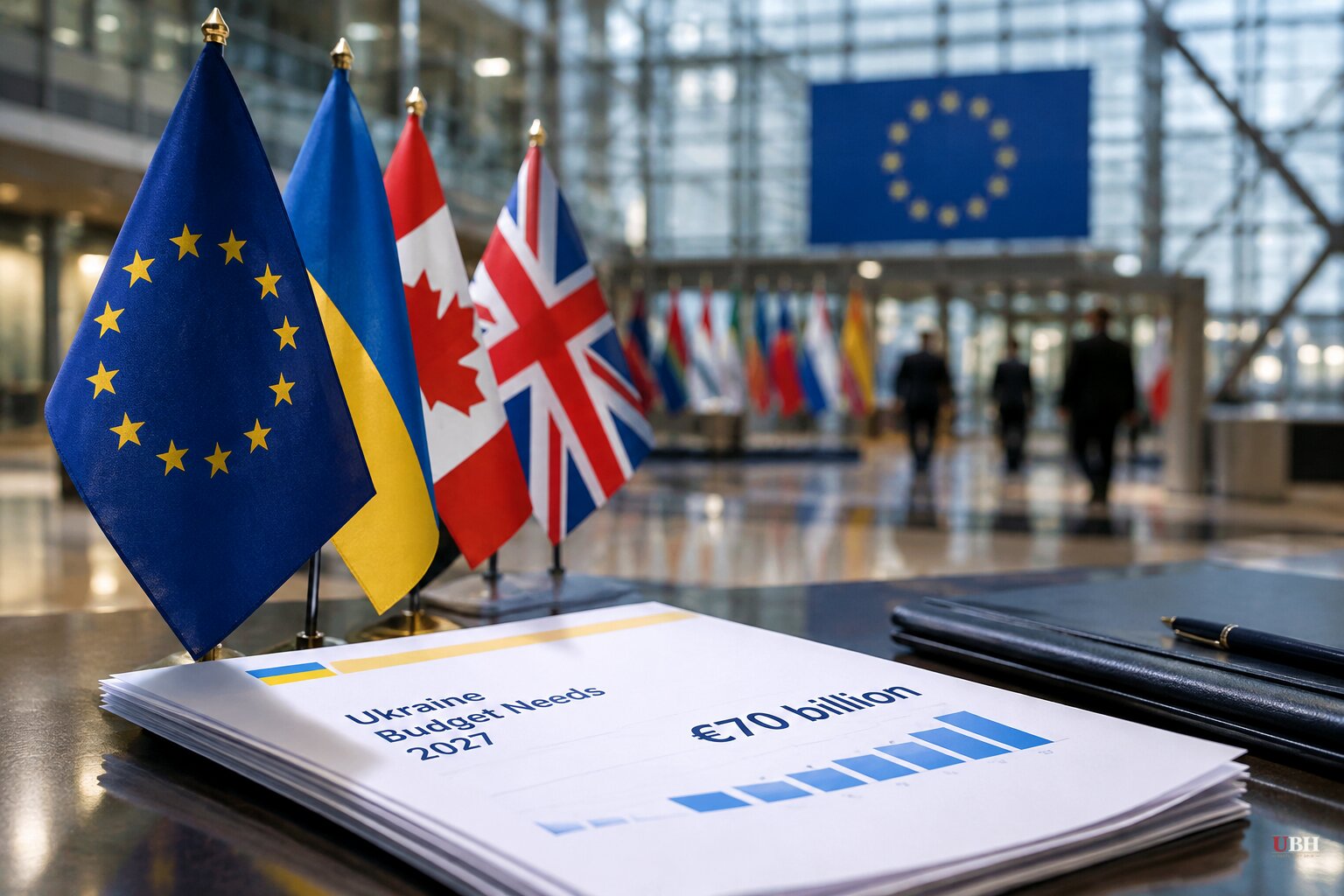
Ukraine is heading into 2027 with a hole in its finances of roughly €70 billion ($77 billion). Brussels says it can't fill it alone.
The European Commission's forecast shows Kyiv's allies outside the EU have so far pledged about €4 billion for next year. That compares with €19 billion in 2026. The G7 members outside Europe's institutions, meaning the U.S., UK, Canada and Japan, are collectively prepared to provide only about €1 billion, according to the Commission's estimates as reported by the Financial Times.
The EU and its member states account for 80% of pledged support for 2027. "Europe cannot meet Ukraine's financing needs alone," a Commission representative said. "International partners must also step up, including NATO allies."
How the gap opened
Earlier this year the EU approved a €90 billion loan for Ukraine covering 2026 and 2027. Of that, €60 billion is for arms procurement and €30 billion for budget support. About €14 billion has been disbursed so far, and the figure is projected to reach €45 billion by the end of this year. The second half arrives in 2027.
It isn't enough. Russian strikes on Ukraine's energy infrastructure have pushed up Kyiv's needs, and Brussels had also counted on €45 billion ($50 billion) from Canada, Japan, South Korea, Australia and Norway. Some of that money has yet to be finalized or disbursed, according to POLITICO.
The U.S. is no longer a meaningful part of the equation. The Trump administration halted new aid packages at the start of 2025, and the Kiel Institute puts total Western financial support since 2022 at over €170 billion ($189.5 billion), with Europe, Canada, Japan, Norway and the UK carrying most of what is still flowing.
Europe's own squeeze
The EU's room to cover the difference is limited. NATO's European members have roughly doubled defense spending since 2021, from about 1.6% of GDP to 2.5%. At the 2025 summit, the alliance committed to raising core defense spending to 3.5% of GDP over the next decade.
The fiscal backdrop is poor. Eurozone debt averages nearly 89% of GDP, and the IMF projects eurozone growth of just 1.1% in 2026. Eurostat says annual inflation rose to 3.8% in September, against the ECB's 2% target. The ECB raised rates in June and September and is expected to hike again at one of its two remaining meetings, which pushes up the cost of servicing debt.
Commission President Ursula von der Leyen said last week that the EU and its members provide 80% of Ukraine's external aid. "We urgently need other partners to step up," she said. European Economy Commissioner Valdis Dombrovskis called for "broad burden sharing" at the IMF and World Bank meetings in Bangkok.
The Commission also estimates that NATO's 32 members are €13 billion short of the €70 billion pledged this year in military support for Kyiv.
Canada, Japan and the UK respond
EU officials say the push is not criticism of Canada or the UK, both longstanding supporters. Ukraine's needs have simply grown, they say.
The partners point to what they have already done. The UK says it has committed £25 billion ($33 billion). Canada's Department of Finance says it has provided C$27 billion since the full-scale invasion, but declined to comment on its budget, due Nov. 5.
Japan's Foreign Ministry disputed some of the Commission's estimates. It said it is not making final statements on future funding and is weighing options in G7 discussions.
Open Canada, a Canadian foreign-policy publication, argues that Ottawa's aid has not kept pace with its rhetoric. It says Germany and the UK are funding air-defense interceptors for this winter, while Canada's package mostly builds capacity for later.
The frozen-assets option
The most obvious pot of money remains untouched. Belgium continues to oppose converting frozen Russian assets into a loan. Euroclear, the Brussels-based securities depository, is at the center of that dispute. Brussels has started emergency planning for other sources, but Euronews has reported that it has no simple solutions.
Support for Ukraine is still broadly popular in the EU. But governments are already facing domestic criticism over rearmament spending, and adding tens of billions in aid for Kyiv on top is a harder sell.
What comes next
The first test comes this week, at the EU-Canada summit on Oct. 29-30. Canada's budget follows on Nov. 5, the EU-UK summit on Nov. 20, and a UK budget is also due. EU leaders are due to discuss the gap at a meeting next month. Whether any of those produces new money, or whether the €70 billion lands back on European taxpayers, is still unresolved.
Sources used for this briefing
7 links from 7 independent newsrooms (syndicated copies of the same report count once)
These are the sources it draws on, linked so you can verify.


