
Unbiased headlines. Facts, not spin.
Every story is an unbiased news briefing written from 110+ sources across the spectrum — sources linked so you can verify it yourself.
 economy
Notable (6/10)
June 10, 2026 at 01:04 PM
economy
Notable (6/10)
June 10, 2026 at 01:04 PM
EU Accepts 15% Tariff Deal with Trump After Months of Failed Negotiations
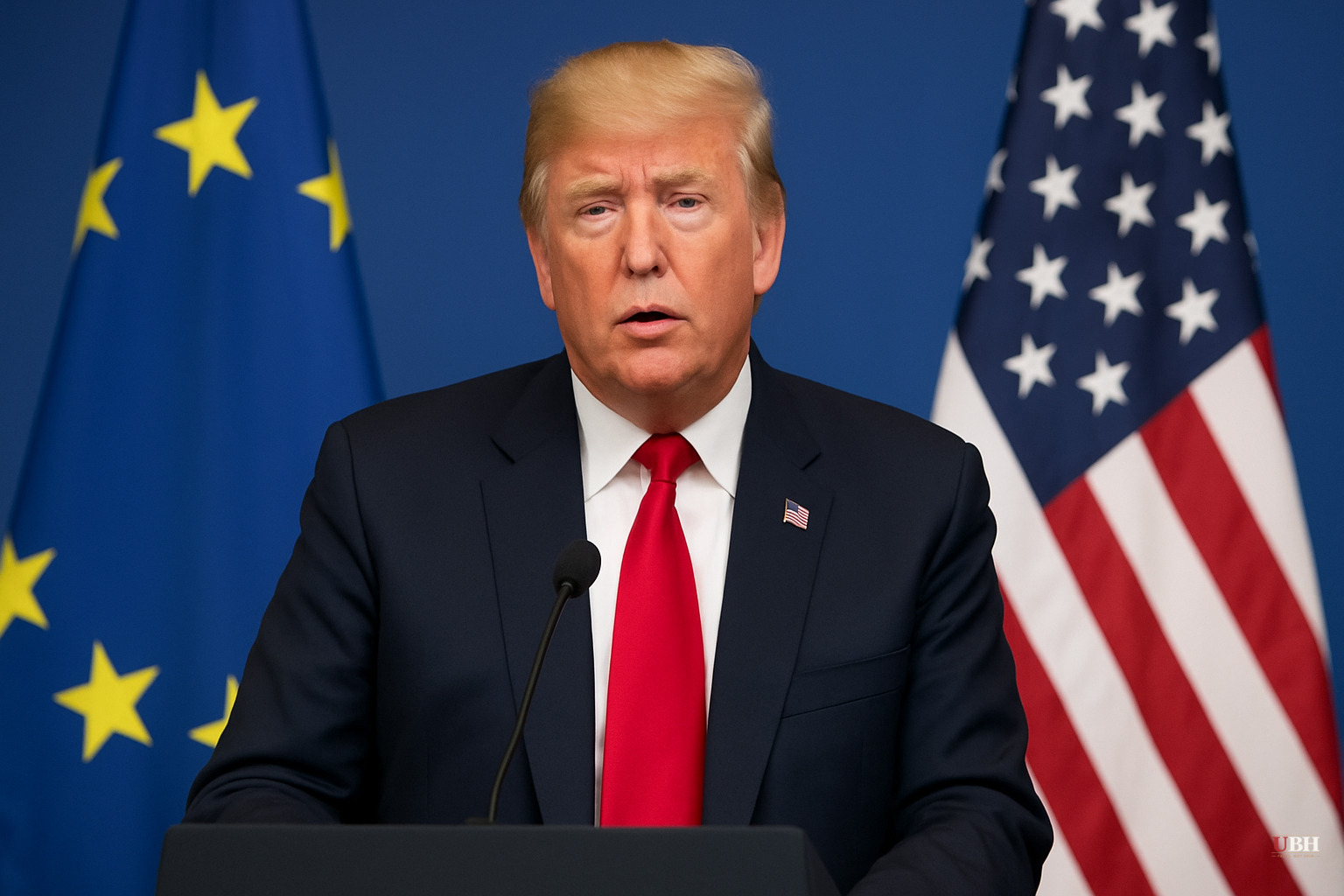
Europe Wanted a Zero-for-Zero Deal. It Got 15% Tariffs.
When President Donald Trump launched his "Liberation Day" tariff campaign in early 2025, the European Union thought it had leverage. It was wrong.
After months of negotiations, European Commission President Ursula von der Leyen accepted a provisional trade settlement at Trump's Turnberry golf resort in Scotland that imposes 15% across-the-board tariffs on most EU goods entering the United States. According to The Guardian's Paul Taylor, Brussels officials believed just two weeks before the deal was signed that they had secured a 10% rate — similar to what the UK received. They ended up with something worse.
The EU originally entered talks demanding zero-for-zero tariffs. The final outcome is nowhere close.
The Deal's Contents
According to The Guardian, the deal commits the EU to purchasing hundreds of billions of dollars in U.S. fossil fuels and weapons for the duration of Trump's presidency. That's in exchange for avoiding the 30% blanket tariffs Trump had threatened to impose starting August 1.
Von der Leyen called it "certainty in uncertain times." But even that framing is contested.
There is an active public dispute between the two sides over whether pharmaceuticals are covered by the 15% rate. Von der Leyen said yes. Trump said no. Pharmaceuticals are one of the EU's largest export categories to the U.S.
How the EU Got Here
Analysts from across the spectrum largely agree on the diagnosis, even if they differ on the cure.
Shahin Vallée, writing for Internationale Politik Quarterly, identifies two fundamental errors from the start. First, the EU treated Trump's second term like his first — hoping for moderation, seeking dialogue, avoiding escalation. Second, it missed a window to build a coordinated coalition with China and Canada early in the tariff fight, when the U.S. was confronting the entire world simultaneously and was at its most diplomatically exposed.
Instead, the EU waited. And the window closed.
China held firm and achieved what Vallée calls "complete U.S. capitulation" because it leveraged its control of critical raw material supply chains. The UK, by contrast, accepted a deal Vallée describes as a "terrible benchmark" that handed Washington the upper hand in every subsequent bilateral negotiation.
The European Council on Foreign Relations notes that Trump's team shifted the tariff trigger date from July 9 to August 1, after closing deals with only three partners — China, the UK, and Vietnam. The EU was still not in the "done" category at that point. The final deal came under the pressure of that August 1 deadline.
The Case for EU Accommodation
Retaliating aggressively against the U.S. risked a full-scale trade war that would have hit European manufacturers — especially German automakers and French agricultural exporters — harder in the short term than any tariff negotiation outcome would. EU internal political consensus is hard to maintain; a confrontational posture could have fractured member state unity faster than it pressured Washington.
The EU also faces a war on its eastern border. Picking a simultaneous economic fight with its primary security guarantor, while Russia is still attacking Ukraine, carries real strategic risk that pure trade analysts tend to underweight.
Vallée acknowledges the short-term economic logic of accommodation. His argument is simply that the long-term cost — being isolated, losing leverage, and setting a precedent that the EU will fold — outweighs the short-term savings.
What Mainstream Coverage Is Getting Wrong
Left-leaning outlets like The Guardian are framing this primarily as a story about Trump's bullying and European humiliation — which is a real part of the story. But that framing obscures something equally important: the EU's own strategic failures.
This was NOT just something that happened to Europe. European leaders made deliberate choices — to avoid retaliation, to negotiate bilaterally rather than in coalition, to hope a U.S. court ruling would weaken Trump's hand. Each of those choices had consequences.
The EU is now, according to officials, hoping the U.S. Supreme Court strikes down Trump's tariff authority under the emergency powers legal challenge currently working through the courts. That's a bet on judicial intervention rather than a trade strategy.
Center-right outlets have largely cheered the deal as avoiding the worst-case scenario. That's also incomplete. Avoiding 30% tariffs by accepting 15% is only a win if 15% is sustainable for European exporters. That math hasn't been run publicly in any honest way yet.
What Comes Next
The deal is described as provisional, and the pharmaceutical dispute alone could unravel key provisions. No final text has been published as of June 10, 2026.
Additional Section 232 national security tariffs — covering sectors like steel, aluminum, and potentially autos — are still in process. Those are NOT covered by the deal von der Leyen signed.
Germany, which has the most to lose from a prolonged trade war given its export-driven economy, is reportedly working on a more assertive European response — though what that looks like in practice remains unclear.
Conclusion
The EU spent months trying to negotiate its way out of a tariff fight, watched China win by refusing to blink, watched the UK set a bad precedent by caving early, and ended up with a deal that is worse than the one it thought it had locked in two weeks prior. European officials are calling it stability. Multiple independent analysts across the political spectrum call it a strategic loss dressed up as a settlement.
Regular people on both sides of the Atlantic pay these tariffs through higher prices on goods. The EU's exporters — cars, wine, pharmaceuticals, machinery — now face permanent elevated costs in their largest foreign market. Whether Europe can course-correct before the next round of pressure arrives remains uncertain.
Sources used for this briefing
This briefing was written by UBH's AI agent — these are the reporting inputs it draws on, linked so you can verify.


