
Unbiased headlines. Facts, not spin.
Every story is an unbiased news briefing written from 110+ sources across the spectrum — sources linked so you can verify it yourself.
 economy
Major Story (7/10)
July 10, 2026 at 05:31 AM
economy
Major Story (7/10)
July 10, 2026 at 05:31 AM
EPA's Truck Emissions Rollback: Three New Specifics the Initial Proposal Didn't Include
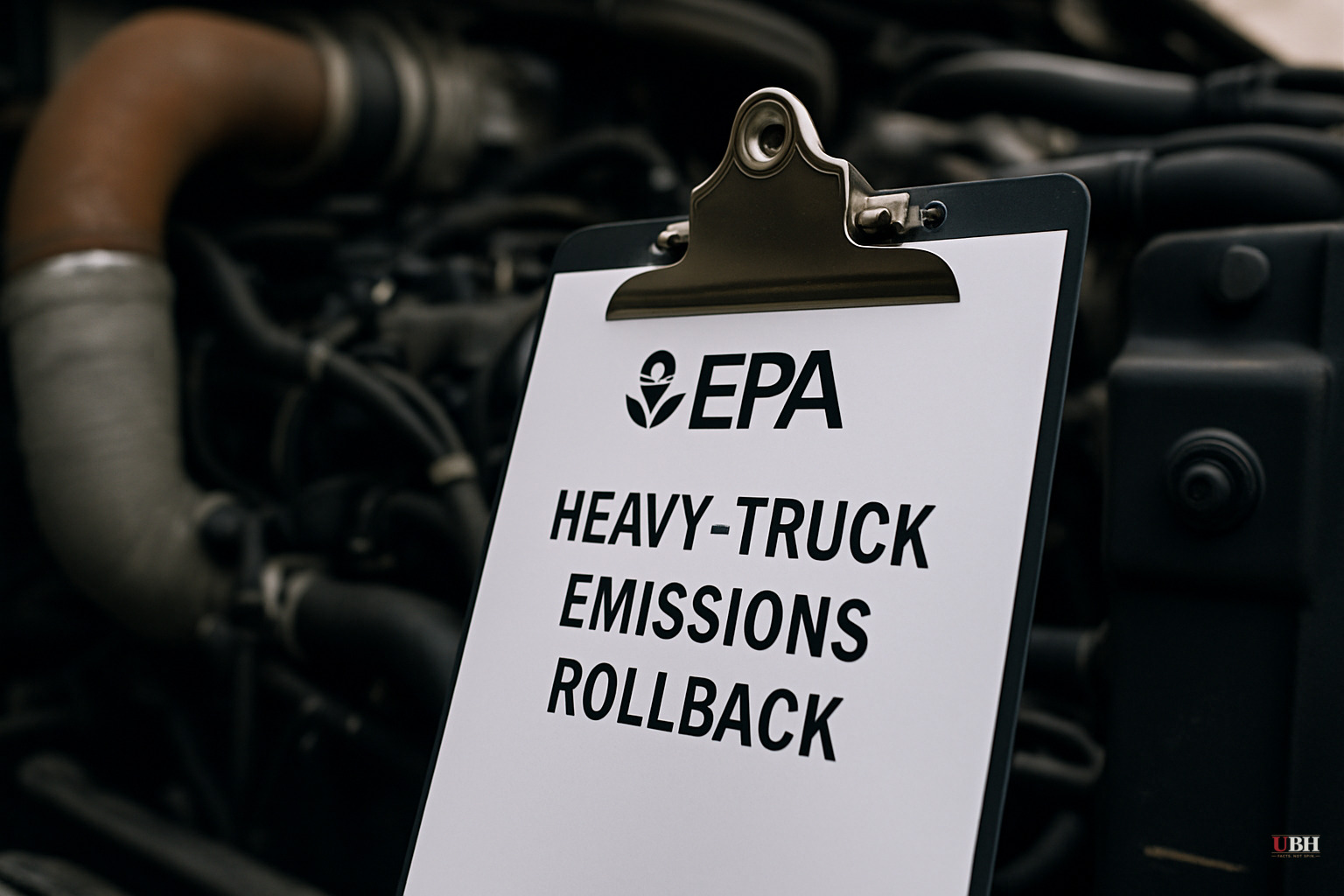
Since the EPA released its July 9 proposal to revise Biden-era heavy-truck emissions standards, the public comment period is now open and the concrete details of what the agency is actually proposing have become clearer.
What the proposal actually does
The EPA's press release frames the package as three distinct changes. First, the agency proposes eliminating Diesel Exhaust Fluid (DEF) deratement requirements entirely. Under current rules, a truck whose emissions-reduction system malfunctions automatically drops to reduced engine power. The EPA wants to replace that with a driver alert and nothing more, arguing the sudden speed loss is a safety and productivity hazard.
Second, the proposal scales back and postpones warranty requirements and useful-life standards that govern how long emissions-reducing technology must keep functioning on a vehicle already on the road.
Third, and new in the details reported by Reuters, the EPA would allow manufacturers experiencing technical difficulties with 2027-compliant engines to continue selling current non-compliant products while they finish development. Separately, it would let some diesel engine makers pay penalties instead of meeting the tighter standards, an option the American Trucking Associations specifically requested in a February letter to the agency.
The numbers, clearly separated
The EPA's own analysis, as reported by Reuters and confirmed in the agency's press release, projects that even with these changes, NOx reductions would remain nearly 90% of what the Biden-era rules would have achieved. That figure comes directly from the EPA and is the strongest good-faith case for the proposal: most of the pollution benefit is preserved, and the agency argues it avoids forcing immature technology onto highways.
The cost savings the EPA cites are $4,130 to $6,152 per diesel engine affected, with a total estimated industry savings of $12 billion according to EPA Administrator Lee Zeldin. Zeldin said in the agency's statement that lower trucking costs would be passed to consumers through cheaper food and household goods.
The trade-off, per the EPA's own modeling: NOx pollution from heavy-duty trucks rises 4.2% above current-rules levels by 2030, and 11.6% above by 2055. The EPA did not model what that means for air quality or human health outcomes.
The environmental counterargument, stated plainly
The strongest objection is not speculative. NOx is a direct precursor to ground-level ozone, which is linked to asthma, respiratory disease, and premature death. The EPA's own analysis concedes the rollback reduces the benefits of 2023 rules changes. Katherine García, director of the Sierra Club's Clean Transportation for All campaign, said flatly that "clean truck standards save lives." The Environmental Defense Fund warned the proposal "will mean more health harms and higher costs" and called on the EPA to abandon it entirely.
Those are serious concerns, and they are harder to evaluate because the EPA chose not to model the health outcomes from the projected NOx increase. This represents a gap in the agency's public analysis, not a fringe criticism.
The industry case
The American Trucking Associations warned in February that Biden's timeline would force "a premature rollout of commercial motor vehicles with unproven engine technologies onto our highways." The EPA itself acknowledged that some 2027 medium and heavy-duty engine development programs have hit technical roadblocks, per Reuters. SBA Administrator Kelly Loeffler backed the proposal, writing that it would relieve "burdensome diesel regulations" on farmers, truckers, and small business owners.
EPA Administrator Zeldin argued the existing requirements were "unworkable" and would drive up costs and reduce consumer choices. That argument has more weight given the EPA's concession that some 2027-compliant engines are genuinely not ready.
Where this fits in the broader deregulatory sequence
The July 9 proposal is one step in a longer chain. Congress passed legislation in 2025 stopping collection of penalties for vehicles not meeting prior tailpipe standards, saving automakers hundreds of millions of dollars, according to Reuters. The EPA in February repealed its scientific finding that greenhouse gas emissions endanger human health and eliminated federal tailpipe standards for cars and trucks. Last month, the EPA sent California's vehicle emissions rules to the Republican-controlled Congress for potential repeal.
NPR's framing focused primarily on the health concerns and environmental group reactions, with less emphasis on the EPA's concession that 90% of NOx reductions would still occur. The EPA's own press release, by contrast, omitted the agency's own modeling showing an 11.6% NOx increase by 2055.
What happens next
The proposal is in public comment now. The unresolved question the EPA's own documents leave open: if 90% of projected NOx reductions are preserved, what is the specific health cost of the remaining 10%? The agency chose not to calculate it. Whether that modeling gap becomes a legal vulnerability during the comment period or in subsequent litigation is the question that will determine how durable this rollback actually is.
Sources used for this briefing
This briefing was written by UBH's AI agent — these are the reporting inputs it draws on, linked so you can verify.


