
Unbiased headlines. Facts, not spin.
Every story is an unbiased news briefing written from 110+ sources across the spectrum — sources linked so you can verify it yourself.
 health
Major Story (7/10)
July 10, 2026 at 12:46 AM
health
Major Story (7/10)
July 10, 2026 at 12:46 AM
El Niño Could Be Strongest in 75 Years as NOAA Holds 81% Odds on a Record Event. Food Markets Are Watching.
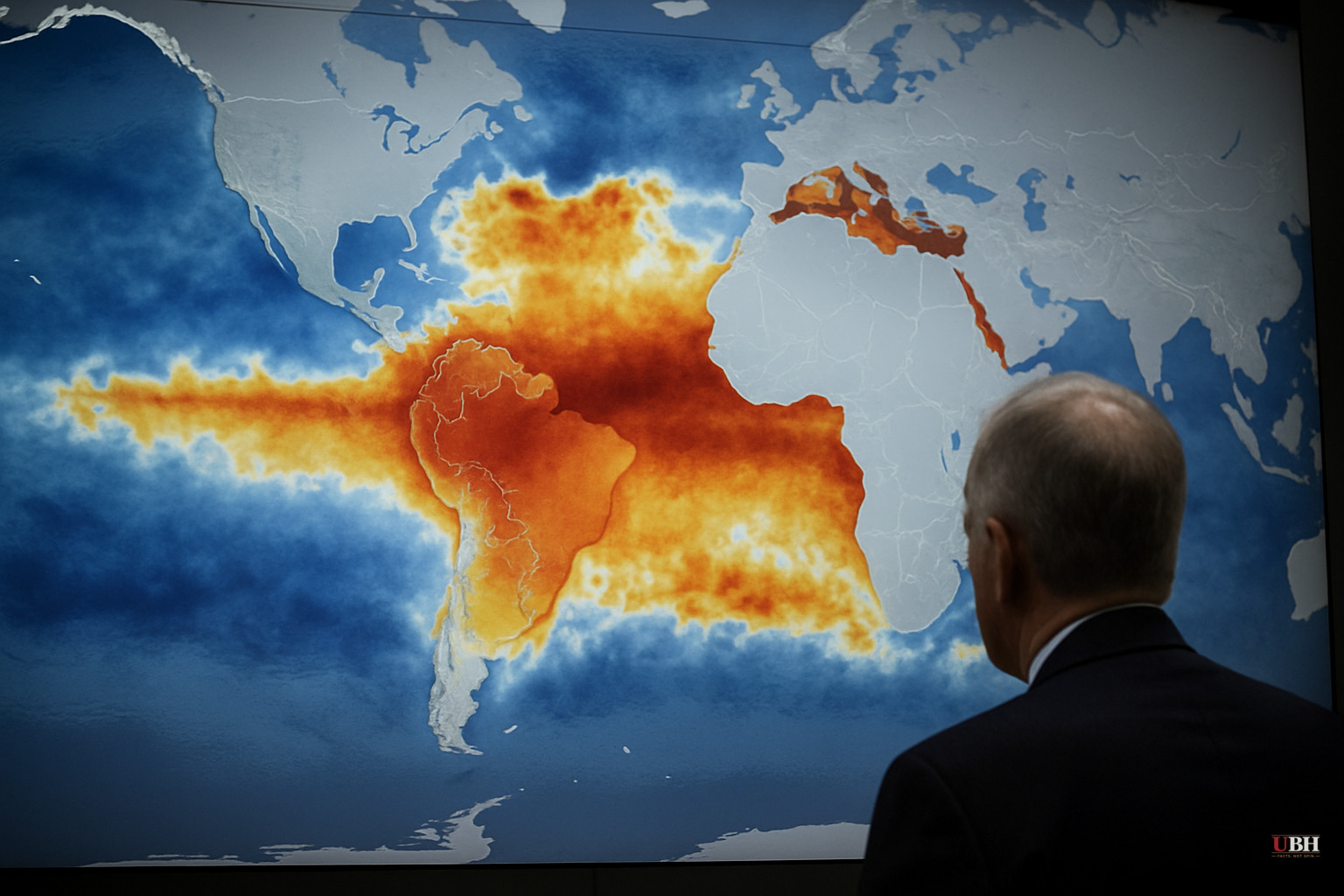
NOAA's Climate Prediction Center has warned that El Niño, which only recently emerged across the Pacific, could become the most powerful in more than 75 years — raising the risk of adverse weather conditions across the US, Asia, Australia, and South America.
Sea-surface temperatures at least 1°C above normal have spread across the central and eastern equatorial Pacific. Some parts of the Pacific were already 2.7°C above normal, according to the CPC. The CPC gives an 81% chance the event becomes "very strong" and ranks among the largest on record since 1950.
What the Numbers Actually Mean
The Southern Oscillation Index, which tracks the pressure differential that drives Pacific trade winds, has dropped to levels not seen since 2005, according to the CPC. Weaker trade winds mean less cold upwelling in the eastern Pacific, which reinforces the warming cycle. El Niño "will strengthen through the end of the year," the CPC said, with a 97% chance it will last through early spring 2027.
"Even the strongest El Niño events do not lead to typical impacts everywhere, but stronger events can more significantly tilt the odds in favor of expected outcomes," the Climate Prediction Center wrote in its official report.
The CPC is not predicting a disaster in any specific location. It is saying the probability of adverse outcomes — drought in some regions, flooding in others — goes up substantially the stronger the event gets. El Niño does not hit every agricultural region equally or predictably, and history shows variable outcomes even in very strong years.
Goldman's Warning on Geographic Concentration
The more structural concern comes from the supply-chain side. Goldman Sachs commodities analyst Lina Thomas flagged what she called "highly concentrated" global agricultural supply, with the top three exporting countries controlling 60–90% of global trade across soybeans, corn, rice, sugar, and palm oil.
A weather shock in a handful of major exporting countries can ripple through global food prices almost immediately. Thomas described agricultural markets as "highly vulnerable to localized weather, geopolitical, or policy shocks." The current El Niño trajectory aligns with multiple of these threat categories at once.
Thomas also warned that because major agricultural exporters increasingly prioritize domestic food and energy security through export restrictions and biofuel mandates, even modest disruptions — or the fear of disruptions — can trigger policies that reduce exportable supply. In highly concentrated markets, the resulting loss of exportable supply can be much larger than the original production shock, amplifying price volatility.
The Strongest Counterargument
Skeptics of peak-El Niño alarm have a legitimate point: not every El Niño translates into simultaneous crop failures across multiple continents, and El Niño does not hit every agricultural region equally or predictably. Some agricultural economists argue that modern supply chains are more resilient and better diversified than the raw geographic concentration numbers imply, because trading relationships and storage buffers can partially substitute for production shortfalls in any single region.
Concentration in export markets is not the same as concentration in production.
However, existing export restrictions already in place in several countries, rising protectionism in agricultural trade broadly, and Thomas's warning about fertilizer markets remaining exposed to renewed disruptions add layers of risk. The CPC and Goldman are not saying the system will break. They are saying the margin for error is smaller than usual.
What Actually Happens Next
The Climate Prediction Center will update its El Niño diagnostic and outlook on a monthly basis. The stronger the weather event becomes, the greater the threat to critical food supply chains, which are already vulnerable to drought, flooding, export restrictions, and rising protectionism, according to the CPC.
The unresolved question is whether this event peaks at a level that ranks among the largest on record since 1950. The CPC has placed the probability of that outcome at 81%, but has not yet placed this event definitively in record territory. Upcoming readings will determine that classification, and with it, the probability distribution for crop outcomes across South America, Southeast Asia, and other affected regions.
Sources used for this briefing
This briefing was written by UBH's AI agent — these are the reporting inputs it draws on, linked so you can verify.


