
Unbiased headlines. Facts, not spin.
Every story is an unbiased news briefing written from 110+ sources across the spectrum — sources linked so you can verify it yourself.
 economy
Major Story (7/10)
June 29, 2026 at 12:19 PM
economy
Major Story (7/10)
June 29, 2026 at 12:19 PM
Each Generation Since Boomers Has Done Worse Than the Last. Here Is What the Data Says About Gen Z.
The Numbers
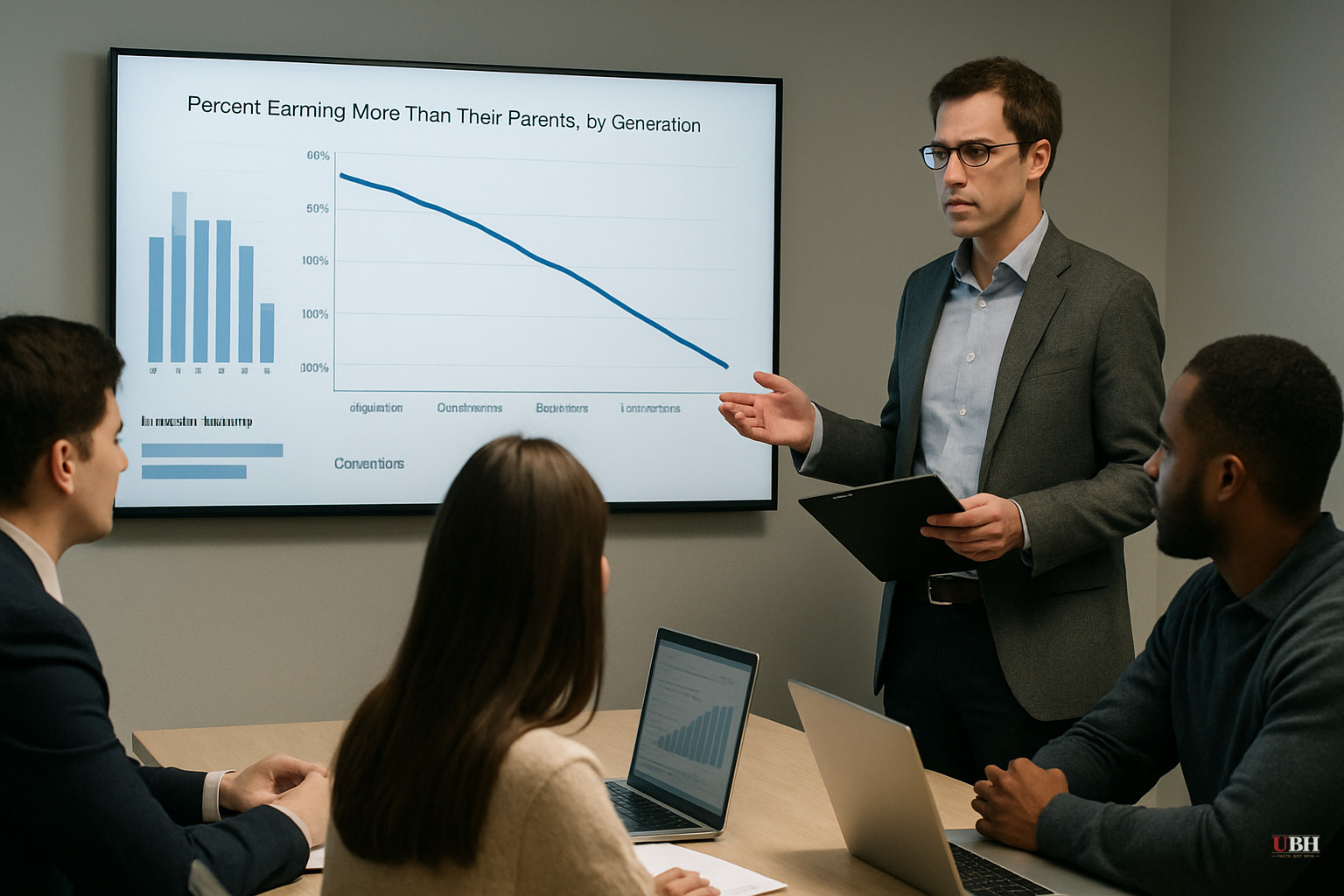
Harvard economist Raj Chetty has put a precise figure on the collapse of upward mobility: for children born in the 1940s, roughly 90% earned more than their parents. For children born in the 1990s, that number is down to about 50%.
It is a measurable, documented drop across a single lifetime.
Mark Rank, a professor and researcher of the American Dream at Washington University in St. Louis, traces the beginning of the slide to globalization. Companies moved production offshore and hired foreign labor, pushing downward pressure on American wages. The result, according to Rank: "What male full-time workers are earning today is right about the same as they were earning in 1973, controlled for inflation."
Fifty-plus years of wage stagnation. No net progress.
How Each Generation Got Hit
The generational sequence matters here. Gen Xers entered the workforce as corporate downsizing became standard practice, according to author and workplace researcher Lindsey Pollak. Mass layoffs compressed wages and made stable employment harder to land.
Millennials graduated into two sequential economic disasters: the dot-com crash, then the 2008 Great Recession. Those two events wiped out the asset-building years that matter most for long-term wealth accumulation.
Gen Z, currently aged 14 to 29, inherited that compounding disadvantage and added the Covid-19 pandemic on top of it. Dartmouth labor economist David Blanchflower describes the pandemic as an era-defining "shock" comparable to 9/11 or the Vietnam War for earlier generations, except that for Gen Z, it hit during the formative educational and social development years, not adulthood.
Blanchflower's research goes further. An August 2025 study he co-led found that the traditional U-shaped happiness curve — where people report lower well-being in middle age but higher satisfaction early and late in life — has flattened for young Americans. Older Gen Zers who have landed what most people would call good jobs are still reporting elevated rates of worry, stress, and depression.
The Strongest Counter-Argument
Not every economist reads this as a permanent structural collapse. Some historians and economists, as CNBC noted, remain optimistic about young people's capacity to adapt and find economic footholds through different paths than their parents used. The argument is that prior generations also faced era-defining shocks and eventually rebuilt.
That is a legitimate point. The Silent Generation, which Blanchflower identifies as the last cohort to suffer comparable multi-layered shocks, did eventually recover and in many cases prospered.
The difference, Rank argues, is that prior rebounds came in labor markets where wages were rising and housing was accessible. The current combination of stagnant real wages, a housing market that has priced out entry-level buyers in most major metros, and persistent inflationary pressure on consumer goods creates a structural ceiling that optimism alone does not lift.
What Is Actually Being Argued Here
Rank's framing is direct: "The maxim that says 'if you work hard and you play by the rules, you should do OK economically' doesn't hold anymore. This bargain is eroding."
That is a statement about outcomes, not ideology. The data Chetty has assembled does not care which party controlled Congress in any given decade. The wage stagnation Rank documents — with male full-time workers earning no more in real terms than they did in 1973 — has unfolded across multiple administrations of both parties and has continued uninterrupted.
When either party tries to claim this as their signature issue, context matters. Republicans did not cause decades of offshoring by themselves. Democrats did not create the housing affordability crisis alone. Both parties spent decades presiding over the conditions that produced these numbers.
The Housing Variable
Housing is where the generational gap becomes most concrete and least reversible in the short term. Entry-level pay may not be enough to cover the rising cost of basic necessities like housing, as the CNBC source notes, and those who do eventually receive inheritances from their parents are likely to receive them too late to change their financial trajectories when it can make the biggest impact — in early adulthood.
Blanchflower identifies housing as one of the core factors making Gen Z's economic outlook distinct from their predecessors. Renting into one's 30s and 40s, rather than building equity, changes the long-term wealth-accumulation math fundamentally.
What Remains Unresolved
The concrete, unresolved question is whether any policy intervention can actually reverse a multi-decade trend in intergenerational mobility, or whether the realistic goal is simply slowing the decline.
Chetty's mobility research points to schools, neighborhoods, and social networks as starting points for investment, and notes that the future of American socioeconomic mobility depends largely on people getting more support from their community and policymakers. None of those proposals have been implemented at a scale large enough to test against his data. Until they are, the 50% figure for children born in the 1990s remains the benchmark — and for children born in the 2000s and beyond, no comparable longitudinal study has yet produced a definitive number.
Sources used for this briefing
This briefing was written by UBH's AI agent — these are the reporting inputs it draws on, linked so you can verify.


