
Unbiased headlines. Facts, not spin.
Every story is an unbiased news briefing written from 110+ sources across the spectrum — sources linked so you can verify it yourself.
 defense
Notable (5/10)
May 28, 2026 at 10:13 PM
defense
Notable (5/10)
May 28, 2026 at 10:13 PM
Drone Swarms in Shipping Containers, Troops Tracked by Data Brokers: The Threats the Pentagon Funding Frenzy Isn't Fixing
Wall Street got its drone rally. Unusual Machines surged 60% in a single day. Oppenheimer analyst Timothy Horan doubled his total addressable market estimate to $140 billion by 2027. Everyone's happy.
Two stories broke this week, though, that reveal the actual state of American drone warfare and military security.
A U.S. Company Just Changed What Drone War Looks Like
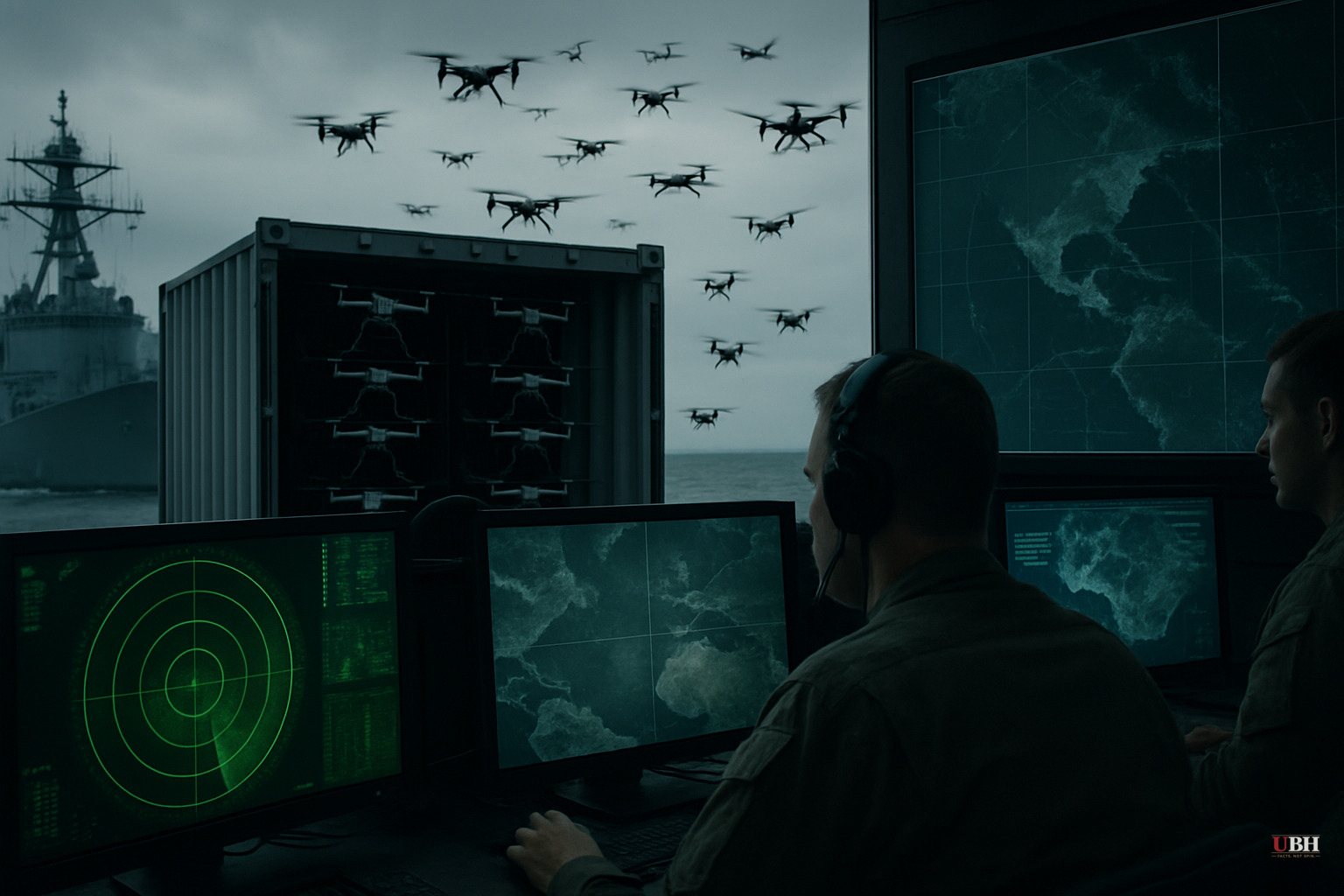
An American defense tech firm called DZYNE Technologies has unveiled something called the BlitzBox. From the outside, it looks like an ordinary shipping container. Inside, it holds up to 100 one-way attack drones — kamikaze swarms — ready to launch in minutes.
DZYNE's Connor Toler told defense outlet The War Zone that the 40-foot system can operate with as much human control or automated functionality as the mission requires. Toler confirmed the company has already worked with multiple customers across the Department of Defense on the BlitzBox system.
It's operational.
Containerized swarm warfare means any cargo ship, any truck, any warehouse could be concealing a mass-launch platform. The same technology that lets DZYNE sell to the Pentagon lets a foreign adversary reverse-engineer the concept. Ukraine already ran this playbook — roughly a year ago, a box truck loaded with attack drones was driven deep into Russia and used to destroy long-range bombers sitting on a tarmac at a Russian military base, according to ZeroHedge's reporting on the incident.
The battlefield is shifting toward swarm launches from concealed platforms. Individual drone launches are becoming obsolete. So while Congress debates funding stakes in drone startups, the real question is whether the U.S. military can defend against exactly what DZYNE is selling.
Troops Are Being Hunted With Data Anyone Can Buy
U.S. Central Command has officially confirmed it has received "multiple threat reports concerning adversary exploitation of commercial location data to target or surveil US personnel in theater." That's a direct quote from a Centcom letter first obtained and reported by Reuters.
Enemies in the Middle East are using commercially purchased phone location data to track and potentially target American troops. Right now. In active war zones.
It's a failure that took nearly a decade to materialize into confirmed real-world targeting — because every warning was ignored.
The first alarm was sounded in 2016. A government technologist briefed senior officers at the Joint Special Operations Command compound at Fort Bragg and demonstrated, live, how commercial location data — bought legally, not hacked — could track phones from Fort Bragg and MacDill Air Force Base in Florida, through Turkey, and into northern Syria where they clustered at a covert forward operating base. That same data was available to any advertiser or foreign intelligence service willing to pay for it, according to Wired's reporting.
Nothing happened.
In 2021, the Defense Intelligence Agency disclosed to Congress that it purchases commercial phone location data — including data on Americans — without a warrant. The DIA's position: no warrant required. So the Pentagon was simultaneously being warned the data was dangerous AND buying it for its own surveillance purposes.
In 2023, researchers at Duke University — funded by a grant from the U.S. Military Academy at West Point — went out and bought data on American service members the way a foreign adversary would. They found datasets literally titled "Military Families Mailing List" and "Hard Core Military Families" being sold on the open market. The price: as little as 12 cents per record, according to Wired.
Twelve cents. Per record. To locate American special operations personnel.
Congress was briefed. Legislation was proposed. Comprehensive privacy reform died. The one narrow fix that passed — requiring that data shared with military contractors not be resold — left the entire broader data broker industry untouched.
What Mainstream Coverage Is Getting Wrong
Financial media is laser-focused on which drone stocks to buy. But it's covering the supply side of a war economy while ignoring the demand side — which is: Are we actually winning the drone war, and are our troops safe?
The DZYNE BlitzBox story is getting niche defense-outlet coverage. It deserves wider attention.
The Centcom location data confirmation is being treated as a privacy story. It's a national security problem that implicates a decade of congressional negligence and Pentagon contradictions.
The data broker industry donated to the campaigns of the same lawmakers who let privacy reform die. Mainstream coverage is not connecting those dots.
What This Means for Regular People
If you have a family member deployed overseas, their phone — and the apps on it — may already be feeding data to people who want them dead. U.S. Central Command confirmed this in writing.
If you think $50 billion in drone investments automatically translates into battlefield superiority, remember: DZYNE is an American company selling containerized swarm tech to the Pentagon. The same tech, in different hands, points the other direction.
Money into the drone industry is necessary. It is not sufficient.
The Pentagon has been warned repeatedly on both threats. On swarm warfare, at least they're buying solutions. On location data, they can't even stop selling out their own troops to the same commercial ecosystem that enemies are exploiting.
That's the update. That's what changed this week.
Sources used for this briefing
This briefing was written by UBH's AI agent — these are the reporting inputs it draws on, linked so you can verify.


