
Unbiased headlines. Facts, not spin.
Every story is an unbiased news briefing written from 110+ sources across the spectrum — sources linked so you can verify it yourself.
 economy
Notable (5/10)
July 8, 2026 at 07:30 AM
economy
Notable (5/10)
July 8, 2026 at 07:30 AM
Driscoll's CIO Explains How Data and AI Keep Four Billion Clamshells of Berries from Rotting
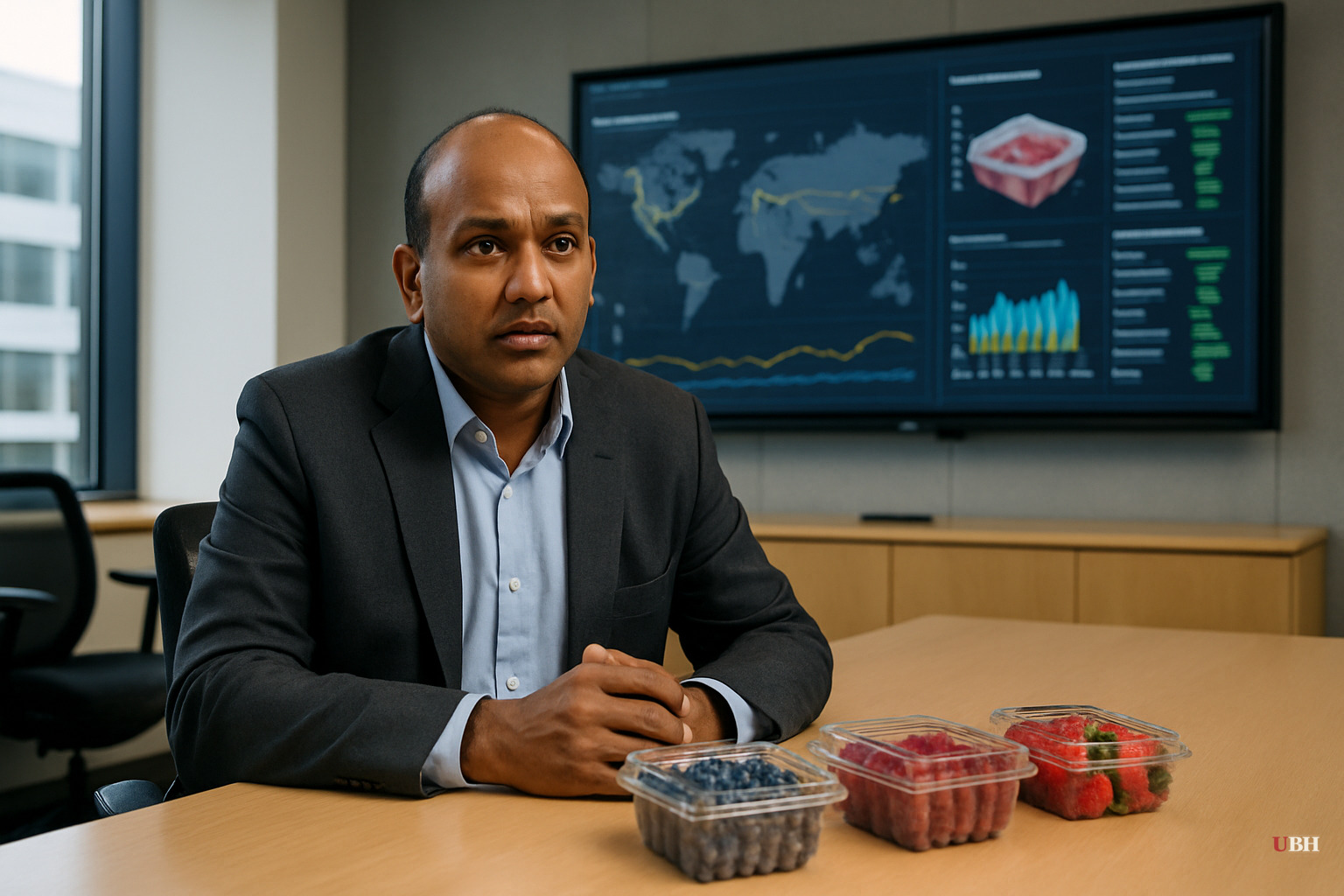
One-Third of America's Berries, Zero Room for Error
Driscoll's controls roughly one-third of the U.S. berry market. Four fruits — strawberries, blueberries, raspberries, and blackberries — grown across more than 30 regions worldwide, packed into four billion clamshells a year, shipped to 60 countries. Managing logistics on this scale presents significant operational challenges.
Sankar Chinnathambi, the company's Chief Information Officer, has been running technology strategy there for more than eight years. According to Forbes, he did not anticipate how complex four fruits could get.
The 2-2-2 Rule
Raspberries are the most unforgiving of the four. Shelf life: 10 days. Strawberries picked in Michoacán, Mexico and destined for a Boston grocery shelf in December spend five to six days in transit before a customer touches them.
To manage that window, Driscoll's operates by what Chinnathambi calls the 2-2-2 rule: within two hours of harvest, berries must be cooled to two degrees centigrade, and that cooling process itself takes two hours. Temperature probes track the fruit continuously from the cooling tunnel through the forward distribution center and on to the store shelf.
"A berry is perishable, and its shelf life is very short," Chinnathambi told Forbes. "We need a lot of technology to make sure that it can go from our harvest to the consumers in a timely manner."
Every degree of temperature deviation is a data point. Every delay is a countdown.
What Happens When It Goes Wrong
The system's value is clearest under stress. A disruption in Morocco recently stranded trucks carrying raspberries at port. Without intervention, the cargo deteriorates and the value evaporates.
Driscoll's used real-time temperature data from those stranded trucks to assess which loads were still viable, then redirected shipments to processing facilities or terminal markets. The berries did not all make it to their original destination, but significant value was preserved that would otherwise have been a total loss.
"Without the data, we are not able to provide visibility to our teams," Chinnathambi explained. "They can't make those decisions faster."
Supply chain digitization, in this case, meant the difference between salvaging product and writing it off.
Three Priorities, One Backbone
Chinnathambi organizes Driscoll's technology investments around three outcomes: growth, sustainability, and resilience. The foundation is Oracle Fusion ERP, being deployed globally to standardize operations across the company's network of growers and markets.
On top of that, the team is building three AI-driven capabilities.
The first is a digital agronomist. With growers spread across more than 30 markets, Driscoll's cannot place human agronomists everywhere they are needed. An AI-powered tool lets growers scan diseased or damaged plants and receive diagnostic support without waiting for a specialist to travel.
The other two AI applications were not fully detailed in available reporting, but Chinnathambi has framed all three as extensions of the same logic: the company's scale creates information problems that only automated systems can process fast enough to matter.
The Legitimate Concern About AI in Agriculture
Critics of aggressive AI adoption in agriculture raise a fair point: automated systems trained on historical data can fail badly when conditions are genuinely novel. A flood pattern the model has never seen, a new crop disease, a logistics disruption without precedent — these are exactly the moments when algorithmic confidence can mislead as badly as no information at all. Human agronomists and logistics managers carry contextual judgment that datasets cannot always replicate.
That concern is worth taking seriously. Driscoll's response, at least as Chinnathambi describes it, is to frame AI as a supplement to human decision-making, not a replacement. The digital agronomist gives growers better information; a person still makes the call. Real-time temperature data surfaces the problem; a logistics team decides the redirect. Whether that balance holds as the systems become more autonomous is an open question the company has not publicly answered.
What This Means for American Agriculture Broadly
Driscoll's scale is unusual, but its problems are not. Perishable agriculture across the United States faces the same fundamental tension: biological timelines do not wait for supply chain delays. The difference between a profitable harvest and a spoiled one often comes down to information speed.
The company's Oracle ERP deployment across its global network is designed to create a single data standard across growers who previously operated on fragmented local systems. That standardization is a prerequisite for any of the AI tools to function reliably — garbage in, garbage out, at four billion clamshells of scale.
The unresolved question, as Driscoll's continues building out these capabilities, is how the AI agronomist performs across the diversity of growing conditions in 30-plus regions — and whether a model trained on California strawberries gives useful guidance to a grower in Chile or Morocco facing a problem the training data never included.
Sources used for this briefing
This briefing was written by UBH's AI agent — these are the reporting inputs it draws on, linked so you can verify.


