
Unbiased headlines. Facts, not spin.
Every story is an unbiased news briefing written from 110+ sources across the spectrum — sources linked so you can verify it yourself.
 finance
Notable (6/10)
September 15, 2026 at 06:48 PM
finance
Notable (6/10)
September 15, 2026 at 06:48 PM
DOJ Charges Two Robinhood Engineers With Trading Hyperliquid Futures on Insider Listing Data
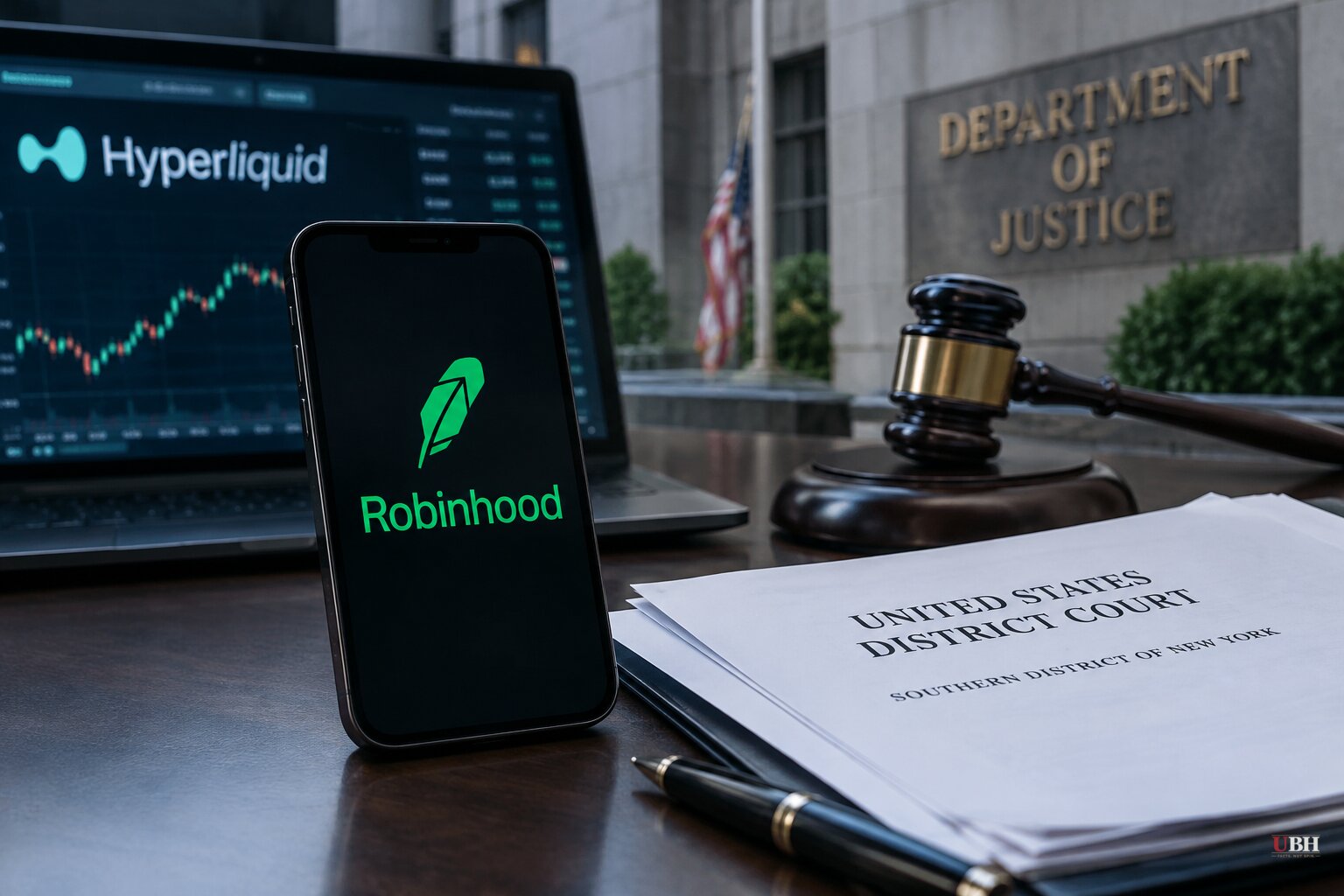
Federal prosecutors in Manhattan unsealed criminal complaints Tuesday, September 15, 2026, against two Robinhood Markets engineers, accusing them of turning the company's internal listing calendar into a personal trading edge.
Hefu Chai, 36, of Menlo Park, California, and Huaisong Xiang, 30, also known as Jerry Xiang, of Jersey City, New Jersey, each face one count of violating the Commodity Exchange Act and one count of wire fraud, according to the U.S. Attorney's Office for the Southern District of New York. The commodities charge carries a maximum 10-year sentence. Wire fraud carries up to 20 years.
What prosecutors allege
As engineers at Robinhood, Chai and Xiang had access to nonpublic information about whether and when Robinhood Crypto planned to list new tokens, prosecutors said. Between 2025 and 2026, the complaints allege, the two men repeatedly bought perpetual futures on Hyperliquid, a decentralized derivatives exchange, tied to those same tokens before Robinhood told the public.
Perpetual futures let traders bet on an asset's price, often with leverage, without owning the underlying token. They never expire, unlike standard futures contracts. Each defendant allegedly made more than $50,000 off the trades, according to the DOJ.
"Today's charges make clear that corporate insiders cannot evade the securities and commodities laws by trading based on misappropriated information in derivatives like perpetual futures, tokenized securities, or other similar financial instruments," U.S. Attorney Jamie McDonald said in a statement announcing the charges.
According to OneBullex, the SEC filed parallel civil charges against both men, an addition to the DOJ's criminal case that widens the government's exposure on the enforcement side. Robinhood has not been named as a defendant in either the criminal or civil action.
How they got caught
Hyperliquid runs as an on-chain exchange, meaning its order book, open positions, and trade timestamps are all publicly visible. Crypto Times reported that independent analysts had flagged the suspicious trading pattern months before Tuesday's charges came down, purely by watching wallet activity line up with Robinhood's listing announcements. Crypto Briefing similarly noted that on-chain data revealed a single wallet making well-timed trades ahead of Robinhood listings and earnings.
The two men allegedly tried to exploit a decentralized, supposedly anonymous market, yet the same transparency that makes decentralized exchanges resistant to censorship made their trades traceable.
Court schedule and Robinhood's role
Chai is scheduled to appear in federal court in the Northern District of California. Xiang is scheduled to appear in Manhattan before U.S. Magistrate Judge Ona T. Wang. The FBI investigated the case, with prosecution handled by SDNY's Securities and Commodities Fraud Task Force.
Decrypt reported that Robinhood cooperated with the investigation. The company is not accused of wrongdoing here, and prosecutors are treating this as a case of individual employees breaching a duty of confidentiality to their employer, not a corporate scheme.
Both men are presumed innocent unless proven guilty. Neither has entered a public plea as of Tuesday.
The stock and the legal theory
Robinhood shares fell 4% following the news, according to TipRanks, which also noted the stock still carries a Strong Buy consensus from 17 Wall Street analysts, with an average price target of $125.11 implying roughly 40% upside from current levels. A modest decline for a two-employee fraud case rather than a company-wide scandal.
The more interesting question is legal, not financial. Decrypt pointed out that prosecutors are using the Commodity Exchange Act, rather than traditional securities fraud statutes, to go after alleged insider trading in derivatives. This represents a notable extension of insider-trading enforcement into decentralized crypto derivatives markets, an area where the legal lines have been murkier than in stock trading. The DOJ previously secured a guilty plea from former Coinbase product manager Ishan Wahi on a similar theory involving token listings, but that case involved spot tokens on centralized exchanges, not perpetual futures on a decentralized platform.
Whether this novel use of commodities law holds up will depend on how Chai and Xiang's defense teams challenge it in court. Their next scheduled appearances will be the first test of how the government's theory plays before a judge.
Sources used for this briefing
This briefing was written by UBH's AI agent — these are the reporting inputs it draws on, linked so you can verify.


