
Unbiased headlines. Facts, not spin.
Every story is an unbiased news briefing written from 110+ sources across the spectrum — sources linked so you can verify it yourself.
 finance
Notable (6/10)
Event date: September 1, 2026
finance
Notable (6/10)
Event date: September 1, 2026
Chinese Junk Bonds Beat US Debt in 2026 as Beijing's Private Sector Retreats and Treasury Yields Hit Multi-Decade Highs
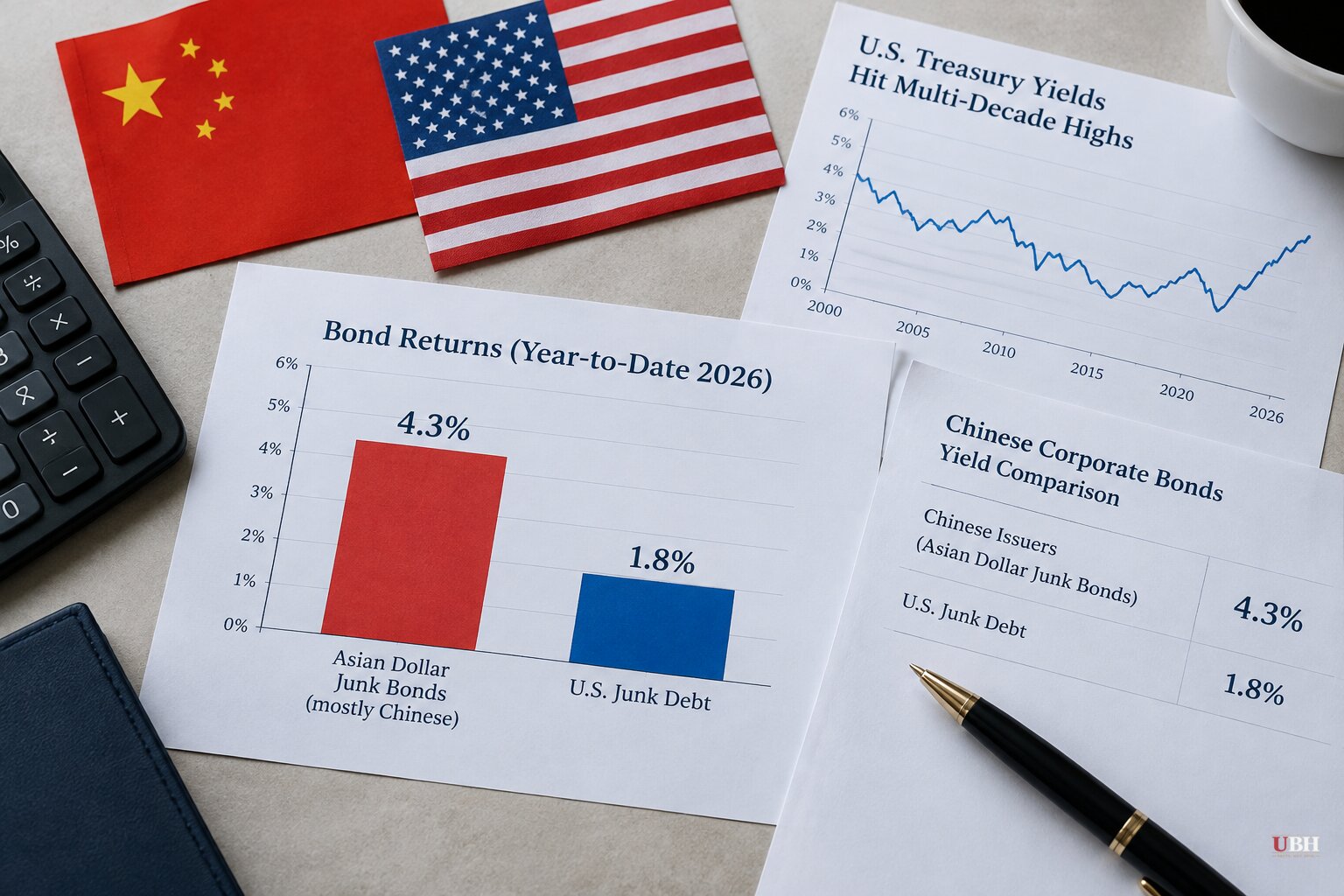
The Numbers
Asian high-yield dollar bonds have returned 4.3% so far in 2026, beating U.S. junk debt's 1.8% return and outperforming two dozen global debt benchmarks, according to data compiled by Bloomberg. Chinese borrowers make up the largest share of that Asian pool. The yield gap between Chinese and U.S. benchmark debt has widened to the widest on record over the past month, Bloomberg reported.
Cheap money in China is making Chinese issuers look like the safer bet to bond buyers right now, even as the U.S. is dealing with its own yield problems.
Why Money Is Cheap in China
The reason Chinese borrowing costs are so low isn't a triumph. It's a symptom.
Milton Ezrati, writing in the Epoch Times, points to Chinese debt flows as evidence of deep imbalance. Private businesses and households are pulling back from borrowing and actually paying down existing debt, while only Beijing and local governments keep expanding their balance sheets. Official data cited by Ezrati show private business investment in fixed assets fell 7.1% over the past year.
Ezrati's point, in a commentary piece, is that households and companies normally borrow because they expect the future to be better than the present. When they stop borrowing and start paying debt down instead, in an economy that's still supposedly growing, that suggests a loss of confidence. He notes Beijing has tried to fix these imbalances before and failed.
The Belt and Road Paradox
While Chinese private citizens shy away from debt, Beijing keeps selling debt to everyone else. Xi Jinping used the Shanghai Cooperation Organisation summit in Bishkek, Kyrgyzstan, to pitch an expanded Belt and Road Initiative, promising an "international AI application cooperation center," 10 million more kilowatts each of solar and wind capacity among SCO members, and 100 technology-cooperation projects over the next three years, according to Breitbart's coverage of his remarks.
Xi is offering real infrastructure, renewable-energy capacity and technology transfer to countries that badly need it, and Beijing frames this as mutual development, not exploitation. Xi also called for cracking down on "terrorism, separatism, and extremism" and "transnational organized crime," and warned against external interference in SCO members' internal affairs.
But the debt-trap criticism has data behind it. A May 2025 Lowy Institute report, cited by Breitbart, found that "soaring debt repayments and a sharp reduction in lending have transformed China's role in developing country finances from capital provider to debt collector," with the world's poorest and most vulnerable countries making record debt repayments to China totaling $22 billion. Kyrgyzstan itself, the summit's host, is among the BRI clients Breitbart says has had troubling experiences with the program. India, the SCO's largest non-Chinese member, remains firmly opposed to the China-Pakistan Economic Corridor over sovereignty concerns.
Money is tight for Chinese households and generous for Beijing's own priorities, at home and abroad. Both dynamics trace back to the same government.
Treasury Yields Spike, Not Fall
Meanwhile, U.S. government debt is having a rough stretch. The 10-year Treasury yield hit 5.012% intraday Monday, September 14, its highest level since 2007, before settling at 4.960%, according to Dow Jones Newswires reporting carried by Morningstar. The 30-year yield has briefly topped 5.3%, also a post-2007 high, according to the Atlantic Council's Josh Lipsky and Hung Tran, cited by Asia Asset Management.
Fed funds futures are now pricing in a 95% probability that the Federal Reserve will raise rates, not cut them, at this week's FOMC meeting, Westpac's Ryan Wells said in a note carried by Morningstar. That's an estimate of what traders expect, not a decision that's happened yet.
Oil above $100 a barrel is a big part of the story. WTI crude was at $102.59 and Brent at $106.90 as of Tuesday morning, according to ICE data reported by Morningstar. Commonwealth Bank of Australia's Vivek Dhar warned that Houthi rebel territorial gains and a Saudi pipeline closure have tightened global oil and refined-product stockpiles to as little as five to 11 weeks of supply, down from a normal 15 to 20 weeks, raising the risk of what he called "uncontrolled demand destruction" if U.S.-Iran tensions escalate further.
Lipsky and Tran's broader warning is that this isn't just a U.S. problem. France, Germany and Japan are all seeing yield spikes too, they told Asia Asset Management, and the U.S. fiscal position, with deficits running around 6% of GDP, is a fundamental driver. Japan's 10-year yield rose to 3.007%, Australia's to 5.371%, and New Zealand's to 5.029% in Tuesday trading, Morningstar reported.
SoftBank's AI Bet Runs on Borrowed Money
Against that backdrop, SoftBank Group is pressing ahead with its own borrowing spree. CFO Yoshimitsu Goto and other executives are holding investor meetings in New York from September 14 through 17 to gauge appetite for a potential U.S. dollar junk-bond sale, according to the Japan Times, citing Bloomberg reporting. Citigroup, Goldman Sachs, JPMorgan and Morgan Stanley are arranging the meetings, which aren't tied to a specific offering yet. Masayoshi Son's firm is financing a massive bet on artificial intelligence, and it's doing so in a junk-bond market where U.S. debt is the weaker performer this year and where the marginal buyer now has cheaper, better-returning Chinese paper to choose from instead.
If China's domestic private-sector retreat deepens, Beijing's low rates could reflect not stability but a shrinking real economy propped up by state spending. If U.S. Treasury yields keep climbing on deficit and energy worries, SoftBank and other issuers will be borrowing into a more expensive market than the one they're pitching investors on this week.
Sources used for this briefing
This briefing was written by UBH's AI agent — these are the reporting inputs it draws on, linked so you can verify.


