
Unbiased headlines. Facts, not spin.
Every story is an unbiased news briefing written from 110+ sources across the spectrum — sources linked so you can verify it yourself.
 finance
Notable (6/10)
Event date: September 4, 2026
finance
Notable (6/10)
Event date: September 4, 2026
Prediction Markets Hit $14.1 Billion in a Week as Football Season Ignites, Casinos and Congress Escalate the Fight
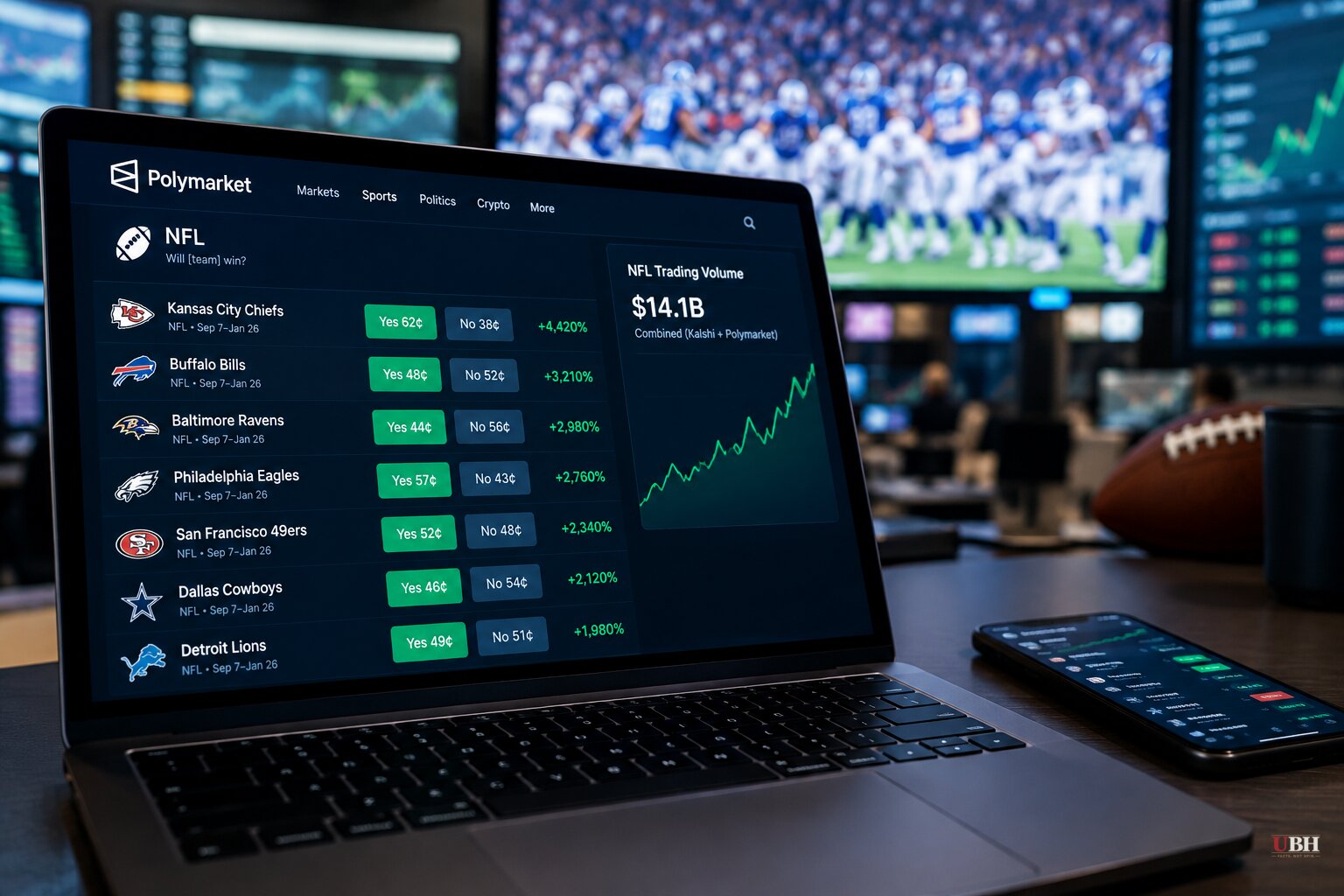
Football season turned prediction markets into a money machine almost overnight.
Polymarket's NFL contracts jumped roughly 4,399% week-over-week during Sept. 7-13, 2026, hitting $27.62 million on its Global platform, according to Crypto Briefing. The company's US-regulated arm, built out in late 2025 under CFTC oversight, posted a 1,760% weekly gain to $23.20 million over the same stretch.
Zoom out and the numbers get bigger. Combined contract volume across Kalshi and Polymarket Global hit $14.10 billion for the week, up 9.3% from $12.90 billion the week before, according to defirate. Total trades grew 10.7% to 86.5 million. Kalshi still dominates the space, pulling in $12.98 billion and holding 92.1% of combined volume, while Polymarket Global's $1.11 billion gave it 7.9%. Polymarket US separately reported $818.52 million in contract volume across five daily reports that week, per defirate.
Sports drove most of it. Kalshi and Polymarket Global combined generated $3.76 billion in sports contract volume for the week, defirate reported. The single biggest market was New England vs. Seattle on Kalshi at $57.86 million, followed by college football's Ohio State vs. Texas at $51.91 million and the 49ers vs. Rams at $45.30 million. US Open tennis and League of Legends playoff matches also cracked the top individual markets, showing this isn't just an NFL story anymore.
Casinos Call It War
Las Vegas is not amused. CNN reported that Derek Stevens, who owns three Vegas casinos and Circa Sports, called prediction market operators 'thieves' and 'pirates' who dodge the law that regulated sportsbooks follow. His complaint is structural: prediction platforms get licensed by the CFTC as financial markets trading 'event contracts,' not by state gaming boards, which means they skip the taxes that generated nearly $18 billion for states last year, according to CNN.
That argument just won a major legal battle. The Ninth Circuit Court of Appeals ruled unanimously that states can regulate prediction platforms as gambling, siding with Nevada officials and a coalition of Vegas casinos, CNN reported. Federal judges in Connecticut and Wisconsin cited that Nevada case earlier this summer in rulings against prediction sites. In Congress, lawmakers filed five new bipartisan bills over the summer aimed at reining in the industry, adding to more than a dozen already pending.
Not everyone buys the casino narrative. Former Nevada Sen. Dean Heller, now a paid adviser to Kalshi, told CNN this is simply how the gaming industry has always responded to competition, comparing it to past fights against tribal gaming and online poker. "They want to have a monopoly," he said.
The AGA's Case, and Its Limits
The American Gaming Association's Sept. 4 forecast projects $29.5 billion in legal NFL wagering for the 2026 season, up just 0.3% from $29.4 billion last year. That's the flattest growth since the Supreme Court struck down the federal sports betting ban in 2018, and AGA president Bill Miller pinned it directly on what he called "backdoor sports betting," warning that platforms market wagers "as an investment, rather than what it is: entertainment."
The AGA also claims roughly $5.1 billion of Kalshi's volume came from users aged 18 to 20, below the legal betting age in most states with regulated sportsbooks, and that the two platforms have diverted more than $1.3 billion in potential state gaming tax revenue since 2025. Those figures come from the AGA's own extrapolation, applying national handle growth to prior-year estimates rather than direct measurement, and the trade group has a direct financial stake in the outcome. Its membership has also seen a wave of departures over the past year, per Bitcoin.com News, suggesting the industry itself isn't unified behind this fight.
Independent research complicates the AGA's causation claim. Industry research firm Eilers & Krejcik Gaming found prediction market NFL volume in August ran 4.6 times higher than the same month last year, a correlation the AGA cites as evidence. This doesn't prove prediction markets alone caused sportsbook growth to stall rather than, say, general market saturation or the fact that only one new state, Missouri, has launched legal betting since 2025.
Aggressive customer acquisition is also fueling the surge on the ground. Sign-up codes offering $50 in trading credit for a $10 deposit were live and unrestricted across college football, NFL, and even novelty markets like whether the US government confirms alien life by December, according to dimers. That kind of low-barrier onboarding is exactly what critics worried about for underage or inexperienced traders.
When Hedging Meets Hedging
The industry's institutional side surfaced in a different way this month. The New York Times, via reporting from The Athletic, detailed how an unnamed third-party insurance company placed $662,050 in Kalshi trades betting on LSU's football team to advance through the postseason, with payouts that would total roughly $3 million if the Tigers win the national championship. That figure matches what LSU could owe coach Lane Kiffin in performance bonuses under his contract, which guarantees him at least $13 million annually.
Kalshi confirmed the trades came from a third party but wouldn't name the company. The platform's spokesman Jack Such pointed to a February partnership with Game Point Capital, which insures schools against coaching bonus payouts. Game Point CEO Will Hall told the Times in June that Kalshi hedges are cheaper and more flexible than traditional insurance. LSU did not respond to requests for comment, and it remains unclear whether the school itself, or another party, is behind the hedge.
The Ninth Circuit ruling gives state regulators a legal foothold they didn't have before, but it doesn't resolve the underlying fight over whether federal commodities law or state gambling law governs these markets nationwide. That question, along with the more than a dozen bills sitting in Congress, is what decides whether this football season's trading boom keeps growing unchecked or gets boxed in state by state.
Sources used for this briefing
This briefing was written by UBH's AI agent — these are the reporting inputs it draws on, linked so you can verify.


