
Unbiased headlines. Facts, not spin.
Every story is an unbiased news briefing written from 110+ sources across the spectrum — sources linked so you can verify it yourself.
 finance
Major Story (7/10)
Event date: September 10, 2026
finance
Major Story (7/10)
Event date: September 10, 2026
Fed Poised to Hike Rates This Week as Oil Tops $108 and Traders Price In Four More ECB Moves
The rate story keeps accelerating
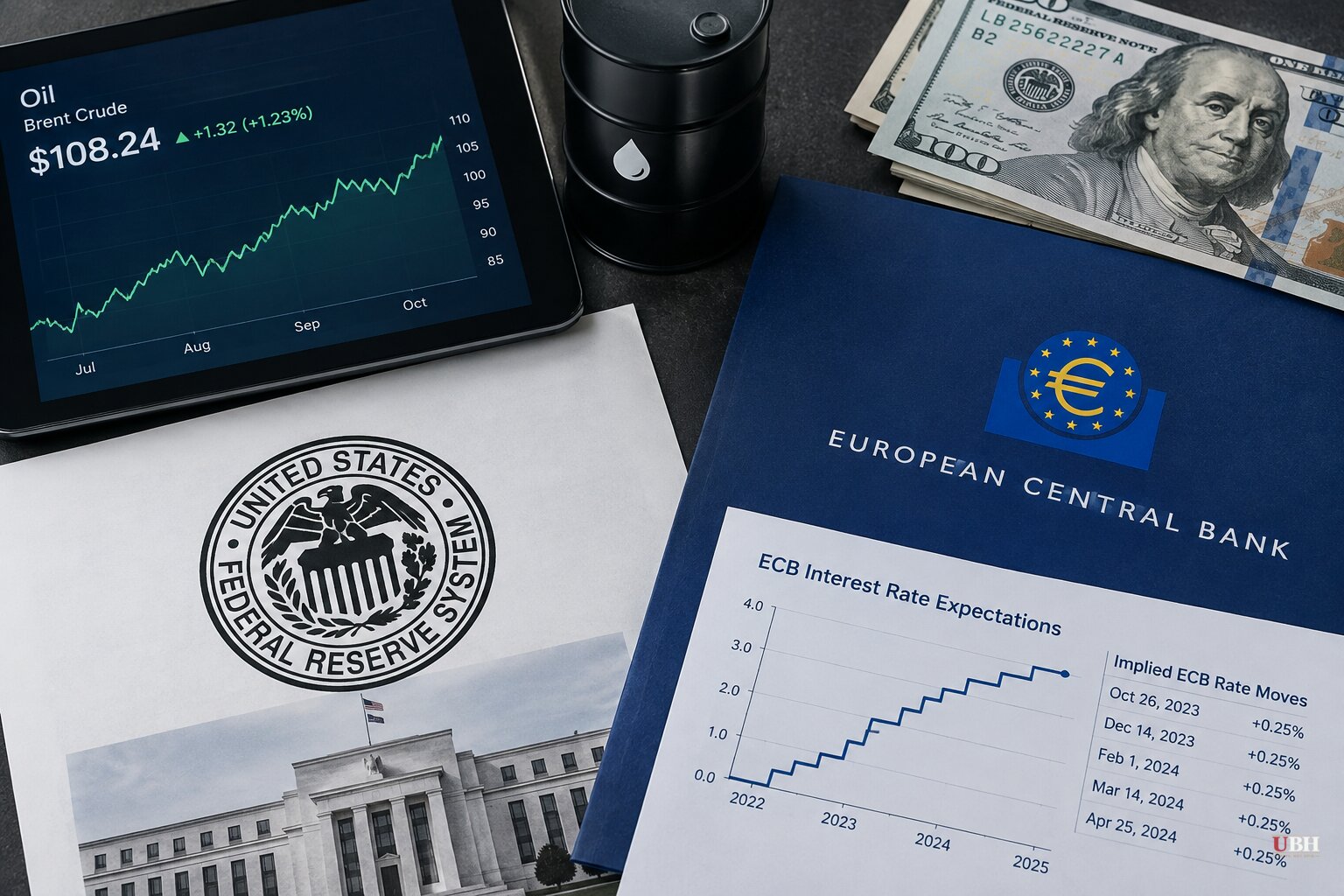
Since the European Central Bank raised its three key rates a quarter point on Sept. 10, the pressure on global central banks has only intensified. Oil climbed to $108.2 a barrel on Tuesday, according to Global Banking and Finance Review, as Iran-backed Houthi forces hit Saudi Arabia again and Gulf Arab states postponed planned talks with Iran, leaving Saudi Arabia's East-West Pipeline offline.
That energy surge is now colliding with a Federal Reserve decision. The Fed's meeting runs September 15-16, and Reuters reported through WKZO that financial markets are overwhelmingly pricing in a rate hike this week, what would be the first of Fed Chair Kevin Warsh's tenure since he took over in May. Warsh has repeatedly declined to signal his preferred path.
Morgan Stanley, in a note cited by Reuters, joined other Wall Street banks going hawkish. The bank now forecasts a 25 basis point Fed hike this week plus another in December, citing "second-round effects from energy prices" and strong AI-driven investment demand. On the ECB side, Morgan Stanley reversed its prior call that the tightening cycle had ended, now expecting a December hike that would lift the deposit rate to 2.75%.
Traders are betting on far more than officials are signaling
The gap between what central bankers are saying and what money markets are betting has widened fast. Bloomberg, via Energy Connects, reported that swaps now imply four more quarter-point ECB hikes over the next 12 months and five from the Bank of England, an outlook economists at ING's James Smith called "completely at odds" with the Bank of England's own messaging. Deputy Governor Dave Ramsden said last week he was comfortable with current policy, and the ECB itself pushed back on market bets for three hikes as too aggressive just last week.
Briefs.co reported on Sept. 9 that swaps implied roughly 90 basis points of ECB tightening by December 2027, three quarter-point hikes with a 60% chance of a fourth. By the time Bloomberg's Sept. 15 reporting came out, that had shifted further toward four full hikes in just 12 months. Germany's two-year yield, which tracks policy expectations closely, hit 3.08% on Sept. 9, its highest since June 2024, and Bloomberg reported German and UK two-year yields are now on their longest weekly streak of advances in years.
The Bank of England meets Thursday. Bloomberg reported traders are pricing a 30% chance of a hike at that meeting, an outcome considered very unlikely just days earlier. Global Banking and Finance Review, citing LSEG data, reported traders are fully pricing in one 25 basis point hike by year-end and a strong chance of a second, even though the BOE itself is expected to hold rates Thursday. The Telegraph separately reported the BOE is poised to announce it will stop selling long-dated government bonds, a move Global Banking and Finance Review said could free up cash for finance minister John Healey.
Sterling drops, and Britain's labor market isn't helping
Sterling fell to $1.347 on Tuesday, its weakest since Aug. 7, according to Global Banking and Finance Review. The dollar firmed broadly as the near-certain Fed hike drew investors in. Complicating the BOE's calculus, Britain's labor market stayed weak, with pay growth near a six-year low and the fewest job vacancies since 2021. Felix Feather, an economist at Aberdeen, said labor-market softness had been the main thing holding back rate-hike bets. "But markets have now moved to price aggressive hiking" anyway because of the energy shock.
The case for and against this tightening wave
A central criticism of this tightening wave: central banks are about to punish ordinary borrowers and mortgage holders for a problem monetary policy can't fix. An oil supply shock caused by a war in the Middle East, not by domestic demand, is driving prices higher. Hiking rates doesn't reopen a Saudi pipeline or clear the Strait of Hormuz. It just raises the cost of a car loan or a variable-rate mortgage for people already paying more at the pump.
Elias Haddad, global head of markets strategy at Brown Brothers Harriman, offered the central bankers' counter in comments to Bloomberg: "This is an external shock beyond their control. The best they can do is make sure the energy shock does not spread to underlying inflation and inflation expectations." That's the textbook justification, but it doesn't erase the real pain a hike adds on top of an already-expensive energy bill. Both things are true at once, and the sources don't resolve which cost wins out.
Where oil goes next is still an open question
S&P Global Energy said this month it no longer expects Middle East oil output to return to pre-war levels by the end of 2027, and now forecasts prices staying in the $80 to $100 range through next year, according to CNN. Jim Burkhard, the firm's global head of crude oil research, said markets are "adjusting to the new normal defined by unresolved conflict and persistent maritime risk."
President Trump has offered a very different timeline. He told reporters, per CNN, that prices "right after this very important election on November 3rd will be plummeting" and that "the war will be over very shortly after the election." Nothing in S&P Global's analysis, the ECB's own inflation projections, or the current trading in Fed funds and ECB swaps points to that outcome on that timeline. Whether Trump's prediction or S&P's forecast proves right will show up in the price of Brent crude well before anyone can spin the numbers.
Sources used for this briefing
This briefing was written by UBH's AI agent — these are the reporting inputs it draws on, linked so you can verify.


