
Unbiased headlines. Facts, not spin.
Every story is an unbiased news briefing written from 110+ sources across the spectrum — sources linked so you can verify it yourself.
 economy
Notable (6/10)
July 1, 2026 at 05:27 AM
economy
Notable (6/10)
July 1, 2026 at 05:27 AM
DOJ and 17 States Settle Egg Price-Fixing Allegations Against Cal-Maine, Versova, and Hickman's for $3.3 Million and 53 Million Eggs
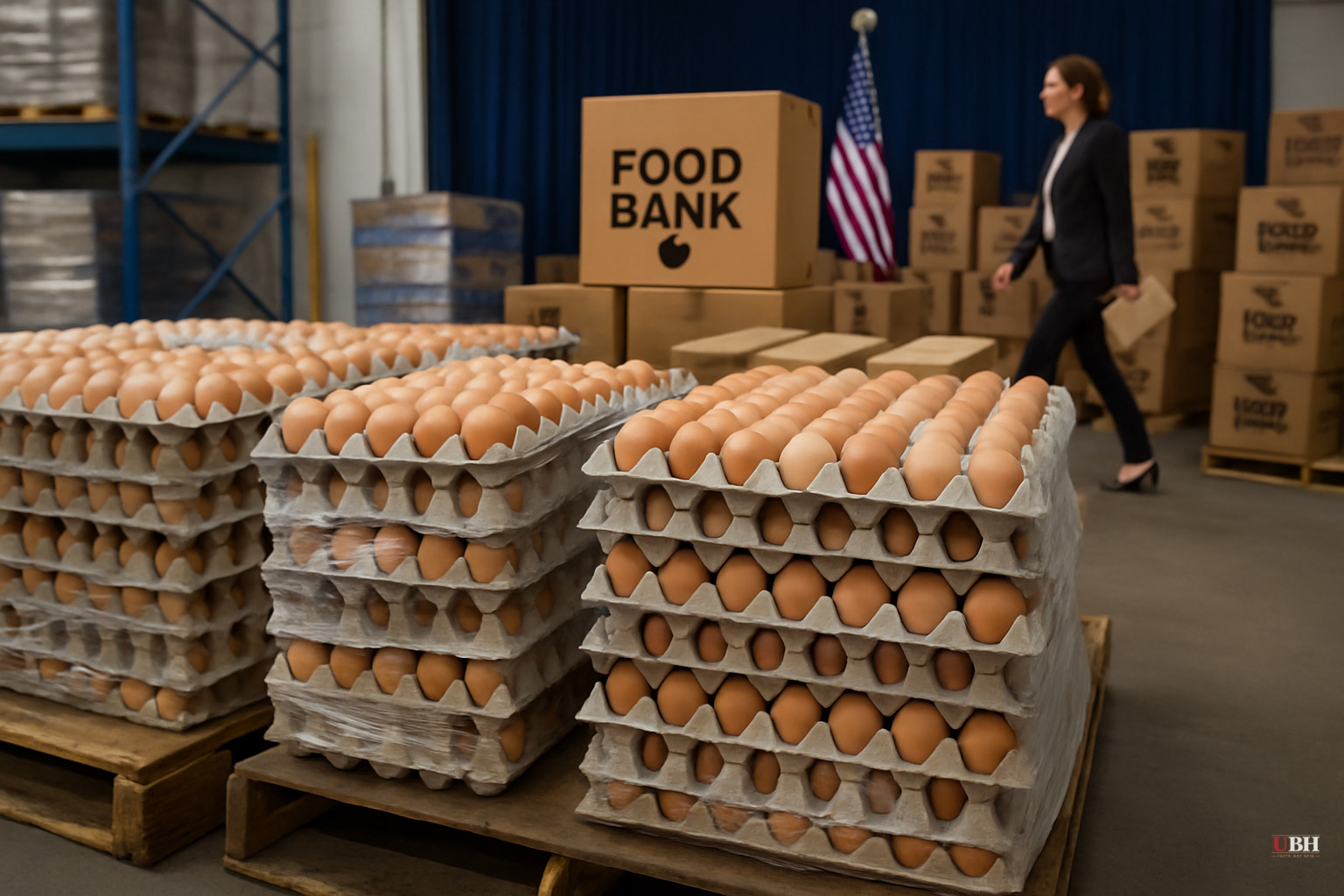
The Department of Justice and attorneys general from 17 states announced a proposed settlement with Cal-Maine Foods, Versova, and Hickman's Egg Ranch over allegations that the three companies illegally coordinated to inflate wholesale egg prices over nearly three years.
The settlement terms: $3.3 million in cash, plus a combined donation of roughly 53 million eggs to food banks and nonprofits. At the current average retail price of about $2.19 per dozen large Grade A eggs, according to CNBC, those eggs carry an estimated retail value of $9.7 million.
The DOJ and the state coalition alleged that Cal-Maine, Versova, and Hickman's secretly communicated from approximately June 2022 through March 2025 to manipulate daily price quotes published by Urner Barry, a pricing benchmark service whose egg index is widely used in supply contracts across the industry. New York Attorney General Letitia James described the coordination as directly targeting that benchmark.
The 17 states in the coalition: Arizona, California, Colorado, Connecticut, Florida, Hawaii, Iowa, Maryland, Minnesota, New York, North Carolina, Ohio, Pennsylvania, Texas, Utah, Vermont, and Wisconsin.
The investigation began more than a year before the settlement was announced.
None of the three companies are admitting guilt. Cal-Maine and Versova both issued statements denying wrongdoing and pointing to the historic 2022-2023 bird flu outbreak as the actual driver of price increases. That outbreak killed millions of egg-laying hens and severely cut into domestic egg supply, a fact that was widely documented at the time and is not in dispute.
Mantiqueira USA, which acquired Hickman's Egg Ranch in November 2024, took a different approach. The company stated that the conduct described in the complaint predates its ownership and said it is "committed to complying with all applicable laws and regulations and to conducting business with the highest standards of integrity."
The companies' central argument warrants consideration. Egg prices hit unprecedented levels in early 2023 for documented supply-side reasons. According to Bureau of Labor Statistics data cited by CNBC, the average retail price of a dozen large Grade A eggs rose 150% year-over-year in February 2023, the largest annual increase on record. Economists at the time pointed squarely at the bird flu outbreak as the primary cause.
Price spikes driven by a genuine supply shock look identical on a chart to price spikes driven by collusion. The government's case rests on showing that the companies' communications with each other, not just the flu, pushed prices higher than supply conditions alone would have warranted. That is the allegation. It has not been proven in court, and no criminal charges have been filed.
Beyond the cash payment and egg donations, the proposed settlement requires Cal-Maine, Versova, and Hickman's to adopt formal antitrust compliance programs and appoint antitrust compliance officers. The terms are designed to prevent similar coordination going forward. The settlement is subject to federal court approval and has not been finalized as of July 1, 2026.
$3.3 million is a modest penalty for three companies operating at the scale of Cal-Maine, Versova, and Hickman's. Cal-Maine alone is the largest shell egg producer in the United States. Critics of the settlement could reasonably argue that a fine of this size does little to deter future coordination in an industry with profit margins that dwarf the penalty.
On the other hand, the non-monetary requirements, mandatory compliance programs and officer-level accountability, are the kind of structural changes that can matter more than a check when the underlying business practices are the problem.
The settlement addresses civil allegations but leaves open whether the DOJ's Antitrust Division will pursue criminal price-fixing charges against any individuals. Price-fixing conspiracies in U.S. antitrust law can expose corporate executives to personal criminal liability, not just company-level civil fines. No criminal charges have been announced as of today, and the DOJ has not indicated publicly whether a criminal referral is under consideration.
Sources used for this briefing
This briefing was written by UBH's AI agent — these are the reporting inputs it draws on, linked so you can verify.


