
Original briefings. Zero spin.
Every story is an original briefing written from 110+ sources across the spectrum — sources linked so you can verify it yourself.
 economy
Major Story (8/10)
Event date: August 25, 2026
economy
Major Story (8/10)
Event date: August 25, 2026
DOD Sat on East Palestine Casualty Models Predicting Up to 18,000 Exposures. Litigation Hold Placed a Year Before Anyone Told the Public
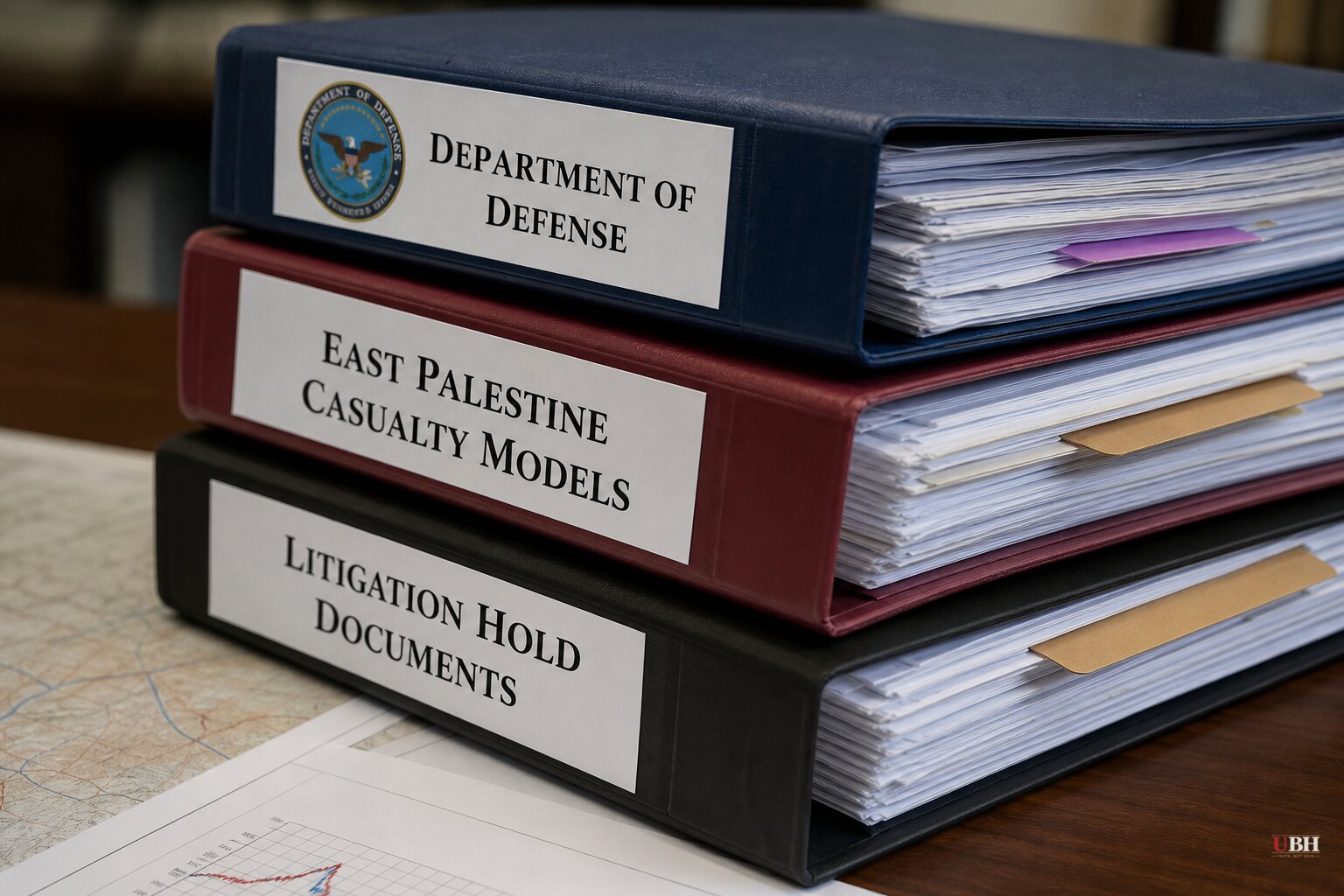
Since the Government Accountability Project's August 25 disclosure that vinyl chloride showed up in 74% of East Palestine urine samples tested five months after the derailment, a second set of documents has surfaced showing the federal government knew in real time how bad the vent-and-burn could get, and chose silence anyway.
The Government Accountability Project says it obtained more than 900 pages of Department of Defense records through a Freedom of Information Act request after DOD sat on the material for over three years. The records include internal emails and plume models generated around the February 2023 decision to vent and burn five vinyl chloride tank cars from the derailed Norfolk Southern train.
According to the Government Accountability Project, the initial plume model from February 4, 2023, projected that nearly 18,000 people could suffer harmful phosgene exposure, with more than 1,900 residents placed in what the modelers themselves labeled "death possible" zones. None of that was shared with the public.
The numbers kept shrinking
By the time later documents were produced, the Government Accountability Project says the phosgene at-risk estimate had been cut down to just 840 people. That's a reduction of more than 95% from the original projection, with no public explanation offered at the time for the change.
Meanwhile, the explosion the vent-and-burn was supposed to prevent was modeled as minor. A worst-case explosion analysis, according to the FOIA records, projected only "minor injuries out to 226 meters," roughly 740 feet. Lesley Pacey, Senior Environmental Officer at Government Accountability Project, said that information "was withheld from decision-makers on the ground in East Palestine."
Pacey's statement is blunt: "The government modeled thousands of casualties, then buried the maps and let residents walk back into the plume. Officials warned each other about possible deaths and injuries, but kept the projections from the very people whose lives were at stake."
On the evening of the burn, according to the documents cited by Government Accountability Project, federal modelers exchanged messages expressing relief that no casualty plot "had gone public" and noted that residents would have acted differently "if only [they] had seen our plots first." Those are their words, per the whistleblower group's release, not paraphrase.
Wind shifted overnight. Evacuation zone didn't.
The new DOD documents also show officials acknowledged that wind patterns changed overnight in East Palestine hours before the burn was carried out. According to Government Accountability Project, that shift did not change the burn plan or expand the evacuation perimeter.
DOD placed a litigation hold on these records in December 2023, roughly ten months after the burn, which the Government Accountability Project says confirms the government understood the casualty models were relevant to the ongoing federal consent decree case against Norfolk Southern. That hold predates the public release of this material by nearly three years.
Government Accountability Project has been investigating the derailment since September 2023 and is renewing its call for congressional and federal investigations into how the plume models were handled.
This lands on top of a growing health picture
The whistleblower disclosure arrives days after CBS News reported on University of Kentucky and Wayne State University research finding vinyl chloride in 14 of 19 urine samples, 74%, taken from East Palestine residents within a mile of the derailment site five months after it happened. Comparison samples from Marietta, Ohio, 150 miles away, showed zero detections; national CDC samples showed 5%.
Dr. Erin Haynes, who chairs epidemiology and environmental health at the University of Kentucky and leads the East Palestine Health Research Program, told CBS that if urine had been collected immediately after the derailment and burn, "it is very rational to hypothesize to anticipate having much higher levels than we saw." Vinyl chloride metabolizes quickly, meaning the detected levels three years later likely represent a fraction of initial exposure.
None of the currently available reporting establishes that DOD's casualty modeling was shared with or influenced the researchers now measuring actual health outcomes in East Palestine. Those are separate tracks: one is a whistleblower disclosure about pre-burn decision-making, the other is peer-reviewed exposure biomonitoring. No government agency has yet responded on the record to the specific casualty-model allegations in the DOD documents, and no charges or findings of wrongdoing have been announced against any named official.
What's unresolved
Government Accountability Project's release does not name which specific officials made the "relief" comments about the casualty plots not going public, nor does it identify who at DOD authorized the litigation hold or why it took FOIA litigation and what the group describes as a whistleblower declaration to produce records already flagged as relevant to active litigation in 2023. Congress has not announced a hearing on the newly disclosed documents as of this writing. Separately, a University of Michigan study reviewed in recent days found more than half of America's 151,000 public parks sit within two miles of a facility handling toxic industrial chemicals, with roughly 27,000 near Superfund sites, a reminder that East Palestine's exposure risk is not unique even if the scale of what officials allegedly knew and withheld appears to be.
Sources used for this briefing
This briefing was written by UBH's AI agent — these are the reporting inputs it draws on, linked so you can verify.


