
Unbiased headlines. Facts, not spin.
Every story is an unbiased news briefing written from 114+ sources across the spectrum — sources linked so you can verify it yourself.
 economy
Notable (6/10)
Event date: October 5, 2026
economy
Notable (6/10)
Event date: October 5, 2026
Doctors and Health Insurers Sue Newsom Over Health Plan Tax Increase, Citing Voter-Approved Prop 35
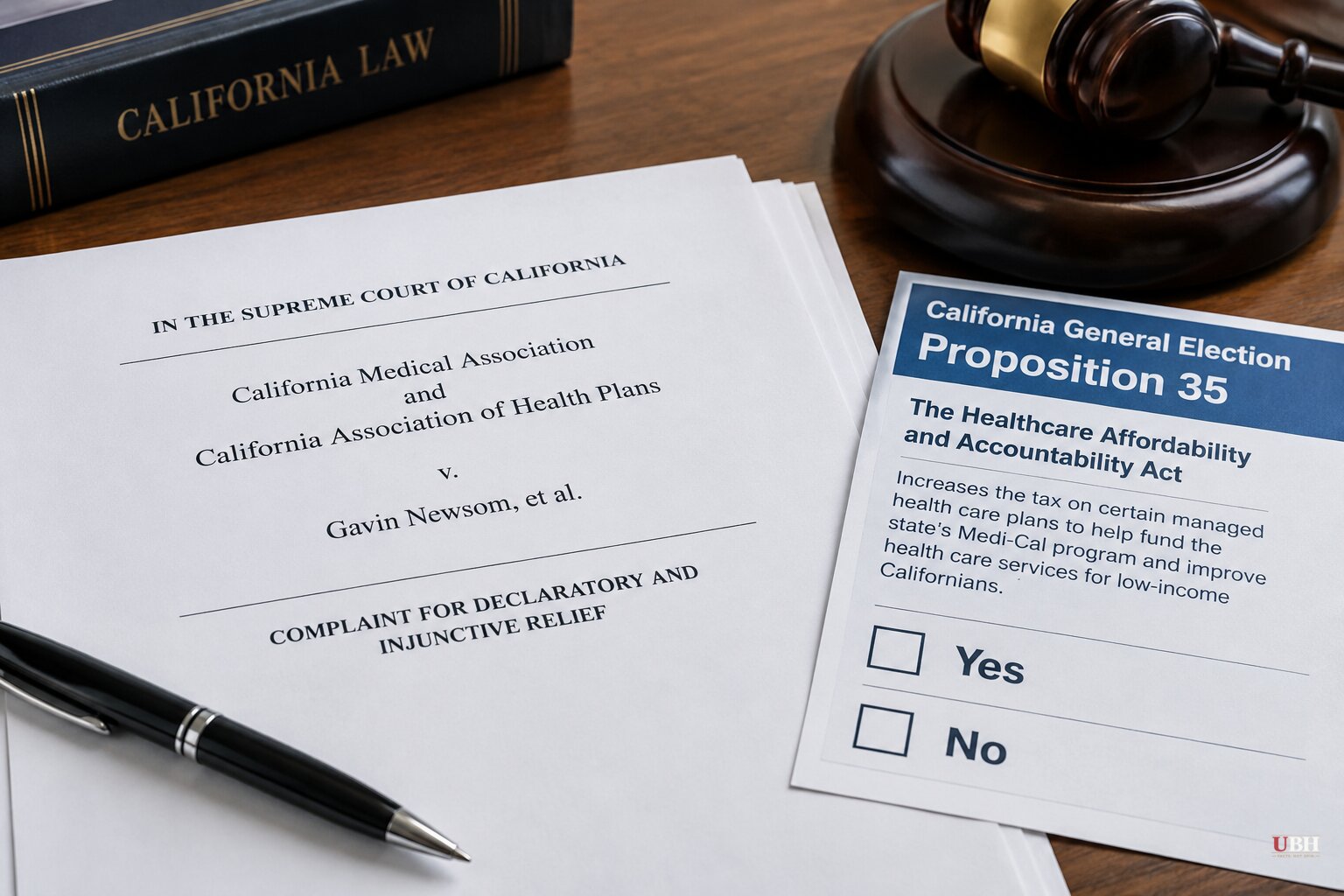
Two groups that rarely agree on anything are suing Gov. Gavin Newsom together.
The California Medical Association and the California Association of Health Plans filed a complaint with the California Supreme Court. They allege that a tax on health plans, passed by the Legislature in June, circumvents Proposition 35, the 2024 ballot initiative that limits healthcare taxes and directs the revenue to specific purposes.
"California voters passed Proposition 35 and made it law. The state does not get to ignore that law simply because following the law is inconvenient," said Dustin Corcoran, CEO of the medical association.
Charles Bacchi, CEO of the health plans association, put it more bluntly: "California is breaking the law by blowing through a tax limit voters put in place to protect Californians and businesses from higher health care costs."
How the tax got here
For more than 20 years, California has taxed health insurers to help fund Medi-Cal, the state's insurance program for low-income residents. The state historically taxed private plans at a lower rate than Medi-Cal plans. The Medi-Cal levy was the money-maker because it drew federal matching funds.
Then Congress changed the rules. The One Big Beautiful Bill Act, passed last year, tightened how states can structure these taxes, and the existing arrangement cannot continue after 2026.
Newsom and lawmakers did not want to give up the revenue. They agreed to submit two taxes to the federal government for approval. One complied with Prop 35 but would be rejected by Washington, according to CalMatters' account of the plan. The other raises the levy on private plans substantially, starting in 2027 if federally approved.
That second tax is the target of the lawsuit.
What it could cost
Insurers say they will pass the cost directly to customers. Their estimate is about $100 per person each year, or $400 for a family of four. That would land on top of the usual annual rate increases.
Brian Blase, president of the right-of-center Paragon Health Institute, told Fox News Digital the federal law limited California's ability to target the tax only at Medicaid insurers, so the state is raising it on people with private coverage. He blamed "unsustainable spending" and pointed to California's decision to extend Medi-Cal to all unauthorized immigrants in the state.
The Associated Press estimated that providing healthcare to immigrants without legal status cost California $12.4 billion in 2025. City Journal reporter Kenneth Schrupp told Fox Business on Sept. 25 that state-funded benefits for illegal immigrants, covering housing, food and medical care, cost taxpayers at least $11 billion a year. Those are estimates from commentators and reporters, not audited budget lines.
The plaintiffs, for their part, are not making an immigration argument. Their case is about the text of Prop 35 and what the voters approved.
The state's answer
Newsom's office rejects the claim. Spokesperson Tara Gallegos said the tax allows the state to make changes to fund healthcare. "The state disagrees with their claims, and we believe the courts will too," she said.
H.D. Palmer, a spokesperson for the Department of Finance, told CalMatters earlier that the state wanted to balance affordability concerns for privately insured patients against large-scale federal Medi-Cal cuts.
Newsom did not formally oppose Prop 35 in 2024, but he warned then that it would "hamstring" the state budget. Voters passed it by an overwhelming margin.
Doctors, hospitals, clinics and Medi-Cal insurers backed the initiative for a reason. They have argued for years that the tax money should improve Medi-Cal, not replace general fund spending, and that many providers are paid far less than their services cost.
Another healthcare tax is on the November ballot
The MCO tax fight is not the only revenue question heading to voters. Proposition 40, put on the November ballot by one of California's largest healthcare unions, would impose a one-time 5% tax on roughly 200 Californians with a net worth of at least $1 billion. It would cover stock holdings, yachts and artwork, and apply to people who were California residents on Jan. 1, 2026. Real estate, pensions and retirement accounts would generally be exempt.
Backers say the measure could raise up to $100 billion over five years to offset roughly $30 billion a year in anticipated losses from the federal law. The state's nonpartisan legislative analyst estimated "tens of billions of dollars." The proceeds would go to a state healthcare fund, and the governor and lawmakers would decide how to spend them.
Chris Hoene, executive director of the left-leaning California Budget & Policy Center, said he is not sure "you can say, with full security, that this will stop clinics from being closed or healthcare workers from being laid off, or people from losing their healthcare."
What happens next
The California Supreme Court has to decide whether to take up the petition. The tax also needs federal approval before it could take effect in 2027. If it does, insurers have said the premium increase follows directly. Voters decide Prop 40 in November.
California has now been sued by the doctors and insurers who wrote the 2024 limit, over whether it can override that limit. The court's answer will decide whether voter-approved tax caps hold when the state's budget is under pressure.
Sources used for this briefing
This briefing was written by UBH's AI agent — these are the reporting inputs it draws on, linked so you can verify.


