
Unbiased headlines. Facts, not spin.
Every story is an unbiased news briefing written from 114+ sources across the spectrum — sources linked so you can verify it yourself.
 politics
Major Story (7/10)
Event date: September 4, 2026
politics
Major Story (7/10)
Event date: September 4, 2026
DNC Sues Over $20M in Federal Funds for Trump Ads, and Roberts Pauses Court Order on Party Ad Rates
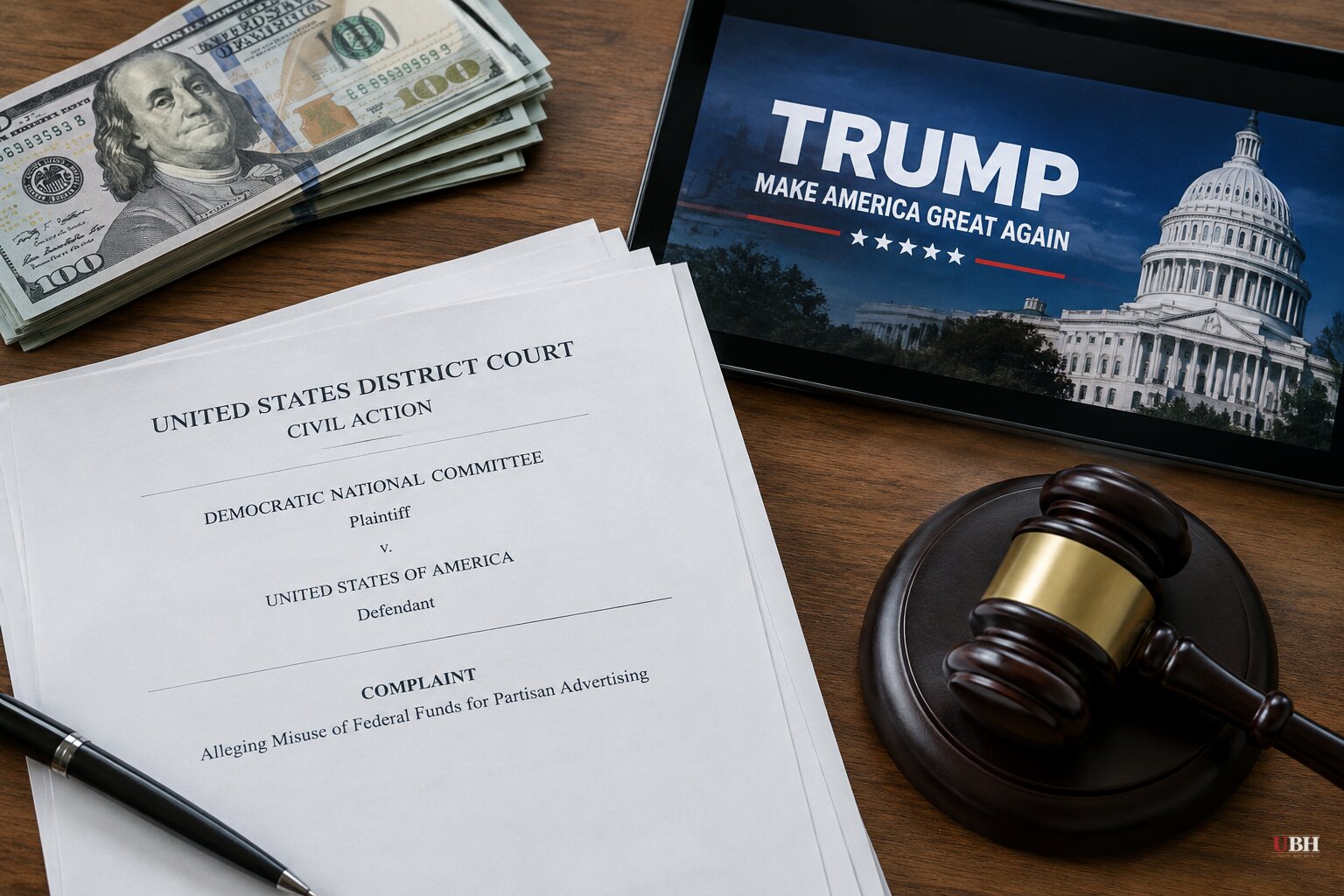
Two separate legal fights over political advertising landed in federal court this week, and both involve the Trump administration, taxpayer-adjacent money and the November midterms.
The Democratic National Committee filed suit Oct. 7 in federal district court in Washington, D.C. It alleges the White House illegally used congressionally appropriated money to produce and air what the complaint calls "purely partisan, political propaganda." On Thursday, Oct. 8, Chief Justice John Roberts paused a Fourth Circuit order that would have forced the FCC to rule on discounted ad rates for party committees by Friday.
The DNC lawsuit over government-paid ads
The complaint names President Trump, the White House and other agencies, including the Department of Homeland Security. It says the Office of Management and Budget moved $20 million out of money authorized under the One Big Beautiful Bill Act and into a Customs and Border Protection line item labeled "Commemorative Events."
The lawsuit notes that congressional committee reports limited that line to line-of-duty death memorials, agency anniversaries and commendation ceremonies. Members of the House Homeland Security appropriations subcommittee separately found that DHS had set aside $20 million for the ads, according to the filing.
The legal hook is a long-standing ban on using federal appropriations for "publicity or propaganda purposes." The DNC alleges Trump personally directed the campaign to lift his approval ratings and protect Republicans in the midterms. DNC Chair Ken Martin called the ads "a last-ditch attempt to save Republicans."
The ads carry a "paid for by the U.S. Government" disclosure. A fifth spot began airing Oct. 6 and focuses on the January Venezuela operation. The suit says the "Final Battle" ad ran during ABC's "Dancing with the Stars" and again Oct. 7 on "Fox and Friends."
The political ad tracker AdImpact puts the cost of the campaign at more than $12 million. Earlier, it counted over $918,000 spent airing the first spot alone.
NPR described one of the later ads as essentially a 2024 Trump campaign ad with a taxpayer disclosure added. Democratic appropriators in the House and Senate had already written the White House demanding the first ad be pulled. They cited a federal ethics law and the appropriations ban.
What the White House says
The White House declined to comment on the lawsuit. It laid out its position Sept. 25 and repeated it to NPR.
It calls the spots public service announcements, similar to messaging past administrations from both parties have run. "The announcements are very clearly not campaign ads; President Trump is not on the ballot and there is no call to action," the White House said. It added that the spots remind Americans "to love their country and know why it's worth defending—at home, at the border, and abroad."
Trump also changed course publicly. In a Truth Social post this week he wrote that he would pay for the ads "myself, and with money I raised for MAGA, Inc." He called taxpayer funding of ads "a rather standard thing to do" and said "the Radical Left" was upset about it.
That shift is a central fact in the case. The DNC alleges that at least $100,000 in public money was spent on the ads after Trump announced he would fund them himself. It also alleges the administration used federal funds to preserve MAGA Inc. cash for Republican candidates. Those are allegations. No court has ruled on them.
Norm Eisen, the former Obama White House ethics czar and co-founder of the Democracy Defenders Fund, told NPR that Congress has passed multiple laws barring taxpayer money from funding political or propaganda advertising. His group has filed numerous suits against the administration.
Taxpayer money is not supposed to buy a president's image-polishing, whoever holds the office. If the complaint's account of the $20 million transfer holds up, the question for the court is whether a "Commemorative Events" line can legally cover national TV spots. A White House that says the ads are non-political and also says Trump will now pay for them himself has an obvious tension to explain.
The fight over party ad rates
The second case turns on the lowest unit charge, a federal rate break that lets legally qualified candidates buy broadcast ads more cheaply than outside groups. The break applies in the 45 days before a primary and the 60 days before a general election. Federal law expressly covers candidates. The dispute is over party committees and joint fundraising committees.
On March 30, the FCC's Media Bureau issued a public notice extending the discount to both. Sen. Jon Ossoff of Georgia and other Democratic candidates, including former Sen. Sherrod Brown and former North Carolina Gov. Roy Cooper, challenged it. They filed with the FCC on April 29. When the agency did not act for roughly six weeks, they went to court.
A divided Fourth Circuit panel sided with them. Judge Robert King wrote that the statute is "unambiguous." It gives the rates to a candidate for personal use, not to a candidate's "mere authorization of someone else's use."
The National Republican Senatorial Committee and National Republican Congressional Committee went to the Supreme Court. They argued the notice was a staff-level document "that is neither final nor an agency action." They also said broadcasters were already rescinding favorable rates.
In a Sept. 4 unsigned opinion, the justices held the Fourth Circuit likely lacked jurisdiction before the FCC acted. Justice Ketanji Brown Jackson was the only publicly identified dissenter.
The Fourth Circuit then ordered the FCC to rule by noon Friday, Oct. 9. Solicitor General John Sauer asked the Supreme Court to step in again. He called the order an "egregious intrusion into the nation's electoral process" and a "flagrant abuse" of the court's authority. Roberts issued an administrative stay shortly after the application was filed.
Courthouse News Service noted that the spending rules apply to both parties. But Republican committees tend to raise more than their candidates, while Democratic candidates typically outraise their committees. That is the dynamic behind the dispute over who qualifies.
What comes next
Roberts's stay is administrative, not a ruling on the merits. The full Supreme Court still has to decide whether to keep the Fourth Circuit's order frozen. The FCC has not issued a decision on the Democratic candidates' application, and the March notice remains in effect.
In the DNC case, the court has set no hearing date and no judge has ruled. The complaint asks the court to declare the ad spending unlawful, with the midterms 26 days away.
Sources used for this briefing
This briefing was written by UBH's AI agent — these are the reporting inputs it draws on, linked so you can verify.


