
Unbiased headlines. Facts, not spin.
Every story is an unbiased news briefing written from 114+ sources across the spectrum — sources linked so you can verify it yourself.
 politics
Major Story (8/10)
Event date: October 7, 2026
politics
Major Story (8/10)
Event date: October 7, 2026
Federal Agencies Give Conflicting Answers on Agents at Polling Places Less Than Four Weeks Before Midterms
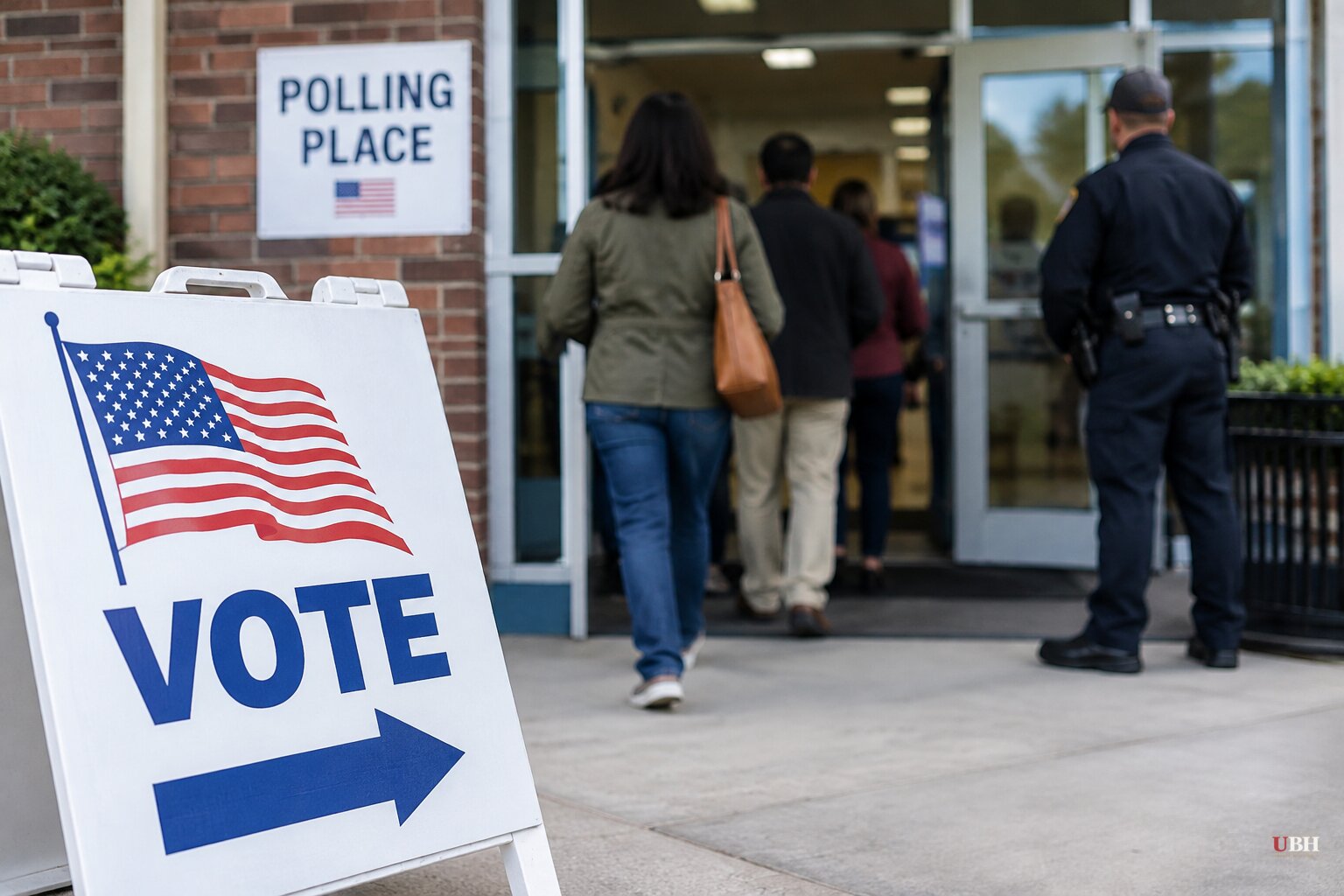
With the midterm elections less than four weeks away, the federal government has not told voters what law enforcement presence to expect at the polls.
FBI Director Kash Patel has declined to rule out deploying agents to voting sites. The Department of Homeland Security has said ICE does not plan to patrol polling places, but has left open the possibility that agents could respond to threats or serve warrants nearby. The Justice Department has said it will keep sending federal personnel to polling locations as part of its election-monitoring work.
Three agencies, three different answers.
States are planning around the uncertainty
In Wisconsin, election officials are being trained on how to respond if armed federal agents show up at a polling place. In Michigan, the attorney general's office has lined up agents, state police officials and legal filings to respond quickly to election-related incidents.
A University of San Diego poll found 40% of Americans think it is likely ICE agents will appear at the polls. A third said their presence would reduce their trust in elections.
Aaron Blacksberg, federal policy counsel at the Institute for Responsive Government, called a federal presence "low likelihood" and said it is "certainly impossible" that agents could be at every polling site in America. "But without knowing for certain, people are concerned," he said.
What the law says
Federal law bars U.S. officials from sending or keeping "troops or armed men at any place where a general or special election is held." The exceptions are narrow: when those people are voting themselves, or when their presence is needed "to repel armed enemies of the United States."
A separate federal statute makes voter intimidation a crime, punishable by up to a year in prison.
Jonathan Diaz, director of voting advocacy and partnerships at the Campaign Legal Center, said the armed-agents ban is a criminal statute. "The person who orders the agents or officers to the polls also would face criminal liability for doing that," he said.
The National Guard question
Asked directly in May about deploying the National Guard or ICE to polling places, President Trump did not rule it out. He said he would do "anything necessary." Several other administration officials have also sidestepped the question, and some have suggested a federal presence might be needed to ensure trust in the vote. Election officials across the country reject that claim and say they plan to run the midterms as usual.
Democratic lawmakers, retired military leaders and civil rights groups have responded with lawsuits, Freedom of Information Act requests and voter-education campaigns. Maj. Gen. Steven Lepper, a retired Air Force lawyer who belongs to the Former Judge Advocates Working Group, points to the Supreme Court's recent rejection of Trump's executive order limiting mail voting.
"As this president's options are dwindling, the idea that he might use the military becomes even more of our concern," Lepper said. He also cited the executive order declaring antifa a terrorist organization, which he says could be used to justify invoking the Insurrection Act if there is disruption at polling places. Trump has repeatedly threatened to invoke that act.
Foreign threats and a thinner defense
In a primetime address in July, Trump warned that U.S. election infrastructure is vulnerable to foreign attack and alleged China tried to influence the 2020 election. The Council on Foreign Relations notes he offered no evidence that elections were disrupted or ballots miscounted. The Chinese actions he cited involved the legal acquisition of voter rolls.
The real foreign activity is documented elsewhere. Russia has used social media for a decade to amplify divisions in the U.S. China has run smaller operations, typically aimed at down-ballot candidates critical of Beijing. Iran hacked the Trump campaign in 2024. All three are still running influence operations, and AI could make them cheaper and more effective.
The second Trump administration has rolled back many of the measures the Obama, first Trump and Biden administrations used to limit foreign exploitation of social media and to protect election infrastructure. That means the administration is warning about foreign interference while scaling down some of the tools built to counter it.
Activists, records requests and ballot seizures
Pressure on election offices is also coming from the other direction. CalMatters obtained public records request logs from 13 California county election offices and found dozens of requests from groups that dispute election results. Some solicit donations from supporters who believe the results can't be trusted.
Under California law, anyone can request government documents. That is how public records are supposed to work.
But some law enforcement agencies are acting on the resulting claims. The Riverside County Sheriff's Office seized 650,000 ballots from last November's election earlier this year, relying on an activist group's findings that CalMatters describes as questionable. The FBI recently visited Shasta County to inspect ballots from its June primary.
David Becker, executive director of the Center for Election Innovation & Research, says fundraising pleas always accompany such claims. "There's always a donate button," he said, calling it an "economy of grift." He pointed to True the Vote, which after 2016 said it had evidence of 3 million illegal votes and sought $1 million to verify it. An investigation by Reveal, based on court and tax records, found the evidence was never released. Reveal also reported that after 2020 the group raised $2.5 million from one donor and routed much of it to founder Catherine Engelbrecht, a board member's company and an attorney for the nonprofit.
Distrust of federal law enforcement runs both ways
A new Justice Department Weaponization Working Group report found the FBI opened 25 "Guardian assessments" involving parents after then-Attorney General Merrick Garland's Oct. 4, 2021, memo on threats against school officials. The report says an FBI whistleblower disclosed that one mother was investigated after a tip noted she was a gun owner and belonged to a "right-wing mom's group." A joint DOJ and Education Department release identified the group as Moms for Liberty.
Moms for Liberty co-founder Tina Descovich said members got calls asking about their mental health and whether they had weapons at home. "They were afraid to lose their jobs," she said. "We need to not forget where we were in 2021 as we go into these midterm elections."
The two disputes are different, but both turn on the same question: whether federal law enforcement can be trusted to stay out of politics.
Patel, DHS and the Justice Department have each given a different answer on what voters should expect at the polls, and none has said exactly where federal personnel will be.
Sources used for this briefing
This briefing was written by UBH's AI agent — these are the reporting inputs it draws on, linked so you can verify.


