
Unbiased headlines. Facts, not spin.
Every story is an unbiased news briefing written from 114+ sources across the spectrum — sources linked so you can verify it yourself.
 politics
Major Story (7/10)
Event date: September 29, 2026
politics
Major Story (7/10)
Event date: September 29, 2026
Supreme Court lets third-country deportations continue while it hears the case in December
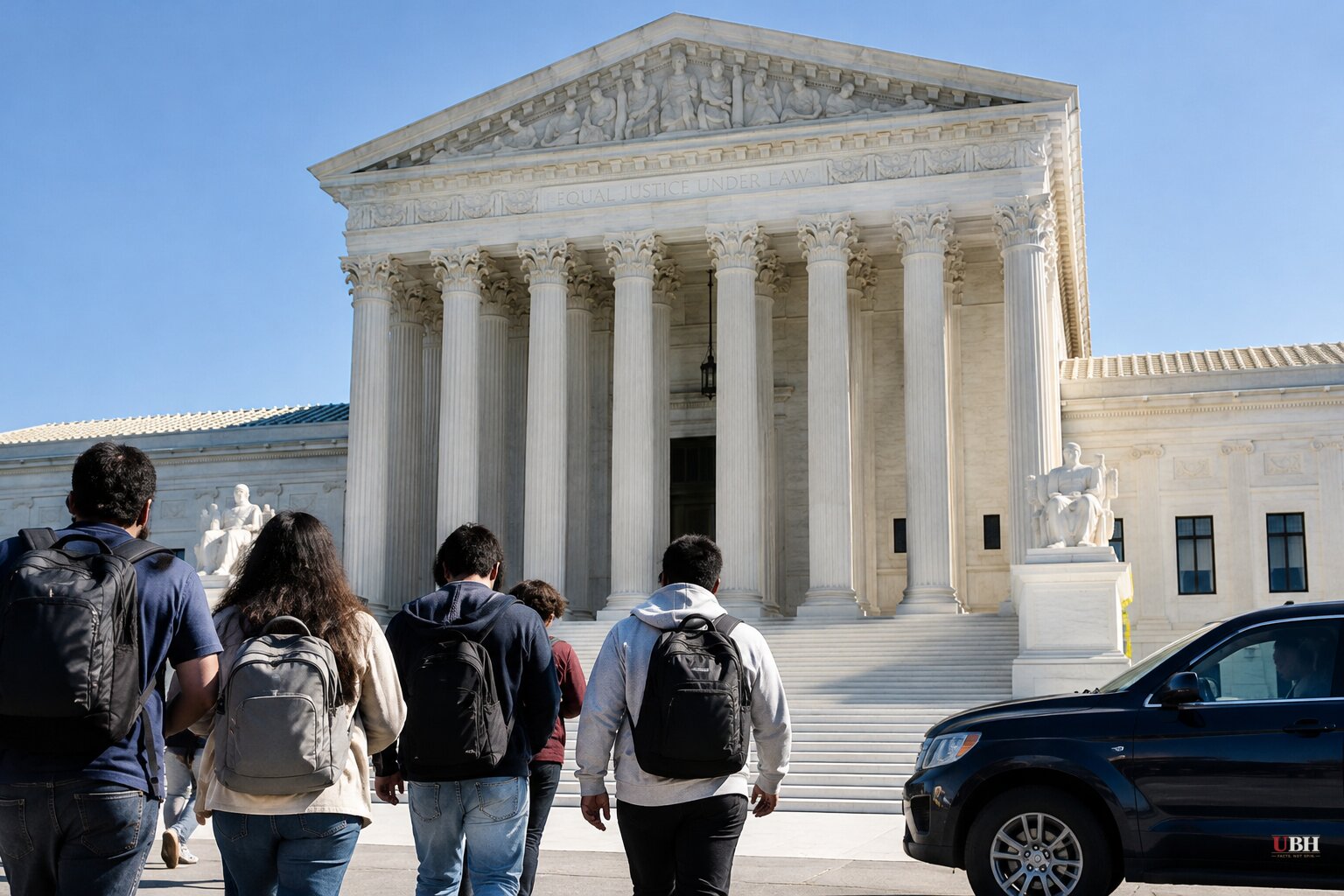
The Supreme Court on Tuesday allowed the Trump administration to keep deporting people to countries other than their own while the justices take up the policy's legality. The order halts an appeals court ruling for now. Arguments are scheduled for December.
Federal attorneys said the lower-court decision forced the cancellation of a deportation flight carrying about 70 people bound for three countries.
What the court is actually deciding
The case does not squarely challenge DHS's underlying authority to conduct third-country removals. It concerns the procedures the agency must follow first: whether migrants get a meaningful chance to object before being sent to countries where they have no ties, and whether those procedures comply with federal immigration law, due process and safeguards against torture.
The justices let the flights continue once before, when the case came before them last year. A federal judge later ruled the policy violates deportees' due process rights, and an appeals court upheld that ruling, which prompted the administration's request to the high court.
DHS General Counsel James Percival says the authority is already in the statute. The third-country provision was part of the Illegal Immigration Reform and Immigrant Responsibility Act, signed by President Bill Clinton in 1996. "It's in the statute expressly that we can do this," Percival told Fox News Digital.
The administration's case
The administration says it sends people with final deportation orders to third countries when they can't be returned to their homelands or their native countries won't accept them, including those who have criminal convictions.
Percival points to Kyaw Mya, a Myanmar citizen convicted of repeatedly raping a child over a six-year period that began when the victim was seven. An immigration judge ordered his deportation, but Myanmar refused to take him back. DHS shipped him to South Sudan in July of last year, according to the Daily Wire.
"Faced with a choice of releasing Mr. Mya or removing him to a third country, DHS chose to remove him to South Sudan," Percival wrote in an X post. "Before President Trump came along, aliens like Mr. Mya were released back into the community to victimize anew."
On the diplomacy, he was blunt with Fox News Digital: "Norway is not taking a rapist from Cuba."
A DHS spokesperson called third-country removals "an essential public safety tool" and described the First Circuit's decision as "as reckless as it is lawless."
Federal attorneys also said the receiving governments provide assurances that deportees will not be persecuted or tortured.
The objections
Attorneys for immigrants say the program reaches well beyond convicted predators. In their account, many deportees have no criminal convictions, and some have been found to be at risk of torture or persecution. Some migrants have found themselves imprisoned in countries they had never heard of before their arrivals. Others face serious safety risks and are left with little choice except to return to the home countries they were fleeing.
Human rights advocates have also pointed to allegations that deportees were beaten by authorities in Equatorial Guinea, whose government received $7.5 million from Washington as part of an agreement to accept third-country deportations. Those are allegations.
CBS News interviewed migrants from Honduras, Guatemala, Brazil, Colombia and Venezuela who were sent to Liberia. "Honestly, I had never heard of Liberia," one Colombian deportee said. A Honduran deportee said: "I'm concerned. I feel far away, on the other side of the world."
The scale and the price tag
Under a series of often-secret agreements, the administration has deported some 25,000 people to more than two dozen countries, including Liberia and Guyana. The vast majority have been sent to Mexico.
The money is substantial. Internal government records reviewed by The Washington Post show the administration had authorized or pledged at least $410 million for agreements with 31 countries, mostly in Africa and Latin America, as of the end of June. That includes $81 million in direct payments to 13 foreign governments. The administration also pledged grants totaling $179 million to the International Organization for Migration and $124 million to the U.N. Refugee Agency for projects in the third countries.
The deals are negotiated by the State Department's Office of Remigration, overseen by career diplomat Christian Ehrhardt, 41. He has traveled across Africa, including a mid-June trip to the Ivory Coast, Gambia, Guinea-Bissau, Togo and Gabon.
Current and former officials told the Post that White House deputy chief of staff Stephen Miller ordered the agreements and has pushed key State Department appointments that let him overrule other foreign policy objectives in pursuit of more deportations. Those accounts are largely anonymous.
The Post also reported that the deals were written through contracts designed to bypass statutory requirements, including human rights safeguards, that come with most foreign assistance spending, according to people familiar with the agreements.
What comes next
The stay keeps the flights moving, but it settles nothing on the merits. In December the justices will take up whether migrants must have a meaningful chance to object before being sent to countries where they have no ties. Whatever they decide will govern a program that has already moved some 25,000 people.
Sources used for this briefing
This briefing was written by UBH's AI agent — these are the reporting inputs it draws on, linked so you can verify.


