
Unbiased headlines. Facts, not spin.
Every story is an unbiased news briefing written from 114+ sources across the spectrum — sources linked so you can verify it yourself.
 politics
Major Story (8/10)
Event date: October 7, 2026
politics
Major Story (8/10)
Event date: October 7, 2026
ICE Investigators Ingested Nearly 100 Million Voter Records and Probed Registration Groups, Documents Show
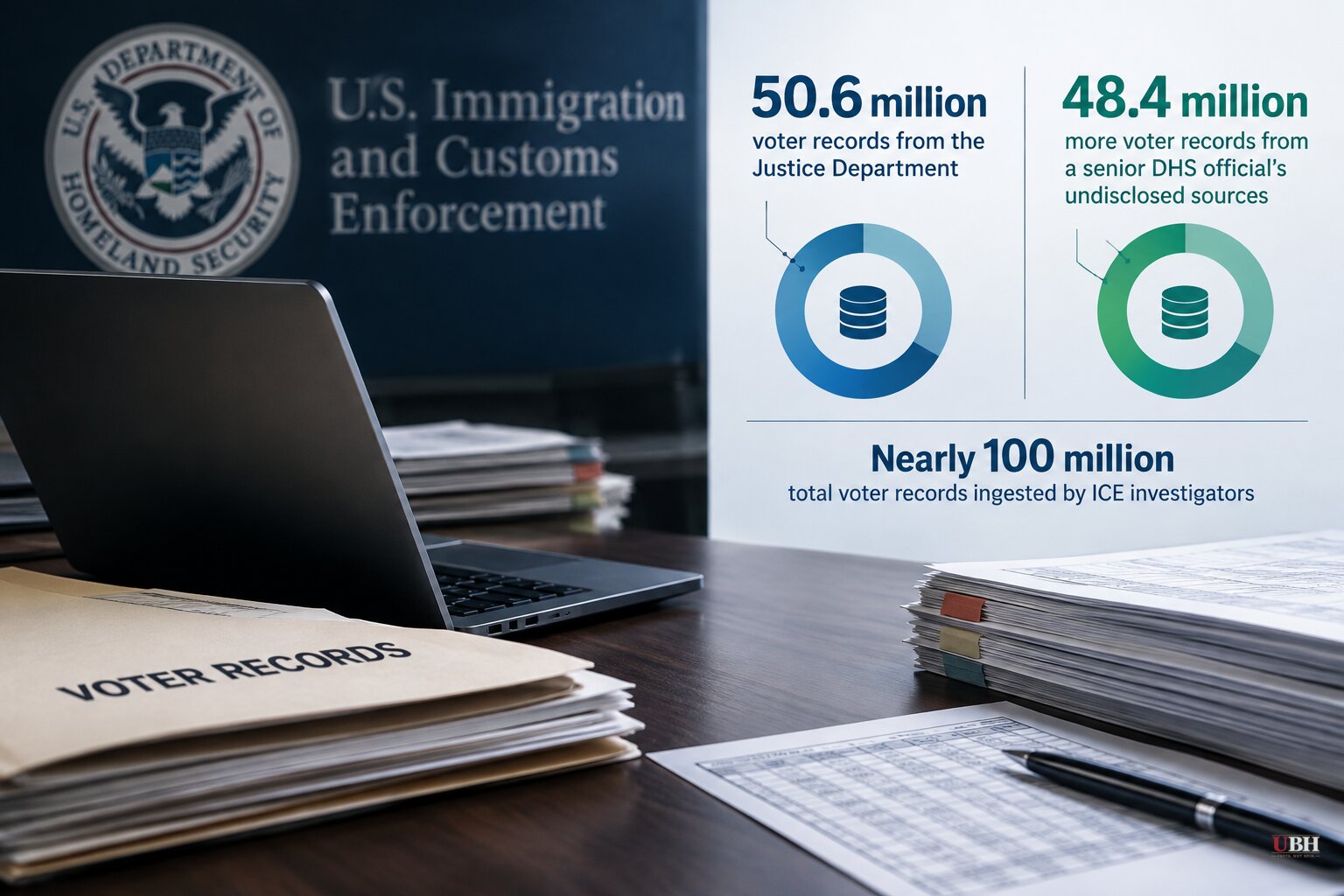
ICE's investigative arm has spent months building a national operation to find noncitizens on voter rolls. It has drawn on close to 100 million voter records, reviewed dozens of voter-registration nonprofits, and considered sending undercover agents to talk to some of them.
The details come from 166 pages of internal Homeland Security Investigations (HSI) records that the legal group Democracy Forward obtained through a Freedom of Information Act lawsuit and released Wednesday, Oct. 7.
The data
A June 1 HSI report says investigators had ingested 50.6 million records from a Justice Department dataset. They also ingested another 48.4 million records that Heather Honey had obtained through what the report calls "independent sources of information." Honey is a senior counselor to Homeland Security Secretary Markwayne Mullin.
The records do not say where Honey's data came from. CNN reported it may include public voter lists from California, New Jersey, Pennsylvania and Nevada that DHS bought and analyzed around that time. The Independent reported that Honey was an election activist who backed efforts to challenge the 2020 result before joining DHS, and that her sources are treated as a "strategic line of effort."
The Justice Department records may include unredacted voter lists that more than a dozen Republican-led states handed over voluntarily. DOJ has sued 30 other states to force them to share their rolls for audit.
HSI identified 10 priority states: Texas, Pennsylvania, California, New Jersey, Minnesota, Michigan, Arizona, Florida, Georgia and Ohio.
In July, Mullin announced that DHS had found roughly 250,000 noncitizens registered to vote in just California, New Jersey, Pennsylvania and Nevada. Officials in those states have repeatedly challenged that claim.
The nonprofits
The records show HSI looking beyond individual voters. Agents were tasked with trying to "dismantle illicit facilitation networks" accused of registering noncitizens, according to the documents. The Independent reported that undercover agents might be used to "disrupt" the groups' activities.
Wired counted more than 150 nonprofits examined. The documents point to heavy attention on Pennsylvania and New Jersey, and the Ohio, Minnesota and Washington, D.C., areas also drew scrutiny. In one review of more than 40 New Jersey nonprofits, investigators reported finding "no derogatory information."
A Hill commentary by Lindsey Granger, citing the records, says HSI opened 418 voter-fraud cases this year and that 318 of them had not been referred for prosecution.
The Palantir question
The most contested piece is whether voter data went into ELITE, a Palantir-built tool ICE uses to identify, prioritize and locate people targeted for immigration enforcement. It can generate maps of potential targets and show a "confidence score" on a person's current address.
A May 26 HSI email with "Voter Fraud" in the subject line said coordination with the agency's Innovation Lab (iLab) continued "particularly on ingesting processed voter roll data into the ELITE enforcement system." A July 7 weekly report said data from Connecticut, Georgia, Kentucky, Missouri, Michigan and New Mexico had been "enriched by the iLab and are pending Palantir entry into ELITE."
Whether that entry ever happened is disputed. A Palantir spokesman told Wired that "voter roll data has never been integrated into ELITE." A source familiar with the matter told Democracy Docket the data "was not and is not integrated." The records themselves do not say how many voter records, if any, went in.
Democracy Docket also noted that state voter files contain little information on citizenship status, so how they would help immigration enforcement is unclear.
Competing positions
Democracy Forward president Skye Perryman said the records "should concern all Americans." She called them "further evidence of an alarming attempt by the executive branch to undermine our elections," and added: "It appears the president and his allies want to pick their voters."
DHS rejects that framing. A department spokesperson said DHS "has been incredibly transparent about the acquisition and the analysis of publicly available voter files" by the Fraud Detection and National Security Directorate of USCIS. The spokesperson added that DHS and DOJ are "laser focused on prosecuting and removing aliens who vote and preventing the dilution of the votes of US citizens." The department also told The Independent it is "actively rooting out and investigating election fraud wherever it can be found."
The underlying law is not in dispute. Noncitizen voting is already illegal under federal law, and checking rolls against citizenship data is a mainstream integrity goal. Critics' objection is to the method and the targets.
On the scale of the problem, the Brennan Center found 30 suspected fraud cases among 23.5 million votes across 42 jurisdictions. Rep. James Clyburn (D-S.C.) said on MS NOW that there is "no voter fraud to any significant degree taking place in this country," citing roughly 100 votes over four decades in a Heritage Foundation database. Those are the critics' figures, and DHS argues its own analysis found far more.
What is still open
DHS has not said where Honey's 48.4 million records came from, or whether any voter data entered ELITE. It has also not said whether undercover agents were ever deployed against a voter-registration group.
No charges against any nonprofit have been announced. The records show the New Jersey review turning up nothing. The midterms are weeks away, and the Justice Department's lawsuits against 30 states over their voter rolls are still pending.
Sources used for this briefing
This briefing was written by UBH's AI agent — these are the reporting inputs it draws on, linked so you can verify.


