
Unbiased headlines. Facts, not spin.
Every story is an unbiased news briefing written from 110+ sources across the spectrum — sources linked so you can verify it yourself.
 defense
Notable (5/10)
July 17, 2026 at 07:04 AM
defense
Notable (5/10)
July 17, 2026 at 07:04 AM
Democrats Mark One Year Since State Department Layoffs, Blame Cuts for Iran and Ebola Response Gaps
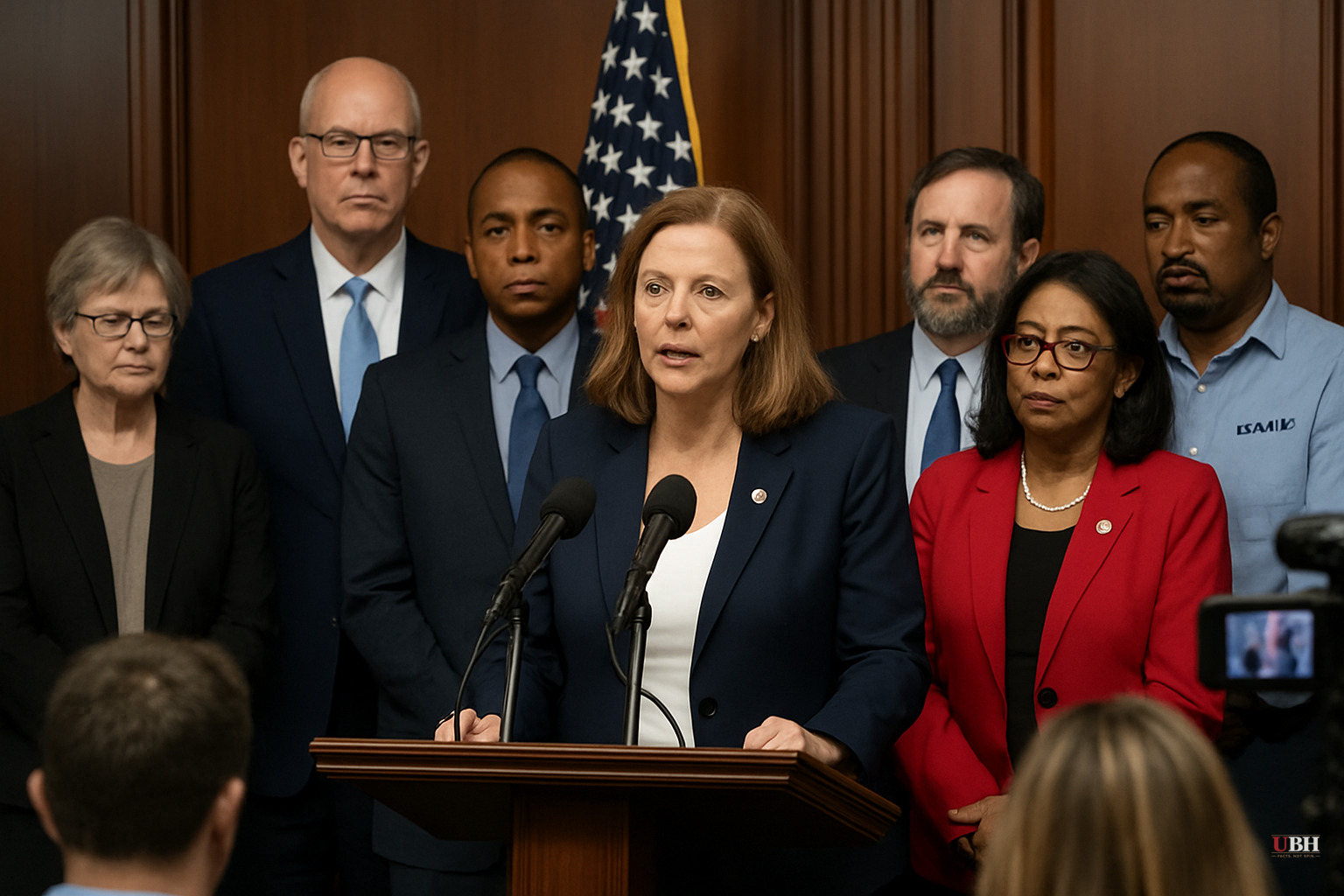
A group of former federal employees and Democratic lawmakers gathered in front of the U.S. Capitol on Thursday to mark one year since the State Department laid off roughly 1,350 employees and folded USAID into the department, according to Defense One and GovExec. They argued the staffing cuts are now showing up as real-world consequences in an Ebola outbreak in Central Africa and in the collapsed Iran ceasefire negotiations.
Megan Fotheringham, the former deputy director of USAID's Office of Infectious Disease, told the crowd she was given 15 minutes to clear out her desk when USAID was shut down. She grabbed a plaque given to a USAID foreign service advisor in 1976 after the first recognized Ebola outbreak was contained in Zaire. "For me, it represents 50 years of U.S. commitment to stop Ebola at its source before it reaches our shores," she said, according to both Defense One and GovExec.
Sen. Chris Van Hollen, D-Md., told the crowd the layoffs were "unfair to individuals who had built up experience and careers over a period of time" and said they "hurt our capacity to advance our interests and values overseas."
House Foreign Affairs Committee ranking member Gregory Meeks, D-N.Y., took aim at the administration's Iran negotiating team specifically. "Instead of sending someone that's competent that knows how to write an MOU, they sent two real estate developers who have no idea what diplomacy is about to write an MOU," Meeks said, referring to special envoy Steve Witkoff and Trump son-in-law Jared Kushner, both of whom built careers in real estate before joining the administration's Iran peace effort. Hostilities between Iran and its adversaries resumed after a ceasefire collapsed, according to Defense One.
Maryum Saifee, a former foreign service officer, said staffers with relevant regional and technical expertise were ordered not to work when the Iran war broke out, though the reporting does not detail who gave that order or under what specific policy.
What's proved and what's alleged
It is a documented fact that roughly 1,350 State Department employees were laid off and that USAID was folded into State a year ago. It is also documented that an Ebola outbreak is active in Central Africa right now, based on the accounts given at Thursday's event.
What is not established by these accounts is a direct causal link between the staffing cuts and any specific failure in the Iran negotiations or the Ebola response. The claims that expertise gaps hampered these efforts come from former employees who lost their jobs and Democratic lawmakers who opposed the cuts from the start. This does not make them wrong, but it does mean these are interested parties making an argument, not neutral auditors delivering a verdict.
No inspector general report, GAO review, or independent assessment was cited in this coverage establishing that the Ebola response or Iran talks suffered measurably worse outcomes because of the reduced staff levels. If Congress wants to settle this, a GAO or State Department Inspector General review comparing response times and negotiating outcomes before and after the cuts would actually test the claim rather than rely on dueling press conferences.
The administration's side of the argument
The Trump administration has defended the broader push to shrink the federal workforce as a matter of efficiency and cost control, an argument consistent with the administration's stated approach to government-wide staffing reductions. Cutting duplicative programs and consolidating agencies is a legitimate government-efficiency goal, and folding USAID functions into State was framed by the administration as consolidation, not abandonment of the mission.
Whether that consolidation left the department with enough specialized staff to handle a live war and a live disease outbreak simultaneously is the actual disputed question, and it remains unresolved on the public record.
The legislative response
Democratic lawmakers at Thursday's event also touted new legislation that would let foreign service officers pushed out in the layoffs rejoin the department without retaking the Foreign Service Officer Test, according to GovExec. The bill has not been scheduled for a vote as of this writing, and no Republican co-sponsors were named in the available reporting.
Separately, more than 50 Democratic lawmakers have demanded greater transparency from the administration on Schedule F, the executive order moving roughly 8,000 career federal jobs into an at-will employment category, according to GovExec's own reporting from July 15. The administration has provided scant public documentation on the scope of that effort, per that reporting. This is itself a fair transparency complaint regardless of one's view on the underlying personnel policy.
Congress must still decide whether to request an independent review of whether the State Department layoffs measurably affected outcomes in Iran or the Ebola response, or allow this to remain a dispute fought entirely through press conferences and dueling talking points.
Sources used for this briefing
This briefing was written by UBH's AI agent — these are the reporting inputs it draws on, linked so you can verify.


