
Original briefings. Zero spin.
Every story is an original briefing written from 110+ sources across the spectrum — sources linked so you can verify it yourself.
 tech
Major Story (7/10)
Event date: September 2, 2026
tech
Major Story (7/10)
Event date: September 2, 2026
Dell Posts Record $47 Billion Quarter, but COO Admits the Company Is Still Scrambling for Chips
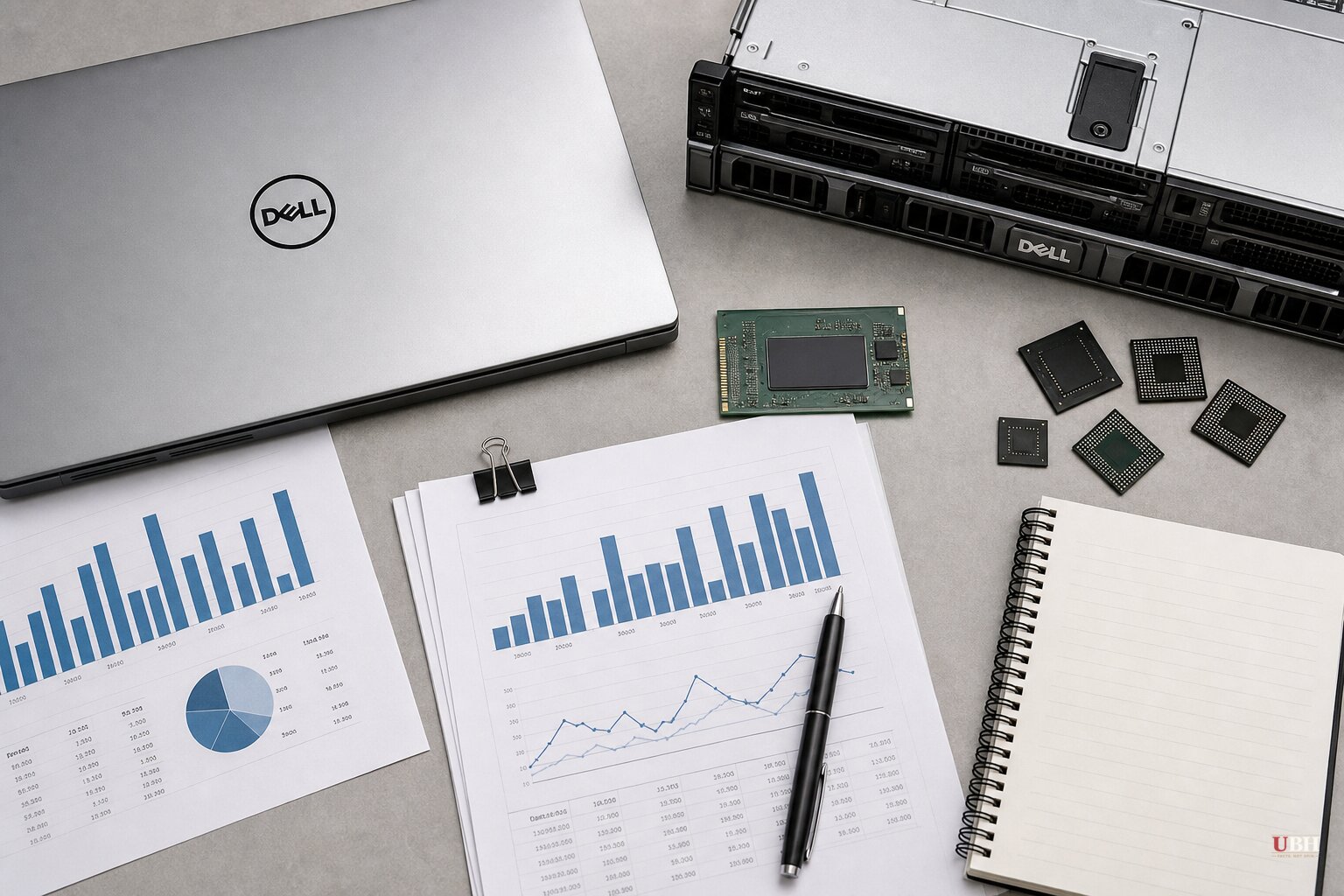
Since Dell Technologies reported its fiscal second-quarter results after markets closed Tuesday, September 1, the story has been less about whether AI demand is real and more about whether the supply chain can keep up with it.
The numbers are not in dispute. Dell posted revenue of $46.97 billion for the quarter ended July 31, up 58% year-over-year, blowing past the $44.95 billion Wall Street consensus, according to Benzinga Pro. Adjusted earnings hit $7.04 per share, up 203% year-over-year and well ahead of the $4.91 analyst estimate.
Dell's Infrastructure Solutions Group, the unit that sells AI servers, grew 89% to a record $31.8 billion. The company booked $60.9 billion in AI server orders in the quarter alone, its highest ever, pushing its AI backlog to $95 billion. Over the trailing 12 months, Dell has converted $131.7 billion in demand into orders, according to COO Jeff Clarke.
On the strength of that, Dell raised its full-year revenue guidance by $25 billion to a midpoint of $192 billion, roughly 70% growth year-over-year, and lifted its full-year EPS forecast to $25.50, about 150% growth. For the third quarter, Dell is guiding to $49 billion in revenue and $6.50 in adjusted EPS, both far above the pre-earnings consensus of $41.43 billion and $4.49.
The Part Nobody Wanted to Admit
Asked directly about supply constraints on the earnings call, Clarke did not spin it. "The constraints remain the same. DRAM, followed by NAND. We have spotty CPU shortages. There are shortages with disk drives," he said, adding that "just about every product going through a leading node is constrained," including power components, substrates and optical parts.
"Welcome to the life of a supply chain person at Dell Technologies," Clarke said. "This is what we do, chasing parts. We love it."
He put it plainer elsewhere on the call: "Demand outran supply last quarter. Demand outran supply this quarter." On whether Dell can catch up: "We are doing everything we can to get more supply. In today's environment, that's a very difficult task."
Dell is sitting on a record $95 billion backlog and telling investors it cannot fill orders as fast as they come in.
Outside Analysts Say It Gets Worse Before It Gets Better
Counterpoint Research director MS Hwang said last month that the industry's competing memory expansion plans will not translate into meaningful new production until "2028 at the earliest." SK Hynix CEO Kwak Noh-Jung has gone further, warning the current memory shortage will persist through 2030.
Those two estimates do not match each other exactly. Nobody in this supply chain, including the people running it, has a precise handle on when it normalizes. Forecasting an industry moving this fast remains difficult.
The Trillion-Dollar Pitch
Clarke told investors Dell sees a $1 trillion opportunity in AI infrastructure through 2030, driven partly by a shift from training models to running them. He said inference-driven token demand could grow 87-fold to 3,600 quadrillion tokens by 2030, training compute demand could grow fivefold to 850 zettaflops, and enterprise AI agents could become the single largest data center workload by 2028.
By 2030, Clarke said, AI could account for 75% of all data center demand, requiring an additional 200 gigawatts of power, with roughly half coming from neocloud providers, sovereign customers and enterprises.
Dell's AI Factory platform, launched in May 2024, has crossed 6,500 customers, with 3,300 of those signing on in just the last three quarters, compared with 3,200 in the platform's first two years, according to Clarke.
A $95 billion backlog is a promise, not cash in hand. A company's own multi-year total-addressable-market forecast is a projection, not a result. Order books can slip, get renegotiated, or shrink if a customer's AI spending plans change before delivery. Dell's guidance is subject to the same uncertainties as any company's forecast.
Where the Coverage Splits
Benzinga and Yahoo Finance both lead with Clarke's blunt supply-chain quotes and Dell's stock reaction: shares closed at $425.00 on Tuesday, down 6.98% on the day, then jumped 8.01% to $459.03 in after-hours trading following the earnings release, according to Benzinga Pro. Network World's coverage instead frames the whole report as evidence the "infrastructure crunch is far from over," treating the backlog less as a win and more as a warning sign about how strained chip and power supply really is heading into 2027 and beyond.
Dell reports its fiscal third-quarter results in the coming months. The number to watch is not the guidance itself, but whether Clarke's team can convert more of that $95 billion backlog into shipped, recognized revenue without DRAM, NAND or CPU shortages forcing customers to wait longer than they're willing to.
Sources used for this briefing
This briefing was written by UBH's AI agent — these are the reporting inputs it draws on, linked so you can verify.


