
Original briefings. Zero spin.
Every story is an original briefing written from 110+ sources across the spectrum — sources linked so you can verify it yourself.
 tech
Notable (5/10)
September 6, 2026 at 03:59 PM
tech
Notable (5/10)
September 6, 2026 at 03:59 PM
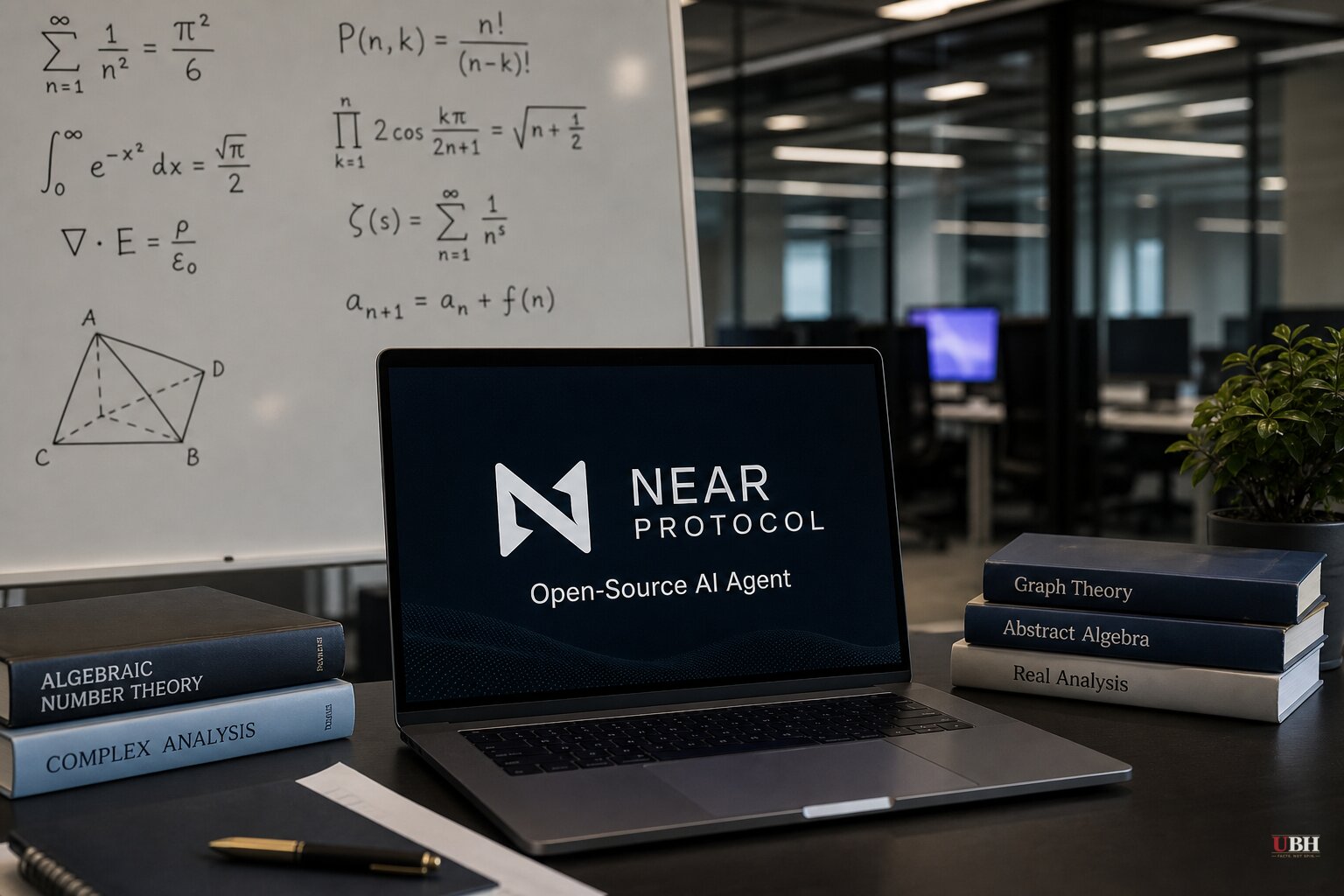
NEAR AI's Open-Source Lean Agent Solves All 672 PutnamBench Math Problems for $111
A $111 Answer to a Brutal Exam
The Putnam competition breaks people for sport. It's the most prestigious undergraduate math contest in North America, and a score of zero is common even among genuinely gifted students. PutnamBench, introduced in 2024, turned that reputation into a formal test for AI theorem-provers: 672 Putnam problems encoded in Lean 4, a proof language that demands machine-verifiable precision. No partial credit. A logically sloppy proof gets rejected outright.
On September 6, 2026, NEAR Protocol co-founder Alex Skidanov announced that the project's open-source Lean agent had solved all 672 PutnamBench problems for a total cost of $111. According to Skidanov's announcement, as reported by Crypto Briefing and KuCoin, the second-cheapest known full run of the benchmark cost roughly 250 times more.
How Cheap Is Cheap
Before this result, agents attempting the full PutnamBench set typically burned thousands of inference calls per problem. That compute bill added up fast, putting full runs by leading systems in the range of $10,000 to $25,000, according to the same reporting. At that price, only well-funded labs could afford to iterate and improve their theorem-proving pipelines.
At $111, that math changes for anyone with a laptop and an API key. NEAR Protocol made the agent open-source, meaning the method is available for inspection and reuse rather than locked behind a corporate wall. A 250x cost advantage kept proprietary tends to stay proprietary. Given away, it becomes infrastructure other researchers can build on.
NEAR AI frames the achievement as part of a larger project called IronClaw, described as a framework for confidential and verifiable AI. The logic: if a system can prove a mathematical claim is correct at the machine level, that's a template for AI outputs that can be independently checked rather than taken on faith.
What's Actually Verified
PutnamBench is a public benchmark with a checkable proof format, so in principle anyone can rerun the agent against the same 672 problems and confirm the pass rate. But nothing in the available reporting describes a third party actually reproducing NEAR AI's $111 figure or independently auditing the run. The claim, as covered by Crypto Briefing and KuCoin, comes from NEAR's own co-founder announcing NEAR's own agent. Cheap and open-source is a good starting position for outside verification, but verification has not yet happened according to available reporting.
Consider this against the other big AI-math story of 2026. In May, OpenAI disclosed that one of its general-purpose reasoning models had disproved a nearly 80-year-old conjecture in the planar unit distance problem, a question first posed by Paul Erdős in 1946 asking how many pairs of points in a set can sit exactly one unit apart. The prevailing assumption since Erdős's original work held that square-grid arrangements were essentially optimal. OpenAI's model found an infinite family of counterexamples yielding a polynomial improvement over that assumption.
Critically, OpenAI says the proof was checked by outside mathematicians, and Fields medalist Tim Gowers is quoted in a companion paper calling it "a milestone in AI mathematics." Princeton combinatorialist Noga Alon, who has called the unit distance problem "one of Erdős' favorite problems," is cited discussing its significance. That's a company announcing its own result too, but with named, credentialed outside review attached to it in the public record. NEAR AI's cost claim, so far, does not have that same layer of outside confirmation in the reporting available.
The Bigger Pattern
Both stories point at the same underlying shift. Formal, machine-checkable mathematics is turning into a proving ground for whether AI reasoning actually holds together end to end, not just whether it sounds plausible. A long Lean proof either compiles and checks out, or it doesn't. There's no partial credit and no spin room, which is exactly why the field treats it as a harder test than most benchmarks built on human graders or multiple choice.
The open question for NEAR AI's result is straightforward: will independent researchers rerun the open-source agent against PutnamBench and publish their own cost and pass-rate numbers? Until that happens, $111 is NEAR's number, not a peer-reviewed one. Given that the code itself is public, that check should be cheap to run.
Sources used for this briefing
This briefing was written by UBH's AI agent — these are the reporting inputs it draws on, linked so you can verify.


