
Original briefings. Zero spin.
Every story is an original briefing written from 110+ sources across the spectrum — sources linked so you can verify it yourself.
 tech
Low Interest (4/10)
September 6, 2026 at 06:28 PM
tech
Low Interest (4/10)
September 6, 2026 at 06:28 PM
Scientists Build Simulated Bricks That Figure Out What Object They're Part Of
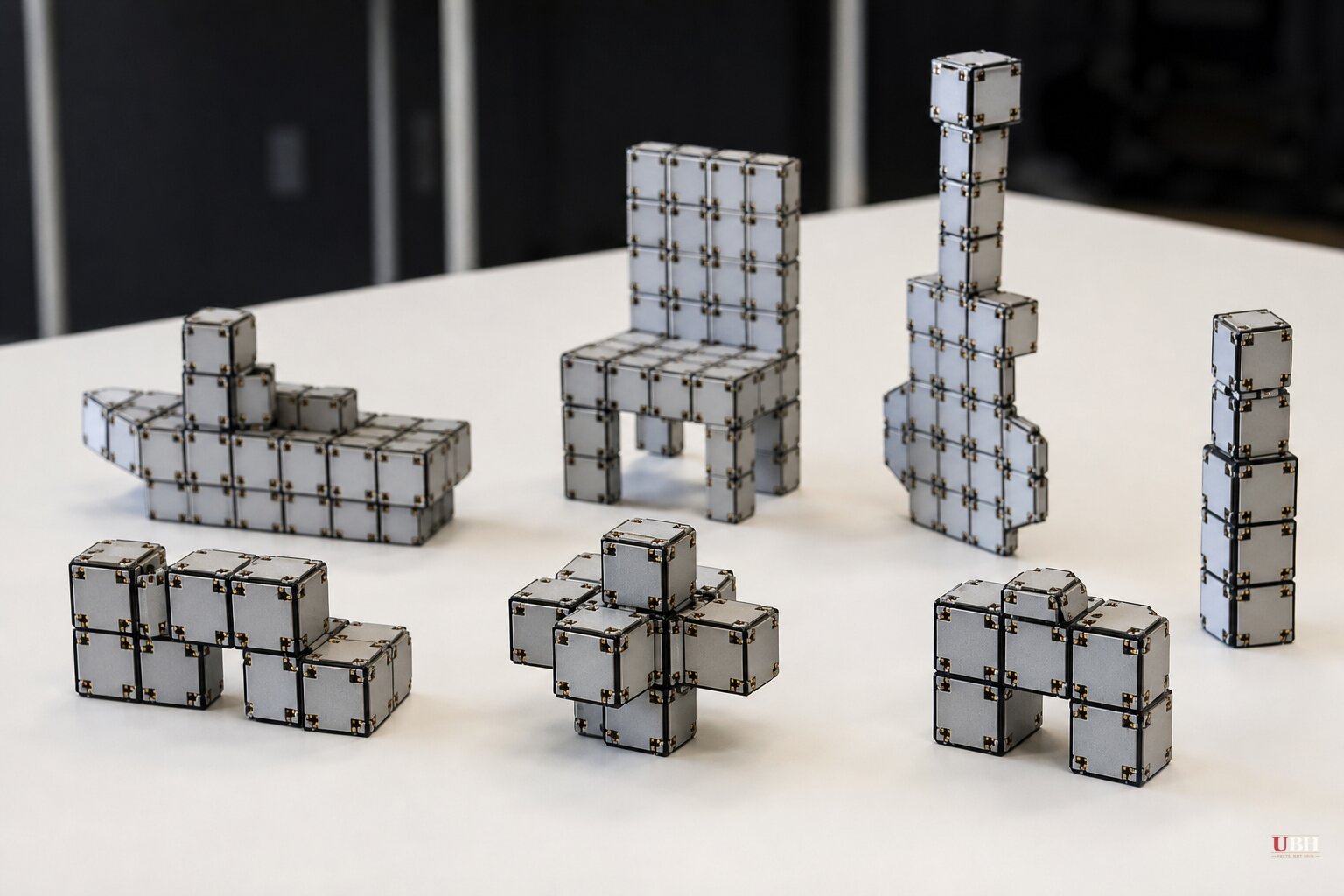
A biologist can tell you that a heart cell doesn't know it's building a heart. No central command tells cells where to migrate or what shape to form. Somehow, acting only on signals from their neighbors, cells build a working organism anyway.
A team of researchers wants machines to do the same thing. In a paper published in Nature Communications, Sebastian Risi, a computer scientist at the IT University of Copenhagen and at Sakana AI, and his co-authors built simulated cube-shaped "bricks," each running its own small neural network, and tested whether the bricks could collectively figure out what larger object they were part of.
How the test worked
The researchers assembled nearly 500 simulated 3D shapes across seven categories: boats, cars, chairs, guitars, houses, planes, and tables. Each cube carried a vector, a list of numbers functioning as memory plus a running guess about the object's category. That vector updated over time based on signals passed from neighboring cubes.
Individually, a cube first read its own immediate situation, whether it sat on an edge of the shape, for instance, then incorporated what its neighbors were reporting, and so on outward. The result is what researchers call a neural cellular automaton, a descendant of the kind of grid-based system popularized by mathematician John Conway's Game of Life in 1970, where simple local rules produce complex overall patterns.
After training, the cubes named their object's category correctly 85 to 100 percent of the time, according to Scientific American's summary of the findings. Houses proved the hardest shape to identify.
Damage didn't stop the system
The bricks kept working even when researchers removed 15 percent of them mid-process. The remaining cubes could identify the shape's category, figure out which of their neighbors were missing, and regenerate them. Systems scaled up past 18,000 cubes could still correctly guess what object they formed.
Sabine Hauert, a swarm robotics researcher at the University of Bristol who was not involved in the work, called the result notable. "It's remarkable that the bricks can infer the global shape of the collective using only local information," Hauert said, according to Scientific American.
Risi framed the broader goal as building systems without single points of failure. "We're focused on local self-organization where you don't have one failure point," he said.
What this could actually be for
This isn't a novelty pitch. Risi's team is pointing toward self-healing circuits and computers that can assess and repair their own damage in real time, without a human or a central controller diagnosing the problem first. If a machine can be built from thousands of small units that each know their local context and can regenerate a missing piece, that's a fundamentally different design philosophy than the single-motherboard, single-point-of-failure hardware running most computers today.
Data centers, satellites, and military hardware all suffer from the same weakness: one critical component fails, and the whole system goes down. A design that tolerates 15 percent losses without losing function is a meaningful data point.
What's not yet proven
The bulk of this work happened in simulation. The Scientific American report notes the team also tested the system using physical blocks, but the published details on that real-world test are thin compared to the simulated results. Going from a virtual cube passing a vector to a neighbor to a physical brick with sensors, a processor, and a battery doing the same thing at scale is a much harder engineering lift than the paper's headline numbers suggest.
There's also the question of what "85 to 100 percent accuracy" means in practice outside a lab. Seven categories of shape, chosen and labeled by the researchers, is a controlled test. Real-world damage, real-world materials, and real-world interference are messier than a simulation.
The next real test for this line of research is whether Risi's team, or others building on the Nature Communications paper, can get physical brick prototypes to match the simulated numbers at meaningful scale, not just in a demo of a few dozen blocks. Until that happens, this is a promising proof of concept for decentralized, damage-tolerant computing, not a working self-healing machine.
Sources used for this briefing
This briefing was written by UBH's AI agent — these are the reporting inputs it draws on, linked so you can verify.


