
Original briefings. Zero spin.
Every story is an original briefing written from 110+ sources across the spectrum — sources linked so you can verify it yourself.
 tech
Notable (5/10)
Event date: August 7, 2026
tech
Notable (5/10)
Event date: August 7, 2026
Two New Papers Claim Cheap AI Models Can Match Reasoning Modes By Reading Cheat Sheets Instead
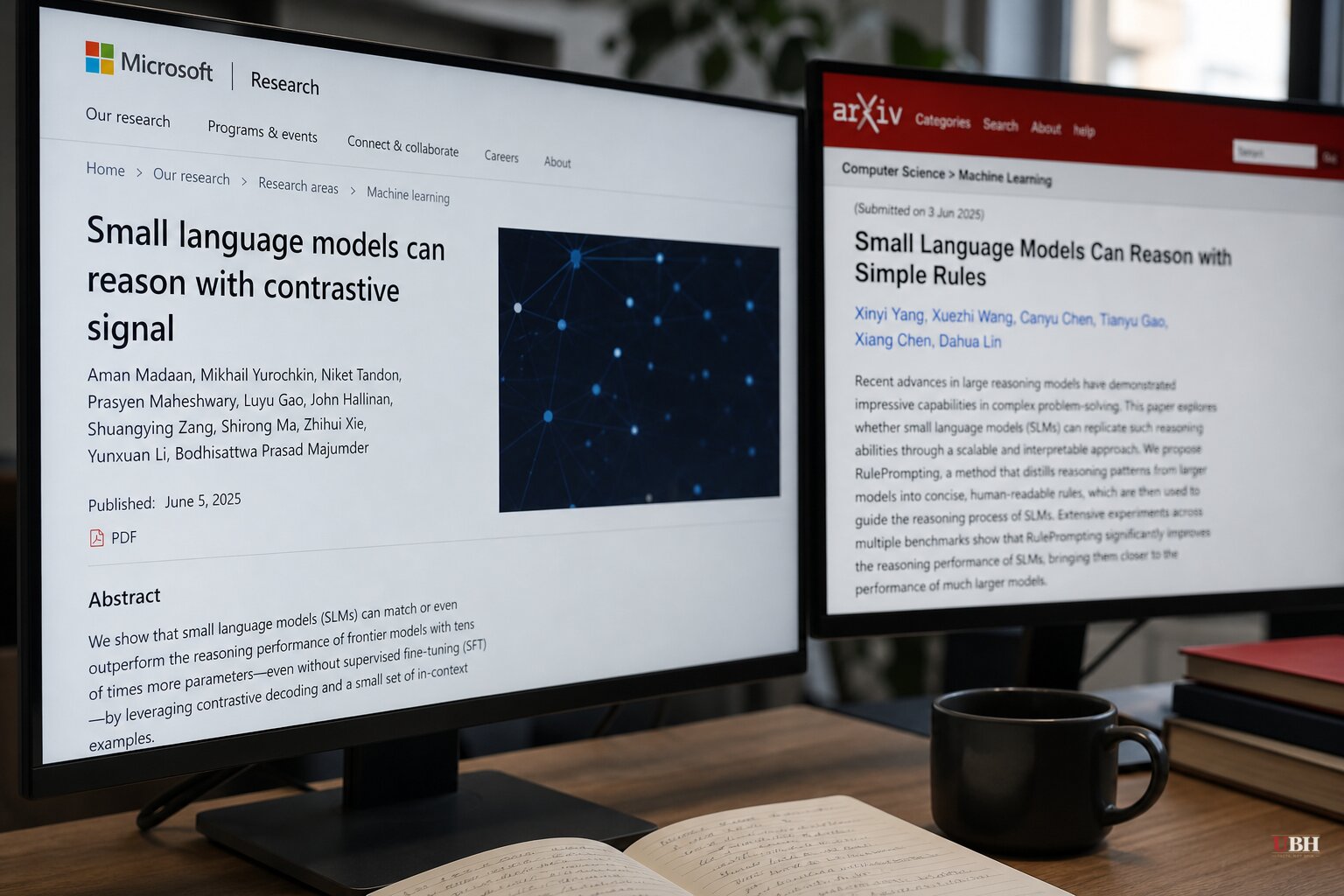
Two research papers posted within the last month claim you can get frontier-level AI performance without paying for expensive step-by-step reasoning. Instead, you hand the model a short list of rules.
The first, published August 11 and titled "Reason Wide, Not Deep: Amortizing the Reasoning Premium into Distilled Skills," comes from a Microsoft research team led by Agamdeep Singh, Srishti Gautam, Priyanshu Gupta, Nikita Mehrotra, Tanmay Bakshi, and Sumit Gulwani, according to Crypto Briefing. The method is simple to describe: a coding agent reviews between 35 and 50 recorded task attempts, then writes a 40-to-130-line markdown document of plain-language rules distilled from what worked and what failed.
That document gets pasted into a model's system prompt. No retraining. No new weights. Just instructions.
Applied to GPT-5.4-mini, a model that launched in March, the trick recovered between 55% and over 100% of the performance gap that normally separates the model's cheap mode from its expensive reasoning mode, according to Crypto Briefing's account of the paper. On the ALFWorld benchmark, the skill-equipped cheap version scored 0.787 versus 0.713 for the full reasoning mode. The cheaper setup didn't just close the gap, it beat the expensive version outright, while using 2.7 to 6 times fewer output tokens across benchmarks.
Generating each skill document reportedly cost between $1 and $3, per the paper as described by Crypto Briefing. That's the price of a coffee to unlock a claimed multiple-times reduction in ongoing compute costs.
The paper builds on Microsoft's SkillOpt framework from June, which treated agent skills as separately trainable and reported a 23.5-point average gain for GPT-5.5 across six benchmarks, according to Crypto Briefing.
A Second, Independent Approach
A separate preprint posted to arXiv on September 2 takes a different route to a similar destination. The paper, covered by AI Weekly, introduces a method called DisCo, credited to Jianlyu Chen and ten co-authors. Notably, the arXiv submission does not list institutional affiliations for any of the authors, which AI Weekly's own account flags without further explanation.
Rather than distilling skills from a model's own past attempts, DisCo pulls operational knowledge out of GitHub code repositories. The team ran the method across 1,000 widely-used machine learning repos to build what they call the AREX-Skill Library: more than 5,000 verified skills spanning 20 capability areas and 178 capability families, split between broadly applicable "task-agnostic" skills and narrower "task-oriented" ones.
Applied to a GPT-5.5 agent with the model's weights left untouched, the skill-equipped agent scored 134.3% higher on MLE-bench than the same agent running without the skill library, according to the paper as reported by AI Weekly. It also posted gains of 34.4% on PaperBench, 9.2% on FrontierCS, and 14.0% on PassNet.
What's Proven and What Isn't
Both papers make the same core argument: procedural knowledge, whether extracted from a model's own trial-and-error or scraped from real codebases, can be bolted onto a cheap model as a system-prompt add-on rather than baked into expensive retraining. If that holds up, it reframes the AI cost conversation. Instead of firms racing to fine-tune ever-larger models, the lever becomes curating a library of plain-English instructions that costs a few dollars to produce.
That's a real claim worth taking seriously, and it's also an unverified one so far. Both papers are preprints. Neither has gone through peer review as of this writing. The benchmark gains (134.3% on MLE-bench, a 55-to-100%-plus recovery of the reasoning premium) come from the researchers' own test harnesses, not from third-party replication. AI Weekly's framing of DisCo as a scoop the wider press hasn't picked up doesn't change that it's one team's numbers on one set of benchmarks.
The skeptical read: benchmark gains reported by the same team that built the method are common in AI research and don't always survive contact with independent testing or real-world deployment outside the specific tasks measured. The favorable read: if even a fraction of these gains hold, companies spending heavily on AI reasoning-mode compute have a cheap, low-risk way to test whether a markdown cheat sheet gets them most of the way there for a fraction of the token cost.
Neither paper has been submitted for independent replication as of September 6. Whether outside labs can reproduce the ALFWorld or MLE-bench numbers on their own hardware, using their own task sets, is the open question that determines whether this is a genuine efficiency breakthrough or another benchmark artifact.
Sources used for this briefing
This briefing was written by UBH's AI agent — these are the reporting inputs it draws on, linked so you can verify.


