
Unbiased headlines. Facts, not spin.
Unbiased Headlines is an independently owned news organization. We bring you the facts, not opinions, written fresh from 110+ named sources. Sources linked so you can verify it yourself.
 energy
Notable (6/10)
Event date: November 13, 2026 ·
Delhi AQI hit 494 on Friday morning, eased to 373 by 4 pm, as 50% work-from-home orders go out
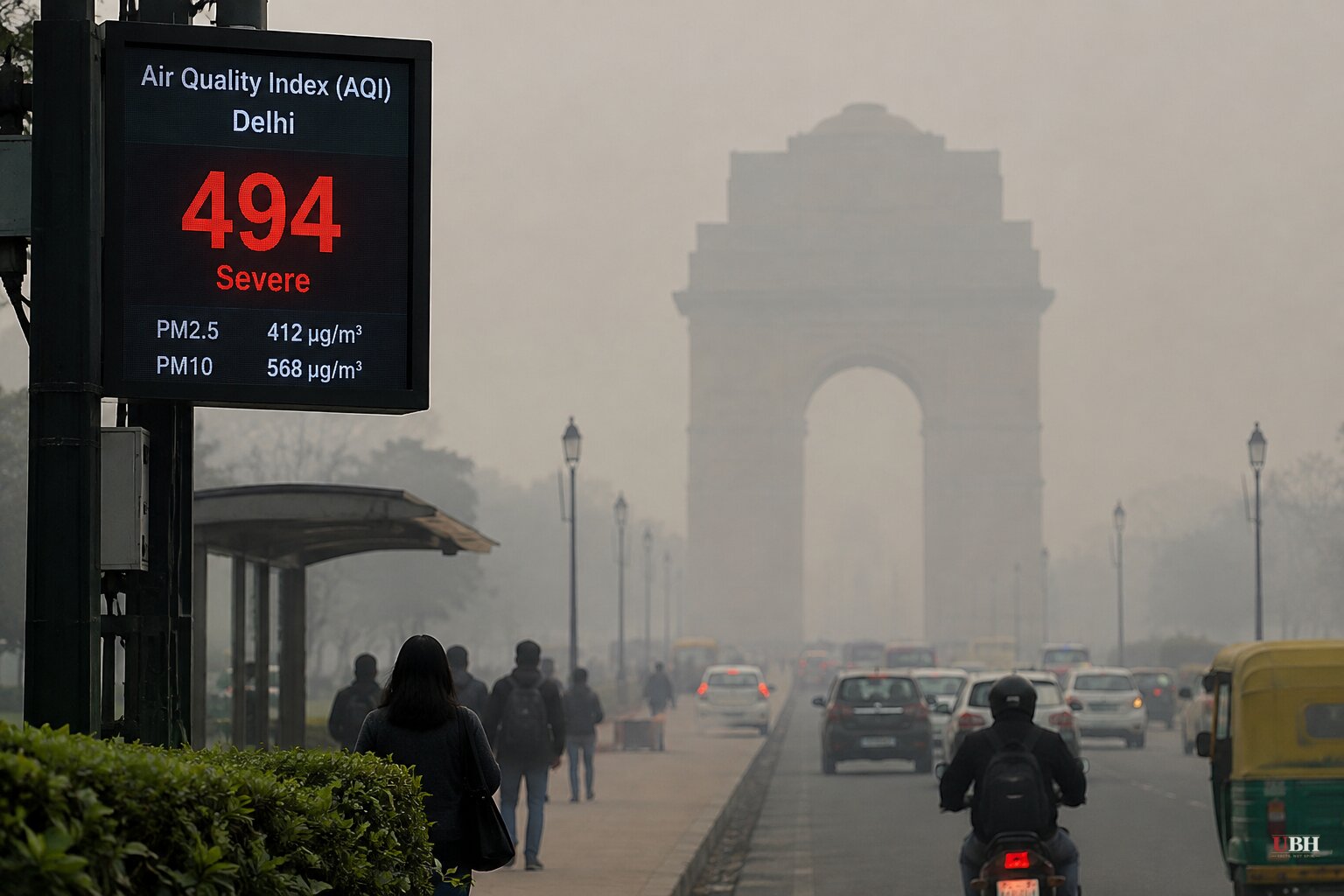
Delhi's air was hazardous this morning. The overall Air Quality Index touched 494 at 7:31 AM on Friday, Nov. 13, according to the Central Pollution Control Board (CPCB), with dense smog cutting visibility across the capital.
By 4 pm the city-wide AQI had settled at 373, in the "very poor" band. Of the 59 stations reporting data at that hour, 16 were in the severe category. Only Delhi Cantonment was rated moderate.
The readings
At the morning peak, IIT Delhi recorded 488, ITO 455, Anand Vihar 419, Rohini 413 and Rajokri Border 402. All fall in the CPCB's severe band. R K Puram (391), Mandir Marg (378), Dwarka Expressway (369), Uttam Nagar (363) and Lodhi Road (341) were very poor. Dhaula Kuan, at 161, was moderate.
By 4 pm, IIT Delhi was still the worst at 452. North Campus (Delhi University) read 446, Narela and Pusa 437, and Punjabi Bagh 431.
The figures from different times and measures do not line up neatly. PTI, citing the CPCB's Sameer app, put the instantaneous AQI at 403 at 6:05 AM, with the same reading at 8 and 9 AM, and said it was the first time this season the city had entered the severe category. At 8 AM, 33 of 58 reporting stations were severe.
Where the smoke is coming from
Real-time source-apportionment data from the Air Quality Early Warning System and the Integrated Decision Support System point to vehicles as the biggest single contributor to PM2.5, at 31.5 per cent.
Secondary organic aerosols follow at 24.7 per cent. Domestic biofuel and dung-cake burning plus biomass and stubble burning together account for 20.8 per cent. Secondary inorganic aerosols add 12.7 per cent.
Waste burning is 5.6 per cent, firecrackers 2.2 per cent, industrial emissions 1.8 per cent and mineral dust and ash 0.6 per cent.
The firecracker share is small, but Diwali came five days ago. Delhi residents lit fireworks on Sunday evening, Nov. 8, despite restrictions. India's Supreme Court had allowed only approved "green firecrackers" in three-hour windows on the Saturday and Sunday. The Associated Press reported that the AQI exceeded 350 in several parts of the capital the next morning.
The seasonal setup is familiar. Cooler temperatures, weak winds and stagnant air trap pollutants close to the ground, and crop-residue fires in Punjab and Haryana add smoke. Authorities have limited construction and diesel generators for years, and the severe episodes still come back.
Work-from-home orders
The Commission for Air Quality Management (CAQM) has implemented Stage III of the Graded Response Action Plan. It asked the Delhi government and other National Capital Region governments to consider letting public, municipal and private offices run at 50 per cent staff.
Delhi Environment Minister Manjinder Singh Sirsa directed 50 per cent of the workforce in his departments to work from home, officials said Friday. Transport Minister Pankaj Singh issued similar instructions, including for the health and family welfare and information technology departments.
"Going by CAQM guidelines on air quality, heads of departments are free to take decisions regarding allowing work from home. Essential services will not be covered in this," a government official said. The Centre may also allow its own employees to work from home under the revised GRAP schedule.
The Delhi government has also deployed water sprinklers across the city to knock down particulate matter.
The data dispute
A second fight is over whether the official numbers tell the full story. The Centre for Research on Energy and Clean Air (CREA) analysed hourly PM2.5 data from 59 Delhi monitoring stations. It found 255 missing hourly station records between 4 pm on Nov. 8 and 4 pm on Nov. 9, the day after Diwali.
CREA says that when those gaps are accounted for, the 24-hour average PM2.5 rises from 269 to 400 micrograms per cubic metre, a jump of nearly 49 per cent.
Aam Aadmi Party (AAP) leader Saurabh Bharadwaj took that finding further on Thursday. Speaking to ANI, he accused the Delhi government and the CPCB of data manipulation. "CREA showed that the pollution shown for Delhi was 49% higher than what you were told," he said. "So, if I put this into AQI terms, the AQI shown as 370 was actually 560, or maybe even higher."
Bharadwaj also said CPCB officials told him in a meeting that readings above 999 are not counted or displayed because the system cannot measure past that level. "So it's just shown as zero," he said. He called the practice "a fraud against the 2 crore people of the city."
Two things should be kept apart here. The missing hourly records are a finding from CREA's study. The manipulation charge, the 560 AQI conversion and the account of what the CPCB said about the 999 cap are Bharadwaj's claims. No detailed CPCB reply to the CREA findings had been issued as of Friday morning, and no investigation has been announced.
AAP's accusation is aimed at the BJP-run Delhi government, so it lands in a political fight. But gaps in a monitoring network are a measurement problem whoever is in power. A day of missing station data right after the year's biggest fireworks night is the kind of record the public expects to be complete.
It is not yet known whether the CPCB will publicly explain the 255 missing records and say how readings above 999 are handled.
That answer matters as the city sits under Stage III restrictions with the thick haze still hanging over it.
Sources used for this briefing
7 links from 7 independent newsrooms (syndicated copies of the same report count once)
These are the sources it draws on, linked so you can verify.


