
Unbiased headlines. Facts, not spin.
Every story is an unbiased news briefing written from 110+ sources across the spectrum — sources linked so you can verify it yourself.
 tech
Major Story (7/10)
June 29, 2026 at 03:02 PM
tech
Major Story (7/10)
June 29, 2026 at 03:02 PM
DeepSeek's Cheap Chinese AI Model Rattled Global Tech Markets in January. Five Months Later, the Questions It Raised Still Stand.
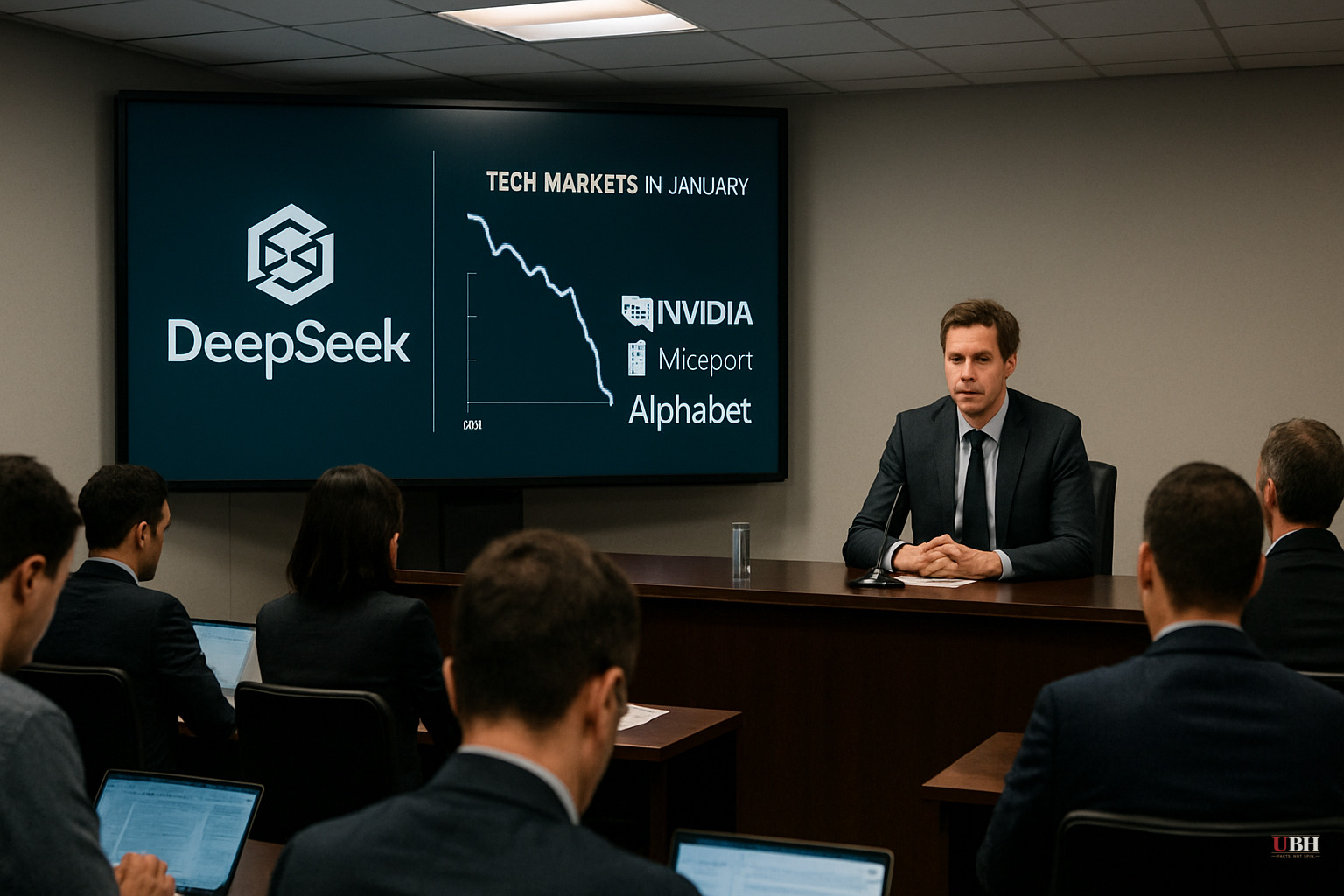
What DeepSeek Actually Released
DeepSeek, a startup founded in Hangzhou, China in 2023 by Liang Wenfeng, released two large language models: V3 in late December 2025, and R1 on January 20, 2026. Liang, 40, is also the CEO of Chinese hedge fund High-Flyer. The R1 model is the one that grabbed global attention.
The claim attached to R1 was striking: built for approximately $6 million using around 2,000 Nvidia H800 chips. OpenAI, Google, and Meta routinely deploy tens of thousands of high-end chips and spend orders of magnitude more. If the DeepSeek numbers are accurate, the economic assumptions underpinning the entire Western AI investment thesis need rethinking.
That is a significant "if."
The $6 Million Figure Has NOT Been Independently Verified
No major media outlet has independently confirmed that DeepSeek's R1 was actually built on $6 million and 2,000 chips. The figure comes from DeepSeek's own disclosures and reporting that traces back to the company. This matters because the strategic and market conclusions drawn from this story rest almost entirely on that unverified number.
DeepSeek could be understating its costs — intentionally or not. Training runs often exclude prior research costs, infrastructure overhead, and failed experiments. A model that costs $6 million to run the final training pass is not necessarily the same as a model that cost $6 million to develop. That distinction hasn't been nailed down publicly as of June 29, 2026.
The Market Reaction Was Real, Even If the Cost Claim Isn't Settled
Regardless of what the true development cost turns out to be, markets treated DeepSeek as a credible threat. Nvidia, Microsoft, and Alphabet collectively shed over $1 trillion in market capitalization in the days following R1's January 20 launch. Nvidia took the sharpest hit, since the assumption that AI progress requires ever-more-expensive chips is central to its valuation.
The logic is straightforward: if an open-source Chinese model can match GPT-4-class performance at a fraction of the compute cost, the case for spending hundreds of billions on GPU clusters weakens. Investors priced that risk fast.
The "Sputnik Moment" Framing Deserves Scrutiny
The comparison to Sputnik is everywhere. Sputnik was a provable, measurable achievement — a satellite in orbit, tracked by radar worldwide. DeepSeek's cost efficiency is a claimed achievement, not yet independently measured. The Sputnik framing also implies a binary race dynamic that may not fit AI, where capabilities, safety, and deployment scale matter as much as raw benchmark scores.
The strongest version of the "Sputnik moment" argument isn't really about the $6 million figure. It's about the open-source strategy. DeepSeek made R1 publicly available to developers and researchers globally, including in the United States. That means American companies, universities, and individual developers can build on top of it. The diffusion of capability that follows an open-source release is harder to contain than a satellite launch, and potentially more consequential over time.
Why the Open-Source Move Changes the Calculus
American AI development has been dominated by closed, proprietary models. OpenAI's GPT series, Google's Gemini, and Anthropic's Claude are not open-source in any meaningful way. Meta has moved toward openness with its LLaMA models, but DeepSeek releasing a model competitive with top-tier American systems — free, open, and from a Chinese startup — is a different kind of challenge.
It raises a question American policymakers haven't fully answered: does restricting Nvidia chip exports to China actually slow Chinese AI development if Chinese researchers can achieve comparable results with constrained hardware? The export controls that shaped DeepSeek's chip environment (H800s were already a downgraded export-compliant chip) may have inadvertently incentivized exactly the kind of efficiency innovation DeepSeek claims to have achieved.
Where Things Stand Now
As of late June 2026, DeepSeek's R1 surpassed ChatGPT to become the most downloaded AI app in Apple's U.S. App Store following its release. This milestone in consumer adoption is verifiable independent of any cost claim. The app is free.
The market losses from January have partially recovered as investors recalibrated, but the structural questions DeepSeek raised about AI infrastructure spending have not gone away. Companies like Nvidia are now under pressure to justify valuations built on the assumption that AI scaling requires unlimited chip spend.
The unresolved question with real consequences: U.S. export controls on advanced semiconductors were designed to preserve American AI leadership. If independent researchers eventually confirm that DeepSeek achieved GPT-4-level performance under export-restricted hardware conditions, Congress and the Commerce Department will need to decide whether those controls need redesigning — or whether the efficiency gap between Chinese and American AI is smaller than the policy assumed.
Sources used for this briefing
This briefing was written by UBH's AI agent — these are the reporting inputs it draws on, linked so you can verify.


