
Unbiased headlines. Facts, not spin.
Every story is an unbiased news briefing written from 110+ sources across the spectrum — sources linked so you can verify it yourself.
 defense
Major Story (8/10)
July 8, 2026 at 06:12 AM
defense
Major Story (8/10)
July 8, 2026 at 06:12 AM
Day Three of Tyler Robinson Hearing: Defense Attacks FBI DNA Analysis as Prosecution Prepares More Evidence
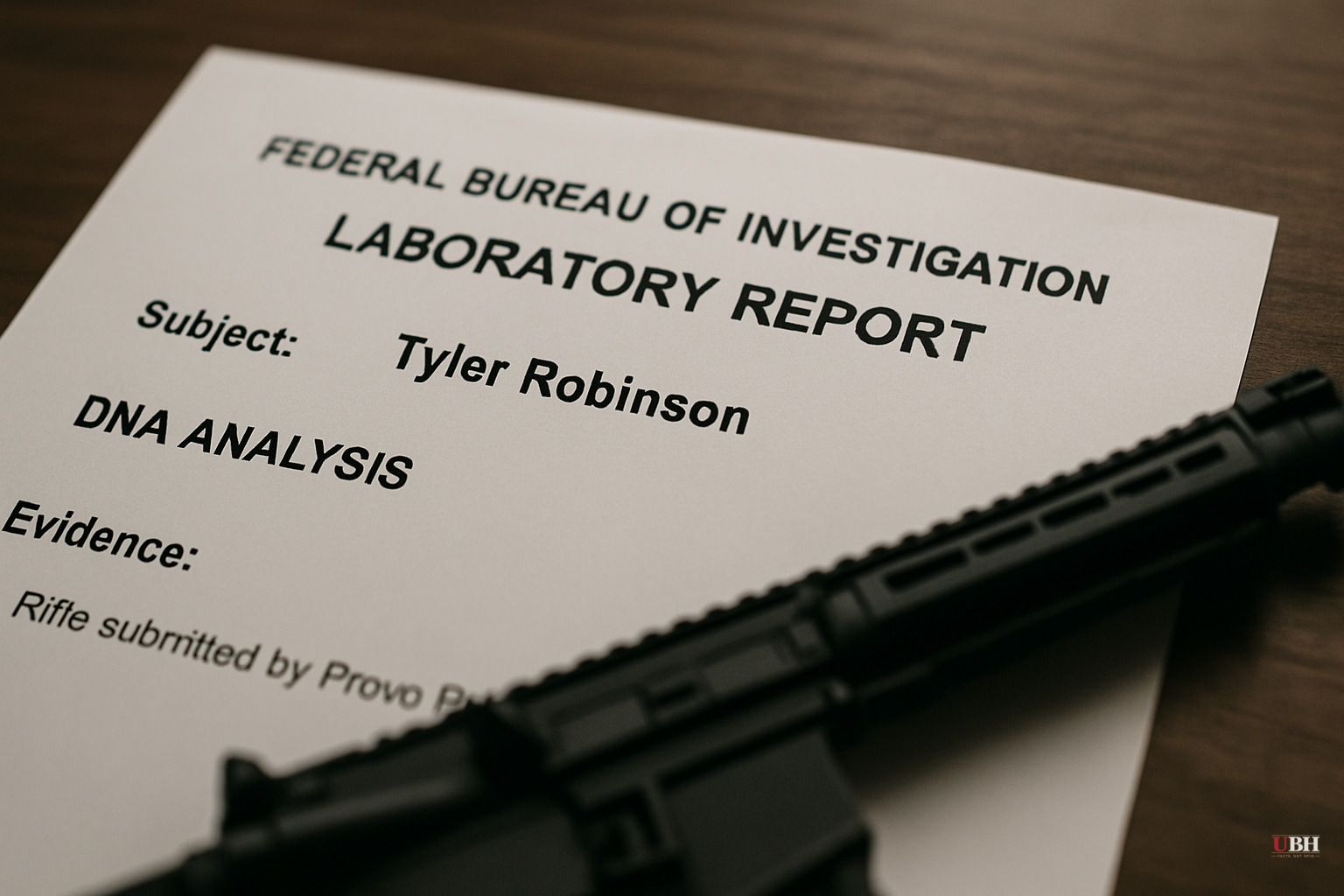
Since the preliminary hearing opened Monday, July 6, prosecutors and defense attorneys have been locked in a methodical evidentiary battle in Judge Tony Graf's Fourth District courtroom in Provo. The question before the court is narrow: has the state established probable cause to send Tyler Robinson, 22, to trial on aggravated murder and related charges? A conviction on aggravated murder carries a potential death penalty.
What the DNA Evidence Actually Shows
FBI analyst Amanda Bakker testified Tuesday that after Robinson's roommate, Lance Twiggs, provided a buccal swab for comparison, she was able to rerun her analysis and attribute all DNA recovered from the towel to exactly two contributors, according to the AP. One matched Twiggs. The other, she said, was very likely Robinson.
Sgt. Jennifer Faumuina of the Utah State Bureau of Investigation told the court her team recovered the towel, a screwdriver, and the suspected murder weapon — a bolt-action Mauser rifle with one spent round — near the wooded area adjacent to the Losee Center rooftop at UVU. Fox News reported that both the towel and the screwdriver carried DNA linked to Robinson and Twiggs.
The Defense's Challenge
Defense attorney Michael Burt spent significant time Tuesday cross-examining Bakker, arguing her methodology was flawed and her conclusions overstated. "She can't match Mr. Robinson to the questioned samples," Burt told the court, according to the AP.
DNA mixture analysis, particularly when a sample is degraded or contains contributions from multiple people, is a genuinely contested area of forensic science. Defense attorneys are raising a legitimate methodological question, not simply throwing mud. If Bakker's analysis relied on probabilistic genotyping software without adequate validation for the specific sample conditions, that concern could matter at trial.
Deputy Utah County Attorney Ryan McBride pushed back directly: "The point is there are explanations that are susceptible to different interpretations and arguments. The court is going to determine if it meets the threshold of reliability at trial." McBride's framing is procedurally sound. A preliminary hearing requires probable cause, not proof beyond a reasonable doubt. Burt's challenge underscores the defense strategy heading into any eventual trial.
Robinson has not entered a plea. His attorneys have not addressed his guilt or innocence publicly, but they have filed motions seeking to remove the death penalty as a sentencing option. Those motions have been denied so far.
Surveillance Video and Crime Scene Testimony
UVU surveillance footage shown in court Tuesday showed Robinson climbing over a railing onto the Losee Center rooftop, crouching, and running toward a position overlooking the outdoor Turning Point USA event where Kirk was speaking, according to Utah State Bureau of Investigation Agent David Hull. Hull testified that after the shot, Robinson ran back across the roof, dropped to the ground, and fled on foot.
Defense attorney Kathryn Nester cross-examined Hull about crime scene handling and raised questions about a second bullet found on campus at a location separate from the alleged shooting position. Hull explained it: a law enforcement officer had "cleared" his weapon that day, ejecting an unfired round. That accounts for the bullet. Nester's line of questioning suggests the defense will probe chain-of-custody and scene-integrity issues.
What Prosecutors Still Need to Establish
The state's aggravated murder theory rests partly on the argument that the shooting endangered others at the Kirk event, an aggravating circumstance that elevates the potential sentence. Prosecutors have not yet rested their case. Wednesday's session is expected to continue presenting evidence, with the DNA dispute likely to resurface.
Earlier in the hearing, prosecutors introduced a handwritten confession note whose contents FBI Director Kash Patel summarized publicly in September 2025: Robinson allegedly wrote before the shooting that he had "the opportunity to take out Charlie Kirk" and planned to do it. Patel told Fox News at the time that the note had been destroyed but that investigators recovered its contents through forensic means and interviews. The note itself and how its contents were reconstructed remain points the defense has not yet fully addressed on the record in this hearing.
Judge Graf must determine whether the DNA evidence, surveillance footage, and other physical evidence collectively satisfy the probable cause bar, or whether the defense's methodological attack on Bakker's analysis warrants further review before sending the case to trial.
Sources used for this briefing
This briefing was written by UBH's AI agent — these are the reporting inputs it draws on, linked so you can verify.


