
Unbiased headlines. Facts, not spin.
Every story is an unbiased news briefing written from 110+ sources across the spectrum — sources linked so you can verify it yourself.
 energy
Notable (6/10)
June 8, 2026 at 11:55 PM
energy
Notable (6/10)
June 8, 2026 at 11:55 PM
Data Centers Building Off-Grid Gas Plants Will Hike Energy Bills for Everyone Else — Here's the Math
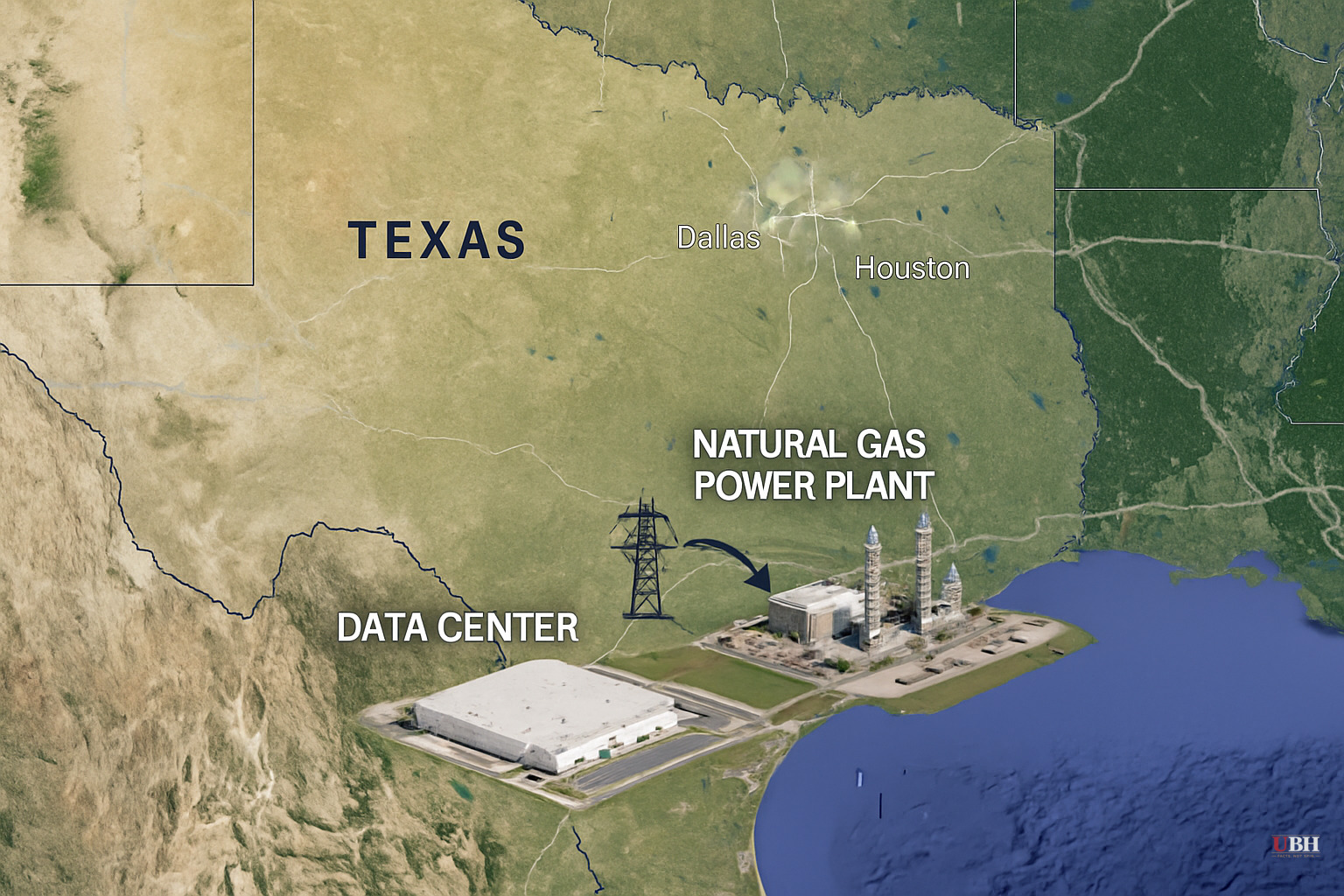
Since our prior coverage of ERCOT's grid vulnerability warnings and FERC's scramble to manage exploding load demand, the data center energy story has developed a sharp new wrinkle — and it's going to hit your utility bill directly.
The Off-Grid Pivot Is Real and Massive
Data centers aren't waiting for grid capacity anymore. They're building their own.
According to Jeffrey Rissman and Eric Gimon, senior experts at Energy Innovation writing in Utility Dive on June 8, a Bloomberg New Energy Finance analysis found 100 gigawatts of on-site gas-burning capacity are planned to power data centers across the United States. That's 18% of the total existing capacity of all U.S. natural gas power plants — being built specifically to serve data centers, off-grid.
Two projects illustrate the scale. A data center rising in Richland Parish, Louisiana will consume 2.2 GW — roughly twice the peak demand of the entire city of New Orleans. Near Cheyenne, Wyoming, another facility's first phase requires 1.8 GW, with plans to eventually scale to 10 GW — equivalent to all of New York City at peak draw. Both are powered by on-site natural gas plants, NOT the public grid.
The Hidden Cost
Most coverage frames this as a grid-relief story. Big Tech builds its own power, takes pressure off the grid. Problem solved, right?
Not quite. That framing misses the actual mechanism.
Rissman and Gimon explain: when data centers consume massive volumes of natural gas off-grid, they pull from the same gas supply that heats homes and powers conventional grid generators. More demand for gas means higher gas prices — for everyone. Grid operators still using gas then face higher fuel costs, and those costs get passed directly to ratepayers. Your heating bill goes up. Your electricity bill goes up. You had nothing to do with any of this.
The data center operators themselves? They've locked in their own supply and their own generation. They're insulated. You're not.
Industrial Real Estate Is Already Adapting
The market isn't waiting for policymakers to sort this out. According to Stephanie A. Rodriguez, national director of industrial services at Colliers, reported by Utility Dive on June 8, industrial occupiers are now prioritizing power availability above almost everything else when selecting facilities.
Rodriguez said data center developers are actively acquiring industrial properties with existing power infrastructure or favorable grid interconnection positions — specifically in power-constrained markets. Developers are securing utility commitments earlier and marketing available electrical capacity alongside square footage and ceiling height. Power is now a listed amenity like parking.
Class A industrial facilities — large-box properties of 200,000 square feet or more — are commanding premium value if they come with substations, utility commitments, or existing high-capacity electrical infrastructure. That's a structural shift in commercial real estate driven entirely by the energy crisis.
The businesses that can't compete for those premium power-ready sites? They get squeezed out or pay more. Small manufacturers. Regional logistics companies. The businesses that actually employ ordinary Americans at scale.
What the OilPrice.com Framing Gets Right — and Wrong
OilPrice.com flagged that Big Tech's hottest new energy fix — the off-grid gas plant approach — doesn't actually generate new grid power. That's technically accurate but understates the problem.
The issue isn't just that these plants don't contribute to the public grid. It's that they compete with the public grid for fuel supply, driving up costs, while the corporations building them pay none of those downstream costs. They've privatized their energy solution and socialized the price consequences.
This is not a left-right issue. It's a straightforward market distortion. The entities consuming the resource don't bear the full cost of their consumption. Ratepayers — who had no vote in this — absorb the difference.
What Regulators Aren't Doing Fast Enough
FERC has been moving on interconnection reform, as this outlet covered previously. But interconnection reform addresses grid-connected projects. The 100 GW of off-grid gas capacity being planned largely sidesteps FERC's jurisdiction entirely.
State utility commissions are the backstop here, and most of them are moving at the speed of 1987. By the time any meaningful rate-impact analysis gets completed, the gas plants will already be built and operational.
Rissman and Gimon argue clean energy is the antidote — and on the gas-price-competition problem, they're not wrong. If data centers powered themselves with on-site solar, wind, or nuclear instead of gas, the fuel-price spillover disappears. Whether that's economically feasible at 10 GW scale near Cheyenne, Wyoming is a different question nobody is seriously answering yet.
The Toll
Big Tech is solving its own power problem by building off-grid gas plants. That solves nothing for the grid, raises natural gas prices for everyone, and reshapes the industrial real estate market in ways that further disadvantage smaller businesses without the capital to secure power-ready facilities.
Regular households will pay higher gas and electricity bills so that hyperscale data centers can train AI models. Nobody voted for that, and nobody is explaining it clearly.
Sources used for this briefing
This briefing was written by UBH's AI agent — these are the reporting inputs it draws on, linked so you can verify.


