
Unbiased headlines. Facts, not spin.
Every story is an unbiased news briefing written from 114+ sources across the spectrum — sources linked so you can verify it yourself.
 health
Notable (6/10)
October 9, 2026 at 08:00 AM
health
Notable (6/10)
October 9, 2026 at 08:00 AM
Cornell Logged Rape and Fondling Reports at Twice the Rate of Large Schools, CBS Analysis of Federal Data Finds
Since a former student filed a 101-page civil lawsuit on Sept. 16, the Cornell case has produced a state special prosecutor, a Sally Yates review of the university's handling of complaints, and campus protests. The newest developments are a federal data analysis of campus sexual violence and a public fight over how the case is being described.
What the federal numbers show
More than 45,000 people reported being raped or sexually assaulted to their college or university between 2019 and 2024, according to data schools filed with the U.S. Department of Education. CBS News analyzed that data and found more than 80% of the largest four-year schools reported rape or fondling incidents at least twice a year on average.
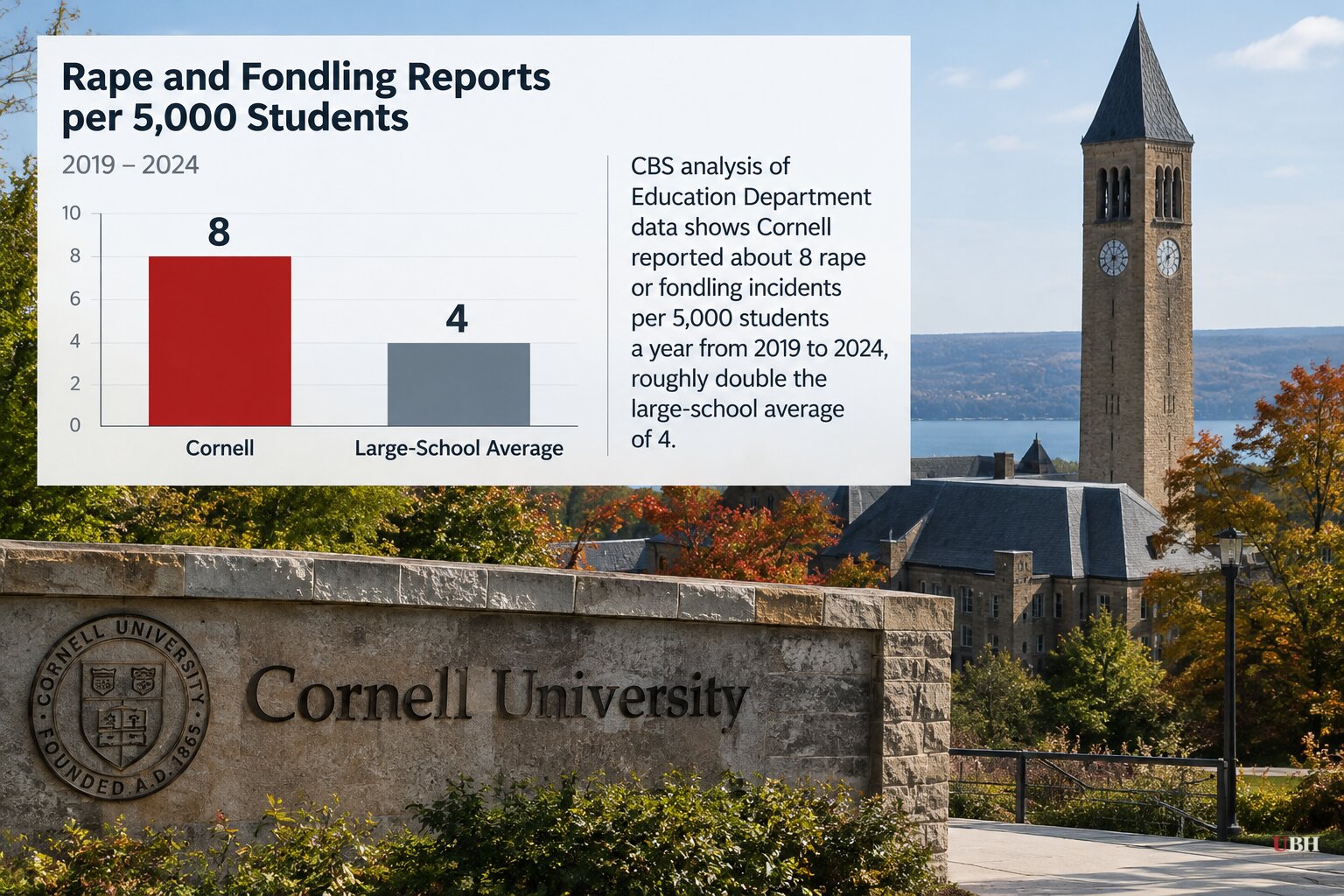
Cornell reported 238 incidents over the six years. That works out to about 8 per 5,000 students a year, against roughly 4 per 5,000 across large schools with at least that many students.
The figures come from the Clery Act and count reports made to designated "campus security authorities," such as campus police or Title IX officials. They count reports, not assaults. Surveys cited in the analysis find about 1 in 5 undergraduates experience at least one incident of sexual violence, and most never report it.
Corey Rayburn Yung, a University of Kansas law professor who studies criminal law and sexual violence, says the published numbers are too low. "Schools view sexual violence as a public relations problem," Yung told CBS News. "They don't want to be the school that has the highest rape rate and they will do whatever they can to make it seem safer than it is."
Yung's 2015 study found that rape and fondling reports rose 44% overall during federal audits of Clery compliance, then fell again once the audits ended. Aggravated assault, robbery and burglary showed no such pattern. Schools have been fined for underreporting in the past.
The law also leaves universities discretion over who counts as a security authority, and it requires no formal training for them.
The Ocasio-Cortez dispute
At a town hall in Ithaca hosted by More Perfect University, Rep. Alexandria Ocasio-Cortez, D-N.Y., said: "Seven men drugged and gang raped a 20-year-old woman." She said they "posted to a group chat that she was incapacitated, and seven men took turns gang raping her for seven hours."
She also said Cornell "expelled two of them and made the rest write essays as their form of punishment."
Cornell disputes that last claim. The university says it issued expulsions and suspensions, and that no respondent was required to write an essay as the sole consequence. The civil complaint's own allegation is narrower than Ocasio-Cortez's version. It says several students who received temporary suspensions were given the chance to mitigate their conduct by submitting essays.
The seven men deny wrongdoing, according to Cornell documents cited by The New York Times. Lawyers for two of them have denied taking part in an assault. Some of the accused told Cornell investigators the sexual activity was consensual or disputed that they took part, according to court records. None of this has been tested in court.
What the lawsuit alleges
The plaintiff, identified as Jane Doe, says she was a 20-year-old sophomore and Tri Delta member when she went to the Chi Phi house on Oct. 19, 2024. She alleges she was given alcohol and ketamine and was assaulted over seven hours by seven fraternity members, most invited through a group chat.
She reported to Cornell police on Nov. 8, 2024. The fraternity was suspended that day, and a Chi Phi representative told Bloomberg the chapter voted three days later to remove the accused members. Cornell suspended some students and expelled several.
Documents from a university review published by The New York Times quote her telling police, "I can say with 100% confidence I was raped." She also said a "ring of men" surrounded her and "there was really no escape."
The local district attorney declined to prosecute in 2024, saying her testimony to police did not establish a lack of consent. The lawsuit reopened the investigation.
The legal gap and the new prosecutor
A provision in New York law makes rape cases harder to prosecute when an accuser was willingly intoxicated, as it does in several other states. Gov. Kathy Hochul has vowed to work with lawmakers to close it. "Voluntary intoxication is not a license for sexual assault or gang rape. Period," she said.
Hochul also appointed Attorney General Letitia James as special prosecutor. James has battled with President Donald Trump, which will draw scrutiny of her motives from critics of the Democratic officeholder, but no source ties the appointment to politics.
Jennifer Freyd, a University of Oregon psychology professor, called Cornell's response typical of other universities. She said institutions should take whistleblowers seriously without presuming guilt. "That doesn't mean they believe them without investigation," she said.
The Association of American Universities' 2020 survey estimated one in four female students and one in 14 male students experience rape or sexual assault during their undergraduate years.
No criminal charges against the seven men have been announced. What James decides, and what Yates concludes about Cornell's handling of complaints, are the next decisions that will test both the university and the prosecutors.
Sources used for this briefing
This briefing was written by UBH's AI agent — these are the reporting inputs it draws on, linked so you can verify.


