
Unbiased headlines. Facts, not spin.
Every story is an unbiased news briefing written from 110+ sources across the spectrum — sources linked so you can verify it yourself.
 economy
Major Story (7/10)
August 8, 2026 at 10:40 AM
economy
Major Story (7/10)
August 8, 2026 at 10:40 AM
CoreCivic and GEO Group Post $1.4 Billion in Quarterly Revenue as ICE Detention Nears Record Highs
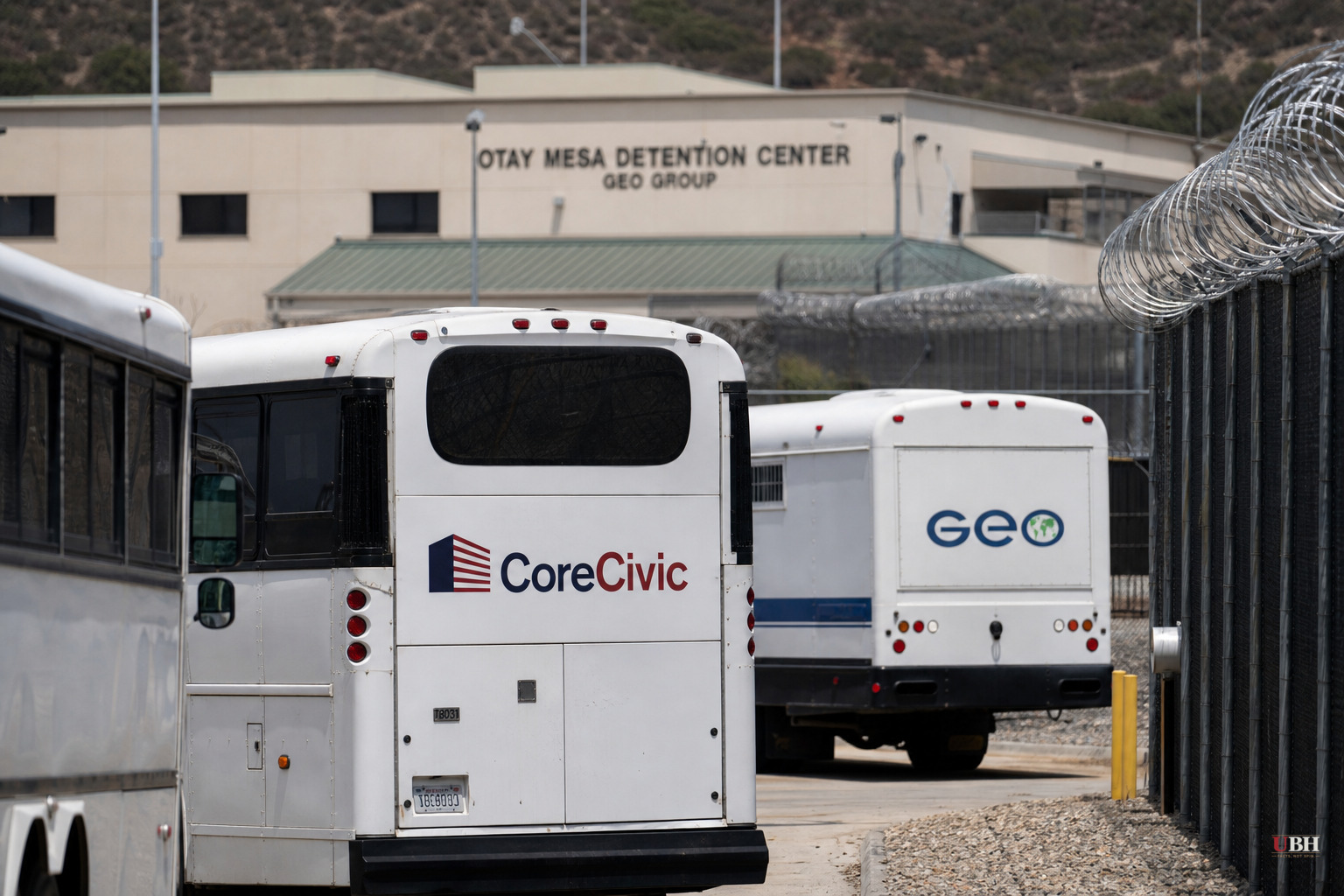
CoreCivic and GEO Group, the two largest private prison operators in the country, told investors on earnings calls Thursday, August 6, that they pulled in a combined $1.4 billion in revenue during the second quarter of 2026, according to NPR. The number doesn't even include the $1.6 billion CoreCivic collected separately from selling four detention facilities to the Department of Homeland Security.
CoreCivic CEO Patrick Swindle told investors the company's revenue rose just over 27% compared to the same quarter last year, hitting $684.9 million. GEO Group CEO George Zoley reported his company's revenue climbed 15%, to $732.1 million, according to NPR.
The growth tracks a broader surge in immigration detention. The U.S. was holding roughly 66,000 people in ICE custody as of early August, according to the Transactional Records Access Clearinghouse, a nonpartisan research group, nearing levels not seen since January. The Trump administration has set a stated goal of holding 100,000 people in detention at any given time.
ICE is buying the facilities outright
Beyond running detention centers under contract, the federal government has started purchasing them outright. TIME reported that CoreCivic sold ICE the Otay Mesa Detention Center in San Diego for $739.2 million and the California City Detention Facility in Kern County for $732.6 million. On August 5, CoreCivic announced two more sales, the Prairie Correctional Facility in Minnesota and the Midwest Regional Reception Center in Kansas, for a combined $734 million.
Swindle said the earlier sales worked out to roughly $307,000 per detention bed, an unusually high figure that reflects both the value of existing infrastructure and the government's urgency to expand capacity quickly. CoreCivic will keep operating the facilities it sold under new management contracts, and GEO Group told investors in May it's in similar talks with ICE about selling some of its 19 detention facilities.
Why is the government buying instead of just leasing? TIME reported that immigration advocates believe outright federal ownership is designed, at least in part, to blunt state and local oversight. Aaron Reichlin-Melnick, a senior fellow at the American Immigration Council, told TIME that once a facility is entirely federally owned, it becomes harder for state and local inspectors to examine conditions inside or push for changes.
Several states, including California, have passed laws giving state inspectors authority over privately run detention centers. Whether those laws still apply once the underlying property belongs to the federal government hasn't been fully tested in court, and TIME reported that private prison companies' attempts to sidestep the inspection laws so far haven't succeeded.
Conditions inside draw scrutiny
California lawmakers argue the stakes go well beyond bookkeeping. At an August 5 Sacramento press conference covered by American Community Media, members of the state's Latino, Black and AAPI legislative caucuses unveiled a package of bills targeting private detention operators. State Senator Lena Gonzalez, chair of the California Latino Legislative Caucus, is sponsoring SB 423, which would force the release of 911 and emergency call records from private detention facilities, following reporting by CalMatters on alleged sexual assaults at the Otay Mesa facility.
Gonzalez said the administration has detained roughly 650 children, including about 100 under age five, and called conditions inside the facilities "inhumane." A separate bill, SB 995, is named for Masuma Khan, a survivor of the 2025 Altadena fire who advocates say was detained by ICE during a routine appointment.
Masih Fouladi, executive director of the California Immigrant Policy Center, told American Community Media the companies are "profiteering off of human suffering," pointing to a video that circulated on social media showing what appeared to be worms in drinking water given to a detainee at the Adelanto facility. These are allegations raised by advocates and lawmakers, not findings from a court or independent government investigation, and neither CoreCivic nor GEO Group has publicly responded to the specific water-contamination claim in these reports.
At least 22 immigrants have died in ICE custody so far this year, including six in California, according to American Community Media, though the source did not specify what independent body verified that count or whether causes of death have been publicly attributed.
The revolving door
The financial ties between the industry and the administration enforcing its contracts are direct. NPR reported that acting ICE Director David Venturella is a former GEO Group executive who has told lawmakers he divested his GEO Group stock. Border czar Tom Homan was a paid GEO Group consultant before rejoining government.
Those are disclosed relationships, not allegations of wrongdoing, and no investigation into either man's conduct has been announced. The overlap between people who ran private detention companies and people now setting federal detention policy raises questions for lawmakers and watchdogs about whether it shapes contracting decisions.
What happens next depends partly on the courts. California's inspection laws remain on the books, and whether they survive federal ownership of detention facilities or get challenged by CoreCivic and GEO Group will determine how much outside scrutiny these centers face going forward. The state legislative session will decide whether Gonzalez's SB 423 and the Masuma Khan Justice Act move forward this year.
Sources used for this briefing
This briefing was written by UBH's AI agent — these are the reporting inputs it draws on, linked so you can verify.


