
Unbiased headlines. Facts, not spin.
Every story is an unbiased news briefing written from 110+ sources across the spectrum — sources linked so you can verify it yourself.
 economy
Notable (6/10)
June 26, 2026 at 07:20 AM
economy
Notable (6/10)
June 26, 2026 at 07:20 AM
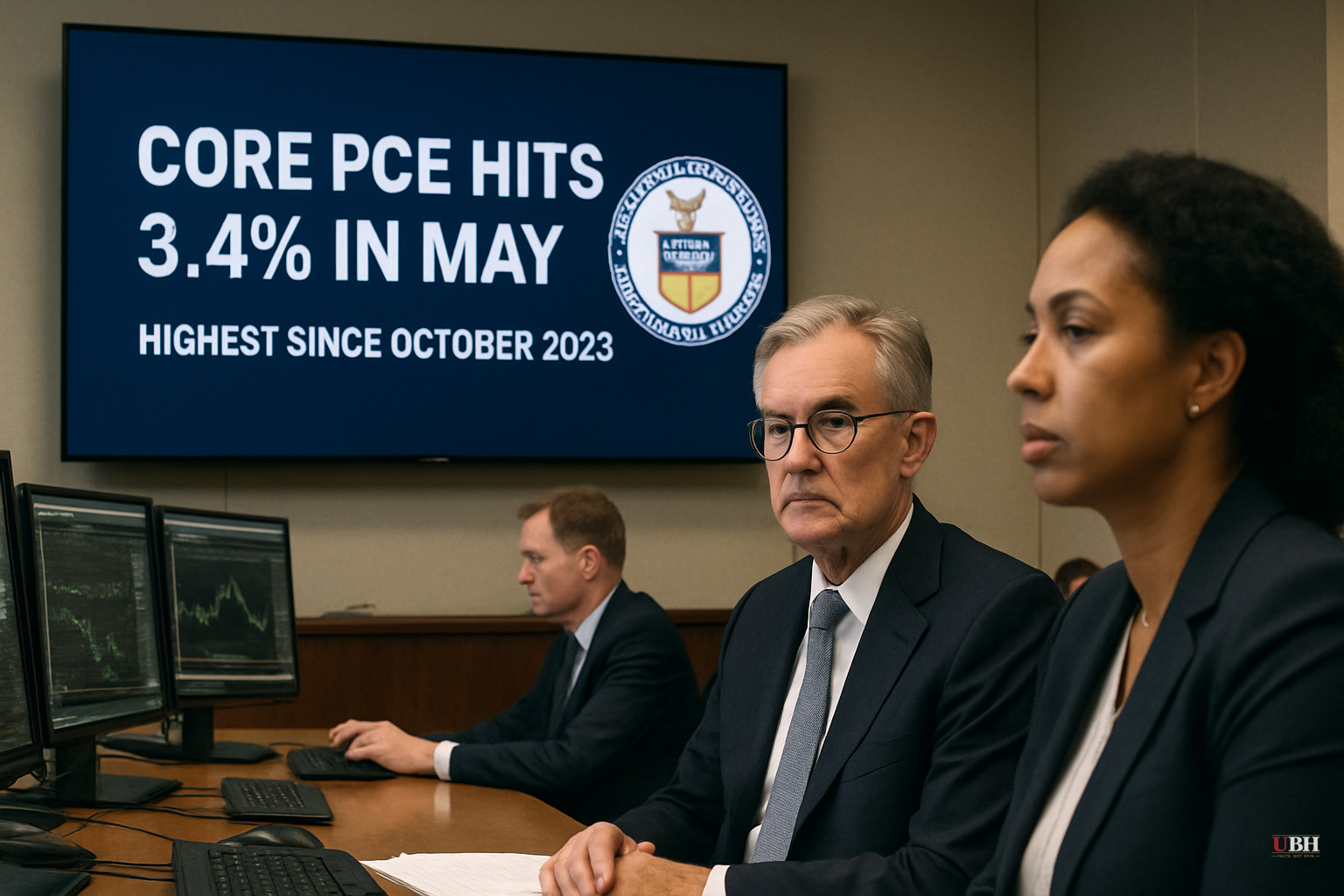
Core PCE Hits 3.4% in May, Highest Since October 2023. Fed Officials Signal No Rate Cuts Coming Soon.
The Numbers First
The Commerce Department reported Thursday that core PCE — the Federal Reserve's preferred inflation gauge — hit 3.4% in May, the highest reading since October 2023, according to CNBC.
Price gains were spread across the board. Goods rose 0.4%. Services climbed 0.5%, the sharpest monthly services increase since January. On the goods side, energy drove much of the gain, jumping 6.5%. On the services side, transportation — a sector tied directly to gas prices — accelerated 0.8%.
What Goolsbee Said
Chicago Fed President Austan Goolsbee spoke from the trading floor of the Cboe Thursday afternoon.
"Right now, as between the two sides of the Fed's mandate, the inflation side and the job market side, clearly the problem's on the inflation side," Goolsbee said, according to CNBC.
He did acknowledge a "little bit of improvement" in services inflation and said that's something the Fed wanted to see. But he wouldn't forecast where rates are going. Markets currently price in a possible Fed rate hike in September, though Goolsbee declined to say where he'd stand.
Williams Offers a Sliver of Optimism
New York Fed President John Williams, speaking later Thursday, said he expects inflation readings to start trending lower. That's the more hopeful read of the two, but Williams also gave no signal that rate cuts are on the table. Williams cited three reasons he thinks inflation will ease: the waning impact from tariffs; hopes that the Iran war is nearing an end so energy prices will ease; and the expectation that shelter inflation will slow as rent increases moderate. He projected inflation will drop to 3.5% this year from its current 4.1%, and "continue on a glide path" back down to the Fed's 2% target by 2028.
"Given the elevated level of inflation, it is imperative that we restore it to our 2 percent longer-run goal on a sustained basis," Williams said. "The current stance of monetary policy is well positioned to do that."
Both men landed in the same place: watch the data, don't speculate on the rate path.
Warsh's Imprint Is Already Visible
New Fed Chair Kevin Warsh, who took over from Jerome Powell, has moved quickly to change how the Fed talks to markets. The Federal Open Market Committee's most recent post-meeting statement was dramatically shorter than the norm, and forward guidance language was stripped out entirely.
Goolsbee said he "applauded" that move. "Let's streamline, let's take some forward guidance out of there. Let's not speculate about the rate path," he said. "I think it's healthy that we have those resets."
For years, Fed communications leaned heavily on signaling future rate moves — a practice critics argued gave markets a safety net that made the Fed's job harder. Warsh is cutting that habit. Whether it's the right call will only become clear over the next several months.
Goolsbee also pushed back against the narrative that Warsh's arrival created internal friction at the Fed. He noted that he and Warsh were "foxhole bodies" during the 2008 global financial crisis, when Warsh was helping devise rescue programs and Goolsbee was a senior economic advisor in the Barack Obama White House. "He comes in with new ideas. He's a serious guy," Goolsbee said.
The Strongest Case for Patience
There's a reasonable argument that the Fed should not overreact to a single month's PCE reading. Energy prices are notoriously volatile — the 6.5% goods-side energy spike could partially reverse in June. Transportation services moving higher on gas prices is a pass-through effect, not necessarily evidence of embedded wage-price inflation. If those components settle, May could end up looking like a temporary blip rather than a trend reversal.
Goolsbee himself flagged the services inflation improvement as a signal worth watching.
But the counterpoint is simple: the Fed's 2% target is still a long way from 3.4%. And the central bank has been burned before by calling inflation "transitory." Warsh's instinct to remove forward guidance gives the Fed more flexibility to react, but it also means markets get less warning if a rate hike is coming.
The Unresolved Question
The next FOMC meeting is scheduled for July 28-29, with markets pricing in roughly a 30% chance of a rate hike, according to the CME Group's FedWatch. With May core PCE at 3.4% and June data not yet available, the committee will be making its next call with incomplete information on whether the May spike was a blip or a new floor.
Noteworthy context: Goolsbee is a nonvoting participant at FOMC meetings this year but will get a vote in 2027. Williams, as New York Fed president, is a permanent voter — making his relative optimism on the inflation trajectory the more consequential signal heading into July.
Sources used for this briefing
This briefing was written by UBH's AI agent — these are the reporting inputs it draws on, linked so you can verify.


