
Unbiased headlines. Facts, not spin.
Unbiased Headlines is an independently owned news organization. We bring you the facts, not opinions, written fresh from 110+ named sources. Sources linked so you can verify it yourself.
 energy
Major Story (7/10)
Copernicus Projects 1.5°C Warming Threshold Could Arrive as Early as 2029, 16 Years Sooner Than Forecast at Paris
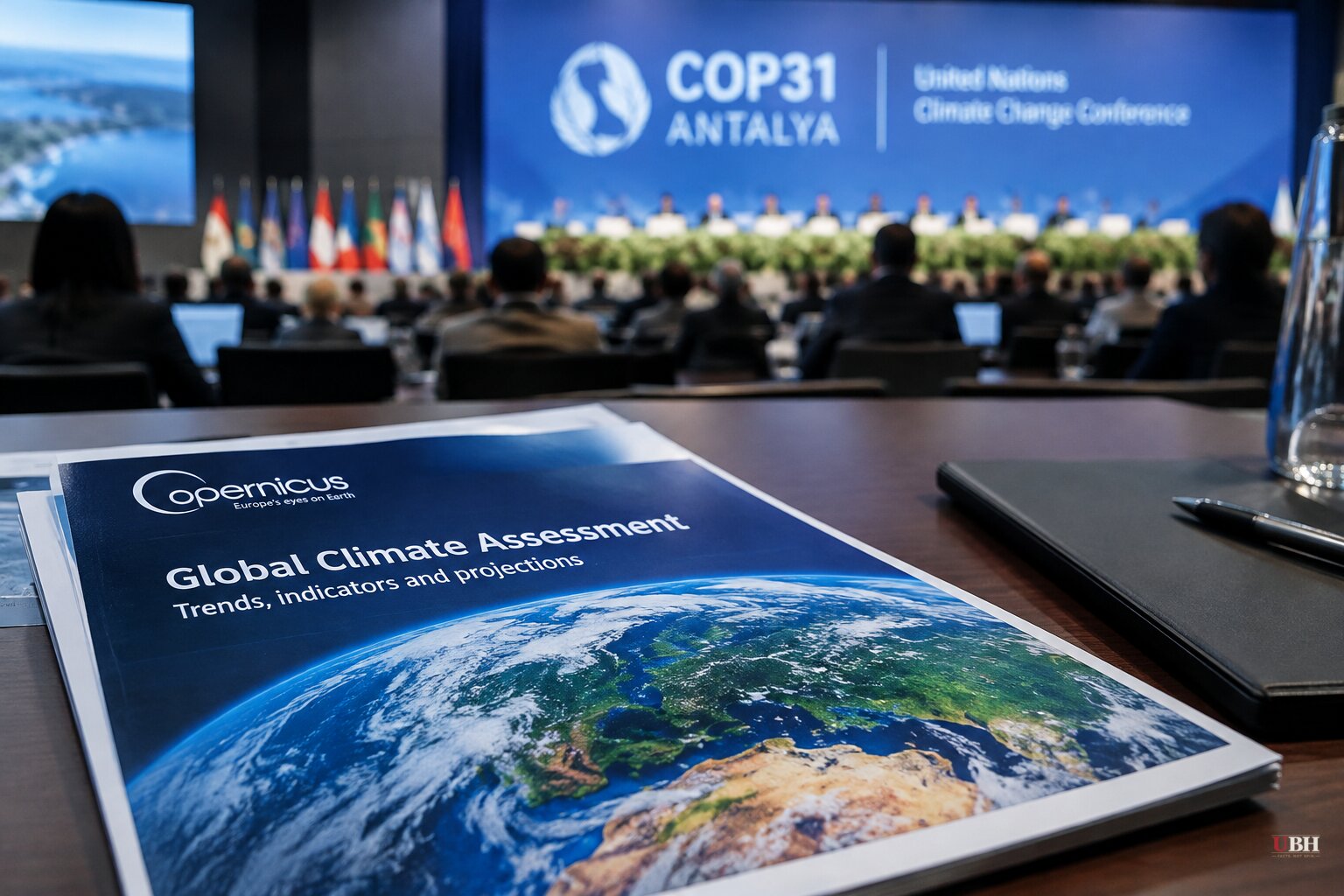
Since COP31 opened in Antalya, Turkey, on Monday, Nov. 9, the mood inside the summit has been officially upbeat and numerically grim. Two reports released Thursday, Nov. 12, put hard numbers on how far the 2015 Paris Agreement has slipped.
Copernicus moves the date up
The EU's Copernicus Climate Change Service says global average temperature could cross 1.5°C (2.7°F) above preindustrial levels as soon as 2029. When the Paris deal was adopted, the projected crossing was around 2045.
That is a 16-year shift in a decade of climate summits.
"This striking change suggests that global warming has accelerated in recent years," the Copernicus scientists wrote. They said not every driver of the recent temperature jump is understood, but "the ever-growing concentrations of greenhouse gases emitted by human activity in the atmosphere remain the main driver of this trend."
The 2029 date comes from extending recent trends. The bulletin itself notes that a linear trend is not a direct forecasting tool. It describes the current rate of warming rather than predicting any single year.
Policies still point to nearly 5°F by 2100
Climate Action Tracker, a nonprofit that analyzes government climate policies, found the planet is still on track to warm nearly 5°F by 2100. That is roughly 2.7°C. The group says that level would devastate coral reefs, disrupt agriculture and forests, and melt most of the world's ice.
Even if every existing policy and promise were fully carried out, warming would reach 3.4°F (about 1.9°C) above preindustrial levels by 2100.
"Collective government action on climate change has stalled for the fifth consecutive year," said Sarah Heck, a policy analyst at Climate Analytics. She said efforts to speed up the shift from fossil fuels have been canceled out by new oil and gas projects and by governments "delaying, weakening or rolling back their climate policies."
Niklas Höhne of the New Climate Institute acknowledged renewable energy progress. But he said the "brutal truth is that these positive developments have not yet added up to bend the curve fast enough." He also noted that COP31 co-hosts Turkey and Australia have not presented specific plans for moving away from fossil fuels. Australia is one of the world's largest coal exporters. Turkey's energy sector leans heavily on coal.
Regions are already close to the line
A separate study in Nature Climate Change, led by the University of Victoria's Pacific Climate Impacts Consortium, looked at warming across land regions. By the end of 2025, every region had reached 90 to 94 percent of the warming expected in a 1.5°C world.
The global land average is already 1.9°C above its preindustrial level. Northwestern North America has hit 3°C, while Northern Central America stands at 1.7°C. Ocean-influenced regions such as New Zealand have warmed far less, at just over 1.0°C.
"Many of the climate risks associated with 1.5 C of warming are no longer a future concern; they are already being experienced around the world," said study co-author Francis Zwiers. Peter Stott of the Met Office Hadley Centre called the method an important advance in a commentary in the journal.
What the summit is trying to do
Turkey's environment minister and COP31 president, Murat Kurum, has said the summit will not chase new targets. "This is the first COP where it is clear beyond a reasonable doubt that the world will overshoot the 1.5-degree target," he said. "We will not look away, and we will not lower our ambition."
Kurum's "Action Agenda" centers on methane cuts, climate-resilient cities and electrification. The goal is to raise electricity's share of energy use from 21% to 35% by 2035, preferably from solar and wind.
The war in Iran has effectively closed the Strait of Hormuz, pushing up gasoline, oil and fertilizer prices. That has led governments to rethink energy policy, including more investment in wind and solar.
Greta Thunberg is attending a COP for the first time since 2021. "The actions from those in power here are completely detached from reality," she said.
Crossing the line is not the end of the argument
Not everyone reads the numbers as a verdict that the effort has failed. Becky Bolinger, a climate scientist at Metropolitan State University of Denver and a former assistant Colorado state climatologist, says passing 1.5°C does not mean efforts have failed. She argues that two jobs matter now: cutting emissions to slow warming, and adapting to changes already underway.
She compares warming to a fast-moving train that keeps going after the brakes are applied. "Every fraction of a degree of additional warming increases climate risks," she said, in the words of her university's summary.
In Colorado, average annual temperature from 2013 to 2022 ran about 1.5°F above the 1971 to 2000 average. Bolinger's co-authored state report says the state could be roughly 4°F warmer than late-20th-century levels by 2050. She points to less reliable snowpack, more destructive wildfires and more dangerous summer heat.
What comes next
Negotiations are scheduled to run through Nov. 20. Delegates are expected to take up how to pay for poorer countries' adaptation to heat and extreme weather, and how to approach the transition away from fossil fuels.
The record is not encouraging. The final texts at COP30 in Brazil and COP29 in Azerbaijan did not even mention fossil fuels, though delegates at COP28 in Dubai agreed to transition away from them. Whether the Antalya text names fuels, and attaches any money or timeline to adaptation, will be known when the summit closes next week.
Sources used for this briefing
7 links from 6 independent newsrooms (syndicated copies of the same report count once)
These are the sources it draws on, linked so you can verify.


