
Unbiased headlines. Facts, not spin.
Every story is an unbiased news briefing written from 110+ sources across the spectrum — sources linked so you can verify it yourself.
 health
Major Story (7/10)
June 15, 2026 at 09:46 AM
health
Major Story (7/10)
June 15, 2026 at 09:46 AM
Congo Ebola Outbreak Reaches 782 Cases and 181 Deaths, With Displacement Camps Now Infected and No Licensed Vaccine Available
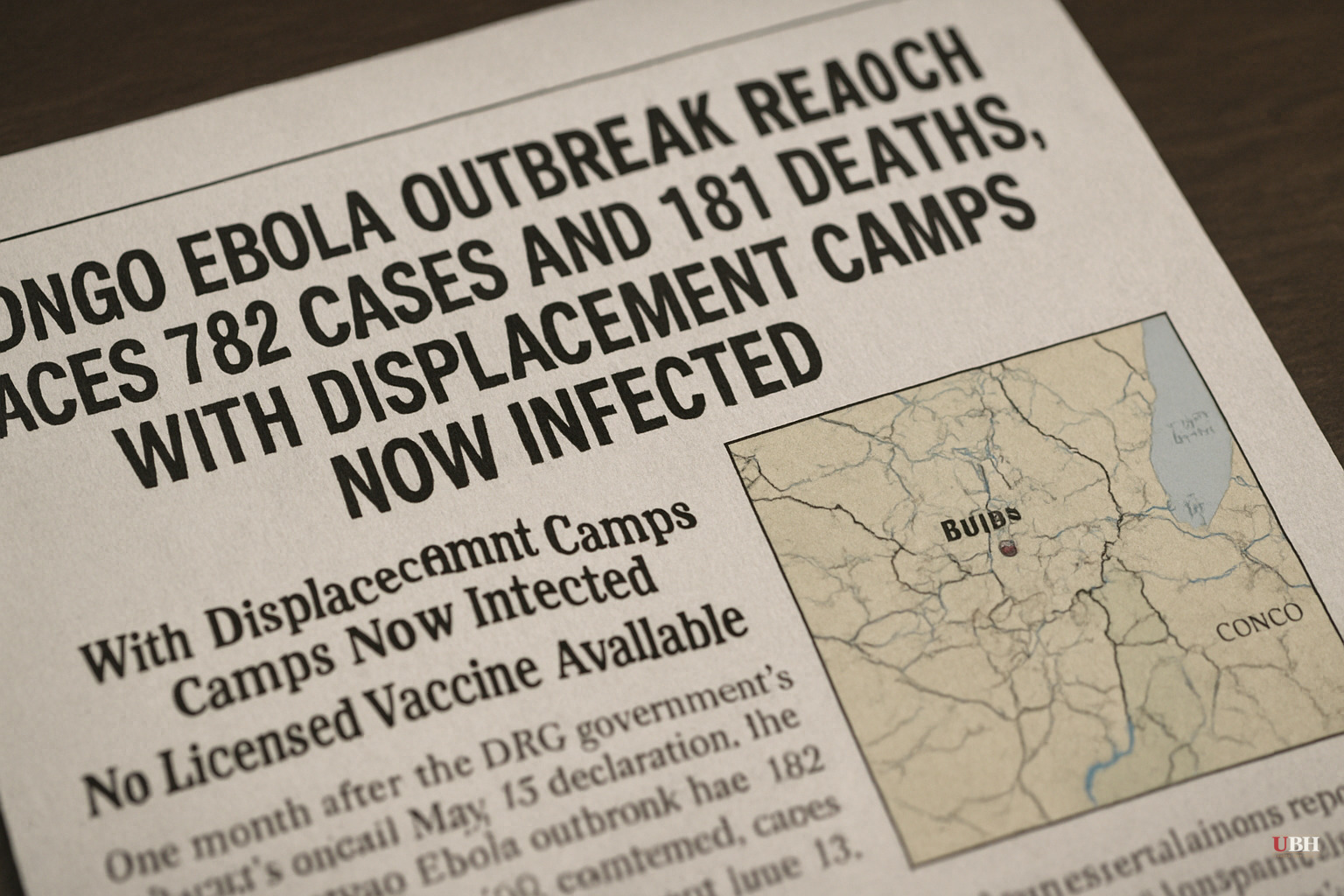
Since the DRC government officially declared the outbreak on May 15, confirmed Ebola cases have climbed from an initial cluster in the remote mining town of Mongbwalu to 782 confirmed cases and 181 confirmed deaths as of June 13, according to AP News and NPR reporting from inside the outbreak zone. Health and aid officials say those numbers are almost certainly an undercount, citing testing delays and deaths going unnoticed in remote villages.
The Ebola strain driving this outbreak is the Bundibugyo virus, a rare variant with no licensed treatments or vaccines, according to CIDRAP. The WHO has prioritized several vaccine and therapeutic candidates, but CIDRAP reported that viable options are still months away from deployment.
Bunia Is Now the Epicenter
Ituri province remains the hardest-hit region. Of the 782 confirmed cases, 629 were in Ituri as of the June 10 figures published by the European Centre for Disease Prevention and Control (ECDC). Bunia, Ituri's capital and a city of over one million people, has 212 confirmed cases — the single largest concentration anywhere in the outbreak zone, according to NPR's Emmet Livingstone and Arsène Mpiana, reporting from the city.
NPR's team witnessed the outbreak's street-level reality firsthand: a sick man vomited blood on his motorbike taxi driver in central Bunia and died on the spot. Specialist decontamination teams retrieved the body. The driver fled before health workers could identify him, precisely the kind of broken contact chain that allows Ebola to spread.
Eliezer Kasongo, a 25-year-old community volunteer in Bunia and president of the local health group REMEDE Bunia, told NPR he initially thought the epidemic would pass in weeks. He now spends his days going door to door on awareness campaigns. "There's fear," Kasongo said. "People are dying every day."
Displacement Camps Add a Dangerous Variable
The outbreak reached a displacement camp in eastern DRC in late May, when a mother and daughter living in a 30,000-person camp died on May 31 and June 1 and later tested positive for Ebola, according to CIDRAP citing Reuters. The camp conditions are overcrowded and unsanitary, a worst-case scenario for containment.
Caitlin Brady, country director for the Danish Refugee Council in Congo, told Reuters: "We are all really worried that Ebola in these camps will spread extremely quickly and that there will be panic and people will flee all over whether or not they're contacts, whether or not they're ill."
UNICEF's global Ebola incident manager, Dr. Douglas Noble, warned at a WHO press conference that most current cases are among socially and economically active adults, but household transmission could shift the burden toward children. Noble noted that early Ebola symptoms in children — fever, diarrhea, vomiting, fatigue — are nearly indistinguishable from malaria and other common illnesses in the region, complicating early detection.
Contact Tracing Is Falling Short
Only 56% of contacts have been traced across the three affected provinces — Ituri, North Kivu, and South Kivu — according to the Congolese health ministry as reported by NPR. Armed groups operating in the same territory make field work dangerous. Roads are poor. Information moves slowly.
Olivier le Polain of the WHO said at a press conference: "Every day, cases are being identified in new health zones. And that reflects really the scale of this outbreak, a scale that is much bigger than what is being detected and the high mobility of the population in this part of the DRC."
The ECDC's June 12 update confirmed 44 confirmed cases in North Kivu across nine health zones and three cases in South Kivu, with three entirely new health zones added since the previous update — one in Ituri, two in North Kivu.
Uganda has separately confirmed 19 cases and two deaths as of June 11, according to the ECDC.
The Strongest Counterargument: Is This Response Adequate?
Some public health observers point to the DRC's track record. The country has fought 16 prior Ebola outbreaks, and the institutional response — handwashing stations, community outreach, decontamination teams — reflects hard-won experience. Ring vaccination worked against the Sudan and Zaire strains in previous outbreaks. The DRC's health infrastructure, however strained, has operational knowledge.
But the Bundibugyo variant is different. There is no licensed vaccine and no licensed treatment for this strain. Previous DRC response playbooks relied heavily on available countermeasures that simply do not exist here yet. Experience without tools is not the same as experience with them.
No U.S. Risk Assessment, But Funding Is Moving
The U.S. has pledged funding for medical countermeasures, according to CIDRAP, though no specific dollar figure was confirmed in the available sources. No U.S. travel advisory or domestic risk elevation has been reported.
This is the 17th Ebola outbreak in the DRC since the virus was identified in 1976, and by case count it is already the fourth largest on record. The unresolved question as of June 15, 2026: whether any of the WHO-prioritized vaccine or therapeutic candidates can clear the regulatory and logistical hurdles fast enough to reach outbreak zones before Bundibugyo spreads further into displacement camps and across additional health zones.
Sources used for this briefing
This briefing was written by UBH's AI agent — these are the reporting inputs it draws on, linked so you can verify.


