
Unbiased headlines. Facts, not spin.
Every story is an unbiased news briefing written from 110+ sources across the spectrum — sources linked so you can verify it yourself.
 economy
Notable (5/10)
August 15, 2026 at 02:03 PM
economy
Notable (5/10)
August 15, 2026 at 02:03 PM
Computer Science Enrollment Drops as AI Tools Reshape What Students Think Coding Careers Look Like
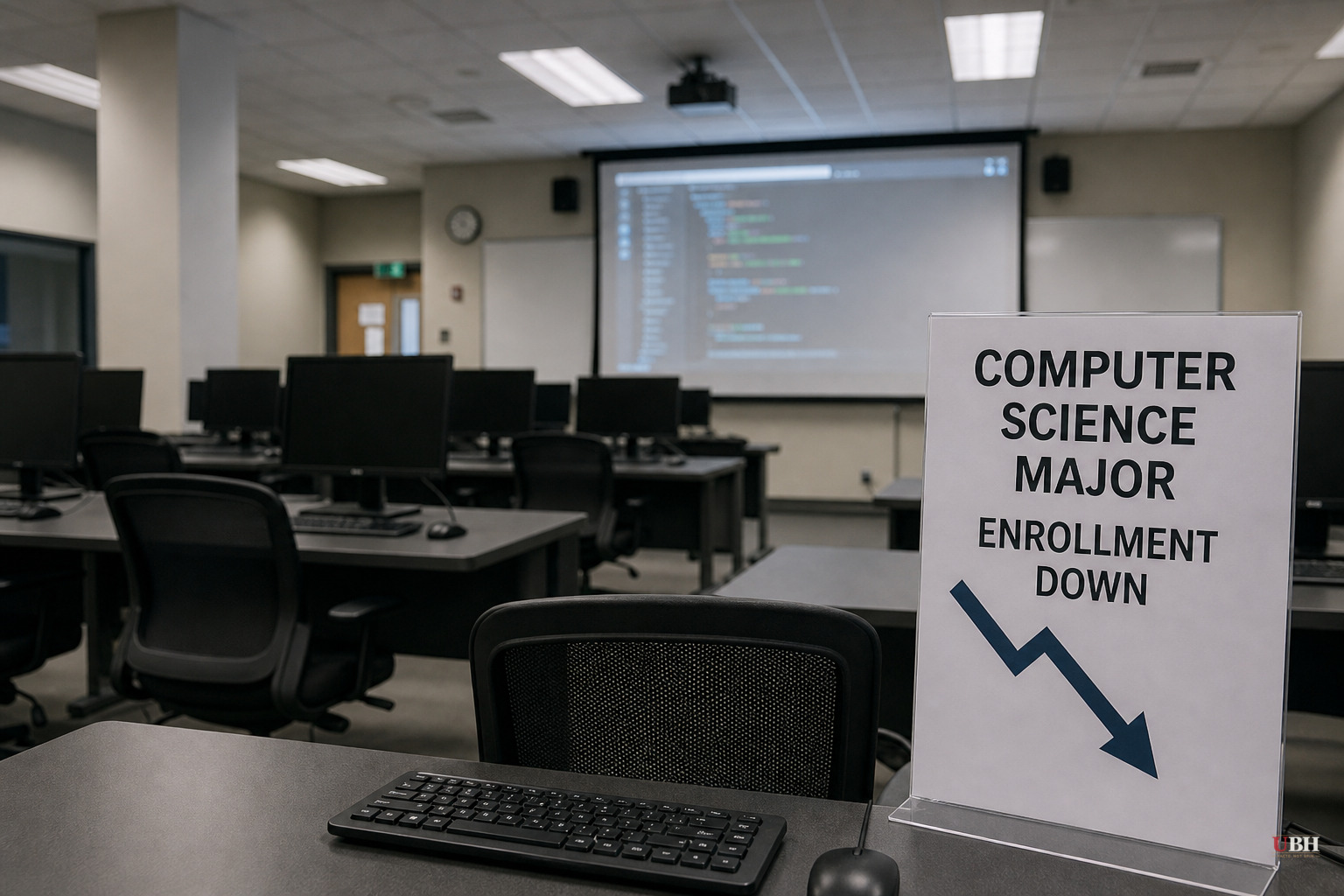
Computer science departments spent the last decade as the golden ticket major. That's changing.
AP News reports that college computer science majors are down, even as interest in AI skills is rising sharply among students in fields that have nothing to do with software engineering. Business majors, biology majors, journalism students, art students. Everyone wants to know how to use AI tools. Fewer of them want to spend four years learning to build the tools from scratch.
The logic isn't complicated. Entry-level coding jobs, the kind that used to absorb thousands of new CS grads every year writing boilerplate and doing routine debugging, are exactly the tasks large language models now handle competently. If a chatbot can write a working function in ten seconds, students are asking why they should spend a semester learning to do it manually, or why an employer would pay a junior developer to do what the AI already does for free.
That's a rational read of the job market, even if it turns out to be only half right. Software engineering hiring has genuinely tightened. Big tech companies including Meta, Google, and Microsoft went through waves of layoffs starting in 2022 and have leaned harder on AI coding assistants like GitHub Copilot ever since. New graduates are competing against a smaller number of open junior roles than five years ago.
At the same time, the shift AP describes, students in non-CS majors picking up AI fluency, reflects something employers are actually asking for. A marketing major who knows how to prompt an AI model to build a campaign draft, or an accounting student who can use AI to audit spreadsheets faster, is offering a skill on top of their core discipline rather than trying to out-code an actual engineer. That's a sensible hedge for a student who isn't trying to become a professional software developer in the first place.
Betting that AI has permanently killed demand for computer science expertise is a different claim than betting that AI has killed demand for entry-level grunt coding work. Somebody still has to understand how these systems actually function, how to secure them, how to fix them when they break, and how to build the infrastructure that runs them. That work still requires deep computer science training, not surface-level prompting skills. If enrollment keeps sliding while AI infrastructure spending keeps climbing, that's a mismatch that could bite the labor market in five or six years when today's freshmen would have graduated as senior engineers.
There's also a fair counterpoint that gets lost when this trend gets framed as pure common sense: entry-level jobs have always been the training ground for senior engineers. If companies stop hiring junior developers because AI covers the basic work, and universities respond by producing fewer computer science graduates, the pipeline for the next generation of senior architects, security experts, and systems engineers narrows too. That's a legitimate concern raised by people who study tech labor markets, and it doesn't require assuming AI hype is fake to take it seriously.
None of this is happening in a vacuum of settled fact. Nobody has a reliable count yet of how many CS jobs AI has actually eliminated versus how many companies are simply citing AI to justify layoffs they'd have made anyway for cost reasons. Meta, Amazon, and other major employers have both increased AI infrastructure investment and cut engineering headcount in the same fiscal years, and untangling which decision caused which is not something any of the available reporting settles cleanly.
What is measurable is the enrollment shift itself. Students are voting with their course schedules. Whether that bet pays off depends on how the software labor market actually shakes out over the next several graduating classes, something AP's reporting flags but can't yet resolve. Universities that build AI-literacy requirements into every major, not just computer science departments, are the ones best positioned either way. The open question is whether the students steering away from CS altogether are reading the market correctly, or whether they're abandoning the deepest technical training right as demand for people who actually understand these systems is about to spike.
Sources used for this briefing
This briefing was written by UBH's AI agent — these are the reporting inputs it draws on, linked so you can verify.


