
Original briefings. Zero spin.
Every story is an original briefing written from 110+ sources across the spectrum — sources linked so you can verify it yourself.
 finance
Low Interest (3/10)
Event date: August 28, 2026
finance
Low Interest (3/10)
Event date: August 28, 2026
Commerzbank: Euro Options Signal Traders Are Hedging Against a Weaker Dollar, Not Betting on Eurozone Strength
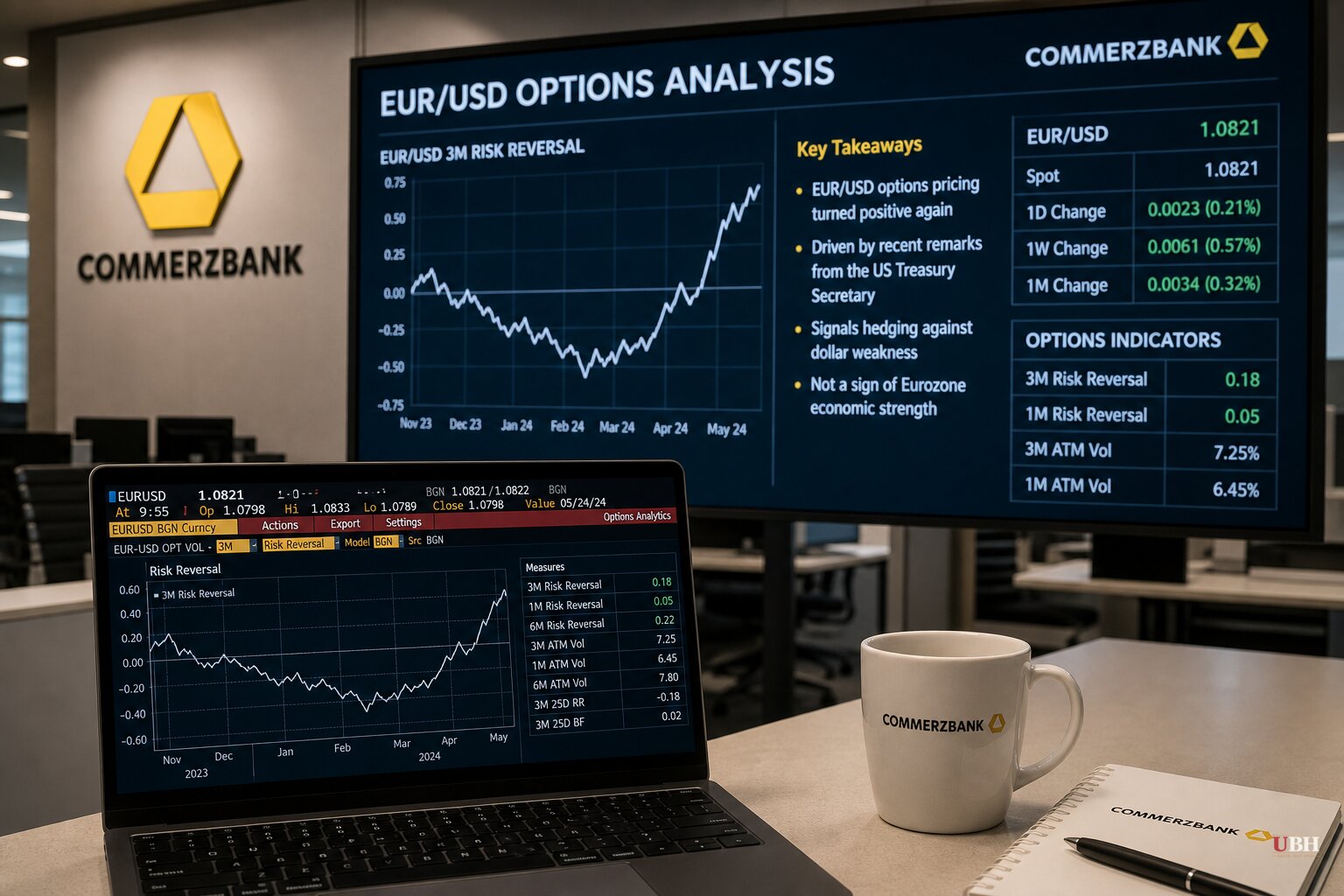
Currency traders are once again paying up to protect against a weaker dollar, according to a note from Commerzbank's Michael Pfister covered by FXStreet and carried separately by CryptoRank. The signal comes from EUR/USD risk reversals, an options-market gauge of which direction traders are hedging against, and it just flipped positive again.
Risk reversals track the relative cost of buying protection against the euro rising versus the dollar rising. When they go positive, it means traders are willing to pay more to guard against dollar weakness. Pfister says that shift happened again after comments from the US Treasury Secretary, though FXStreet's writeup does not name him or quote the remarks directly.
This isn't new territory. Pfister traces the pattern back to what markets nicknamed "Liberation Day," the White House's April 2025 rollout of sweeping tariffs, which he says kicked off a stretch running into late February of persistently positive EUR/USD risk reversals. He now argues that stretch, not the calm that followed, was the real pattern.
"It now seems reasonable to assume that the period from early April last year to the end of February was the exception rather than the rule, after all, we have consistently observed positive EUR/USD risk reversals," Pfister said, according to FXStreet.
Iran conflict added a second layer
The war between the US and Iran added its own wrinkle. Pfister says risk reversals initially snapped back toward their pre-tariff levels once the conflict began, because the eurozone was hit harder than the US by the disruption to oil and gas supplies.
That tension has not fully cooled. The Epoch Times reported the US struck two Iranian rocket launchers loaded with sea mines in the Strait of Hormuz, and that Washington renewed a global travel warning to Americans over Iran-related threats following those strikes. FXStreet separately noted GBP/USD sliding toward 1.3500 as "ongoing tensions in the Middle East provide some support to a safe-haven currency such as the US Dollar."
But Pfister says once the fighting settled down, risk reversals drifted slightly negative again, meaning traders were positioning for dollar strength, not weakness, amid very low implied volatility. He calls that outcome consistent with the old pre-tariff relationship. When nobody expects big swings, nobody pays up to hedge against them.
The caveat Pfister himself makes
A skeptic could reasonably ask whether six trading days of options pricing means anything at all. Pfister raises that exact concern himself.
"Of course, six trading days' worth of data are too few to draw clear conclusions. The trend must therefore be monitored further over the coming weeks," he said, according to FXStreet.
That's an important qualifier missing from headlines that presented the note as a clean "euro benefits from US doubts" storyline. CryptoRank's writeup, credited to Jayshree for Bitcoin World, compressed the same Commerzbank material into an AI-generated summary asserting the pricing "is supporting the euro despite weak eurozone fundamentals," a framing that states as settled fact what Pfister presented as a tentative, data-thin signal.
Pfister's actual argument is narrower and more honest about its limits. Political signals out of Washington, not eurozone economic performance, appear to be driving demand for dollar-weakness hedges. He admits that link is "difficult to back up with data" even as he sees the pattern in the pricing.
What comes next
FXStreet flagged the US August jobs report, due Friday, as the next major data point traders will use to reprice the dollar. A weak print would test whether the positive risk-reversal trend Pfister is tracking actually holds, or whether it fades the way it did after the Iran conflict wound down.
Until more sessions of data come in, the pattern is plausible, the mechanism is unproven, and the market hasn't forgotten what "Liberation Day" volatility felt like.
Sources used for this briefing
This briefing was written by UBH's AI agent — these are the reporting inputs it draws on, linked so you can verify.


