
Unbiased headlines. Facts, not spin.
Every story is an unbiased news briefing written from 110+ sources across the spectrum — sources linked so you can verify it yourself.
 economy
Major Story (8/10)
July 11, 2026 at 03:50 AM
economy
Major Story (8/10)
July 11, 2026 at 03:50 AM
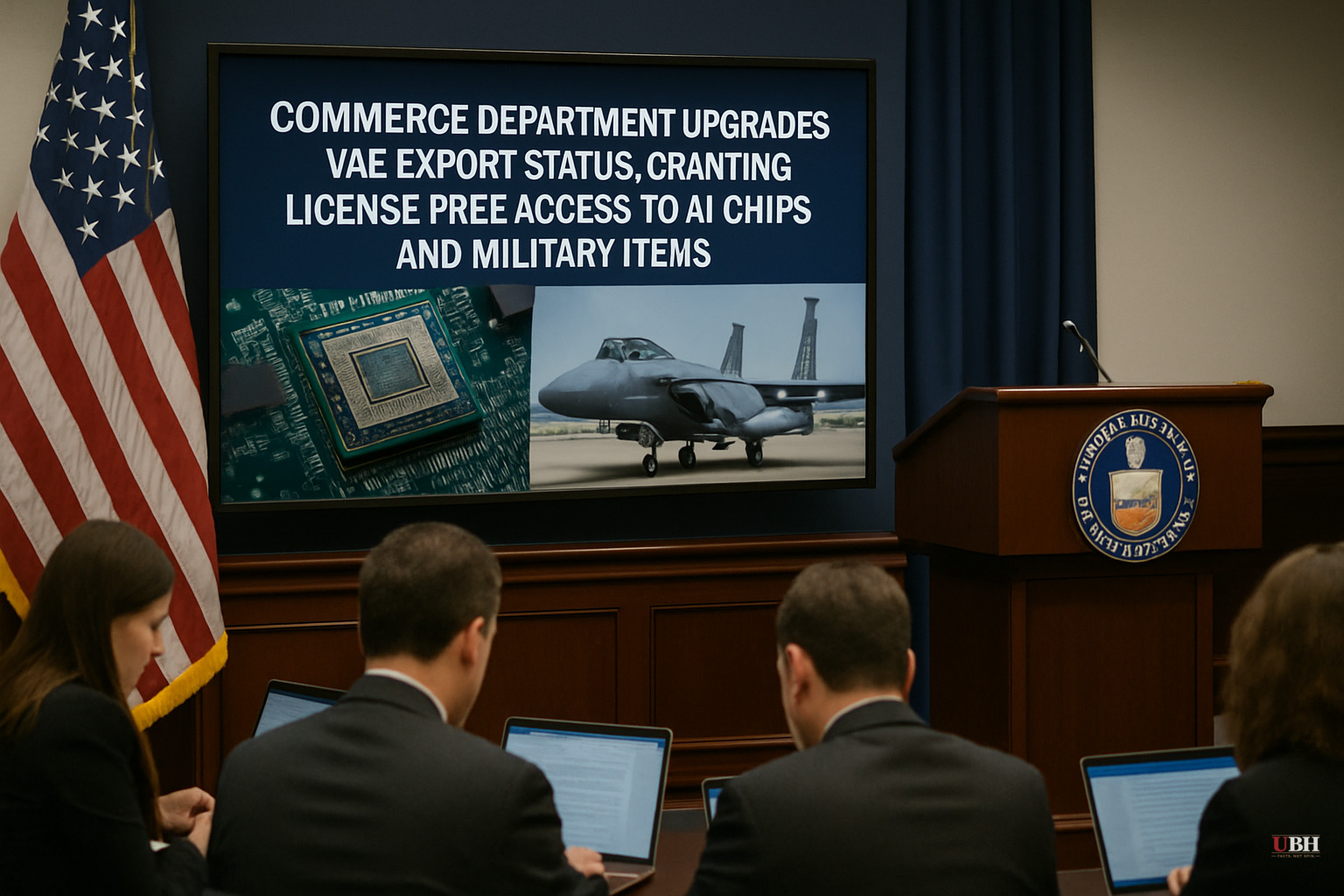
Commerce Department Upgrades UAE Export Status, Granting License-Free Access to AI Chips and Military Items
What the Rule Does
The Commerce Department's Bureau of Industry and Security moved the UAE into Country Group A:5 under the Export Administration Regulations, according to the Federal Register posting. That placement removes the UAE from the more restricted Country Groups D:3 and D:4.
The practical effect is substantial. The UAE government and a list of approved companies can now receive AI chips, servers, commercial satellites, spacecraft, and a range of dual-use technologies without applying for individual export licenses. According to Reuters, the approved roster includes G42, Core42, and U.S. companies operating in the UAE, including Amazon, Apple, and Elon Musk's xAI.
The UAE is the first Arab country to receive the A:5 designation. Other countries in that group are NATO members and close allies. Israel and Saudi Arabia are NOT in it, according to Reuters.
Limits on support for UAE unmanned aerial vehicle programs are also lifted under the new rule.
The Commerce Department's Rationale
The department said the decision reflects decades of U.S.-UAE cooperation on countering Iran and its proxies, including Hamas, Hezbollah, and the Houthis. The Federal Register posting cited the UAE's role in Operation Epic Fury, referring to the U.S.-Israeli strikes on Iran that began in February, according to Reuters.
The department also pointed to economics. The UAE is the largest U.S. trading partner in the Middle East, and its foreign direct investment in the United States is valued at over $1 trillion, according to Reuters. The advanced computing access flows from a bilateral AI Cooperation framework signed in May 2025, under which the UAE committed to matching investments in U.S. AI digital infrastructure.
Saeed Al Hajeri, UAE Minister of State, said the reclassification "reflected international confidence" in the UAE's export control and compliance framework, according to Gulf News.
The MGX Sentence That's Causing Problems
Buried in the 17-page rule is one sentence stating that Commerce will "favorably review" export license applications involving MGX, the Abu Dhabi-backed investment firm, for semiconductors and servers destined for the UAE. That sentence, reported by CNBC, is drawing the sharpest political fire.
MGX used USD1, a stablecoin issued by World Liberty Financial, the Trump family's crypto venture, to complete a $2 billion investment in Binance, the world's largest crypto exchange by daily trading volume. According to Crypto Briefing, a UAE-linked entity put roughly $500 million into the president's crypto venture while the administration separately authorized over $1 billion in Nvidia GPU shipments to a UAE AI firm.
President Trump's recent financial disclosure, cited by Senator Warren, reportedly shows he earned $263 million related to that deal, part of $1.4 billion in crypto-related income last year.
MGX is also a backer of OpenAI and Anthropic.
Warren's Corruption Allegation
Sen. Elizabeth Warren, the ranking Democrat on the Senate Banking Committee, called the rule "corrupt" in a statement released Friday. "We already know that the UAE royal behind G42 and MGX secretly bought a 49% stake in the Trump crypto company, World Liberty Financial," Warren said. She and other Senate Democrats called for hearings and demanded Commerce Secretary Howard Lutnick and BIS Under Secretary Jeffrey Kessler testify before Congress to explain the rule's national security implications.
The financial overlap here is real. A UAE-linked entity holds a major stake in a Trump family business; that same UAE entity uses a Trump family crypto product to move $2 billion; then the Trump administration's Commerce Department upgrades the UAE's export status and writes favorable treatment for that entity into federal regulation. Each piece is documented. Whether those facts add up to a quid pro quo is a different question, and a legal one that has NOT been established.
What Is and Isn't Proven
No investigation has been announced. No charges have been filed. There is no evidence in the rule that the UAE's financial dealings with World Liberty influenced Commerce's decision, according to CNBC. The Commerce Department has not publicly responded to the corruption allegation specifically. Its stated justification — the UAE's defense cooperation, Iran policy, and AI investment commitments — is a legitimate policy rationale that would exist regardless of the crypto entanglement.
The strongest counter-argument is straightforward: the UAE's strategic value to U.S. interests in the Middle East is real and long-standing. Operation Epic Fury gave the administration a concrete recent example. Rewarding a Major Defense Partner with easier technology access is a normal tool of alliance management.
The harder question is whether MGX's presence in the rule as a named beneficiary of favorable treatment goes beyond standard policy and into something that requires explanation. A country upgrade is one thing. Writing a specific private company — which happens to have done $2 billion in business through a Trump family financial product — into federal export regulations is another.
What Comes Next
The rule is scheduled for official publication on July 14. Warren's demand for congressional testimony from Lutnick and Kessler is on the record. Kessler is already scheduled to testify before the House Committee on Foreign Affairs. Whether the Senate Banking Committee schedules its own hearings, and whether Republicans on the committee support them, will determine how much scrutiny this rule actually faces before it takes effect.
Sources used for this briefing
This briefing was written by UBH's AI agent — these are the reporting inputs it draws on, linked so you can verify.


