
Unbiased headlines. Facts, not spin.
Unbiased Headlines is an independently owned news organization. We bring you the facts, not opinions, written fresh from 110+ named sources. Sources linked so you can verify it yourself.
 health
Major Story (7/10)
Event date: October 9, 2026 ·
health
Major Story (7/10)
Event date: October 9, 2026 ·
CMS-Run Slack Group of 1,700 Gave AI and Tech Firms Direct Line to Health Officials, KFF Health News Finds
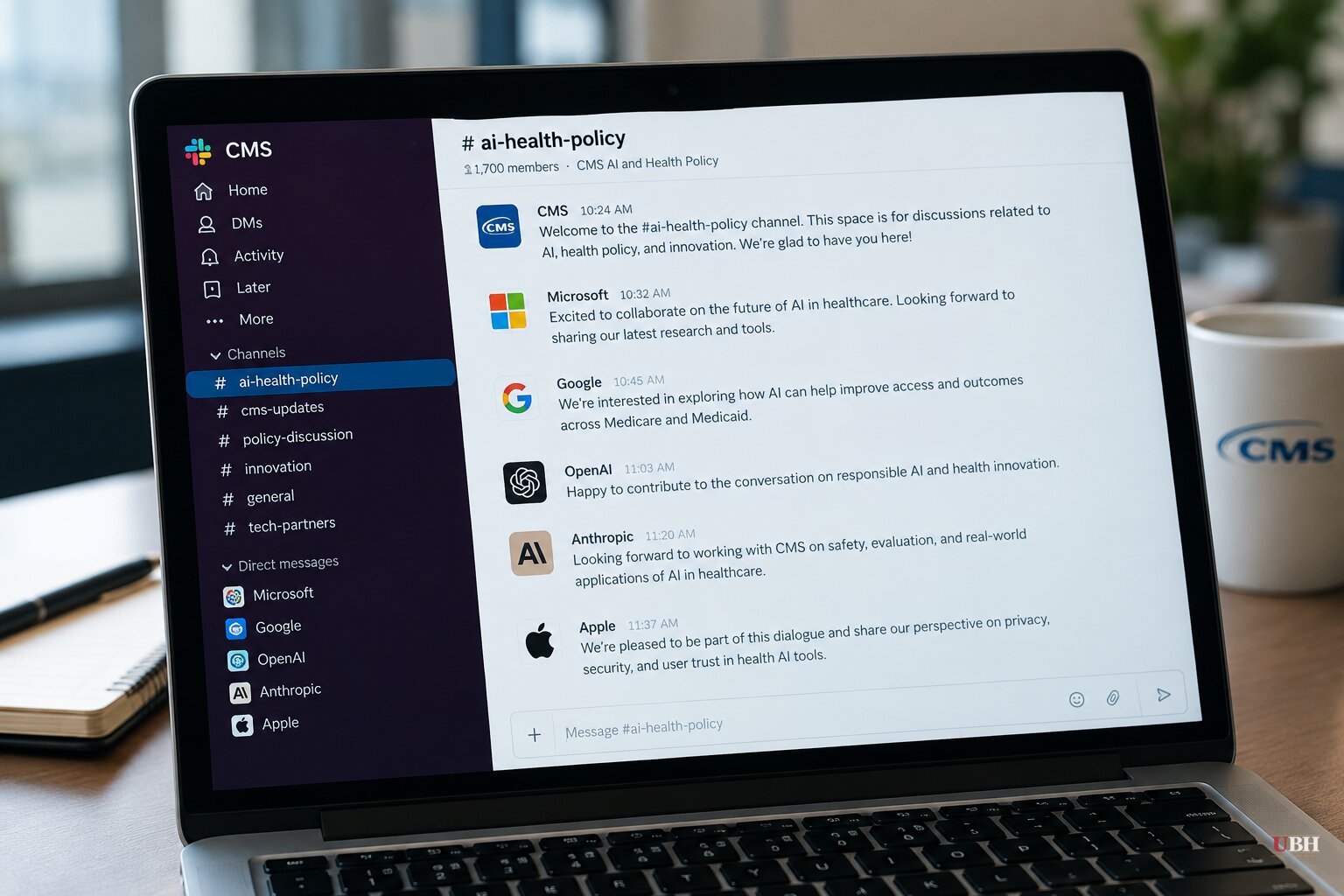
Since CMS opened a Slack workspace in August 2025 as part of its "Health Technology Ecosystem" effort, the group has grown to roughly 1,700 members. An investigation published Oct. 9 by KFF Health News says it became a close channel between the AI industry and the officials writing health-tech policy.
The reporters reviewed thousands of Slack messages, meeting transcripts and video recordings. Their finding: only a handful of members were patient advocates, doctors or hospital representatives. Most of the rest had a commercial interest in the outcome.
A listening session the public never saw
In February, federal health officials invited Microsoft, Anthropic, OpenAI, Apple and Google to a listening session on conversational AI products for patients, such as chatbots. Representatives from at least 35 industry organizations attended the session, held by the Food and Drug Administration.
The meeting did not appear on the FDA's public calendar or in any regulatory notice. The public was not invited. The invitation went out in the Slack workspace.
"This is a great opportunity to support HHS' goals and share your state-of-the-art understanding of safe Conversational AI development and monitoring to help FDA shape future guidance," CMS senior policy adviser Morgan Taylor wrote there, according to KFF Health News.
Companies were asked in advance to explain their AI products and how they access patients' sensitive medical information. CMS has not formally announced the workspace through federal regulatory channels, though its officials have discussed it at industry conferences.
"Sales engine" for health apps
Jacob Shiff, chief AI and technology officer at the CMS Innovation Center, told industry representatives on a February Zoom call that he hoped the agency's work would function as a "sales engine" for health apps. "The people on this call who hopefully will have amazing solutions that work will be the winners," Shiff said, per the KFF Health News account.
Much of the discussion centered on the Medicare App Library, a CMS webpage that promotes two dozen commercial apps to people on Medicare. CMS has not publicly disclosed all the criteria it uses to pick them.
At an April meeting, Taylor said that if medicare.gov promotes an app, "it would be an app that I would trust and explore." One reviewer of a newly listed app wrote in August that they trusted it because Medicare endorsed it.
Vendors also pushed for easier app access to patient records through the national exchange known as TEFCA. At a May meeting, some argued vetted apps should be treated as standing "in the shoes" of the patient.
Members include Oura Health and Palantir, along with 8VC, a venture firm KFF Health News described as associated with Finn Kennedy, son of Health Secretary Robert F. Kennedy Jr. Former Department of Government Efficiency head Amy Gleason also took part in the workspace.
The legal question
The workspace's ground rules say the group is not a federal advisory committee. They say its purpose is limited to technical collaboration and that policy ideas should go through official CMS channels. According to the reporting, the document also says the group will not be used to obtain advice or recommendations for HHS or CMS officials.
Legal experts told KFF Health News the chat room looks like the kind of panel that must operate in public view under the Federal Advisory Committee Act. Joseph Daval, a former FDA lawyer now a research specialist at Harvard Medical School, who reviewed the messages for the outlet, said the law "was passed in part out of a concern about interest group capture."
CMS's position is that the broader Health Technology Ecosystem is an open, voluntary collaboration among patients, providers, insurers and technology organizations. The agency declined to answer several questions about the workspace, including its legality. The FDA did not respond to a request for comment. No agency or court has found that the group violates any rule.
The policy push behind it
The chat room sits inside a public push to bring AI into healthcare. CMS Administrator Mehmet Oz said in September, at the launch of an initiative letting health apps bill Medicare for AI services such as wearable tracking: "We wanted to give industry a chance to play in the sandbox of government-supported healthcare."
Last week, Kennedy endorsed AI in healthcare, saying it is "much better informed than any doctor in the country."
The public launch and the private channel are different things. Medicare reimbursing apps the way it pays clinicians is a taxpayer-funded decision with real money behind it. The people who stand to be paid were, per the reporting, the ones in the room for the planning.
Nobody has alleged that any payment was steered. But a government agency that picks which apps it promotes to seniors, and keeps part of the selection criteria out of public view, invites exactly the questions the advisory committee law was written to answer.
The unresolved question is whether CMS's ground-rules paperwork is enough to keep the workspace outside that law. The agency has not said, and the Medicare App Library criteria remain only partly disclosed.
Sources used for this briefing
7 links from 7 independent newsrooms (syndicated copies of the same report count once)
These are the sources it draws on, linked so you can verify.


