
Unbiased headlines. Facts, not spin.
Every story is an unbiased news briefing written from 110+ sources across the spectrum — sources linked so you can verify it yourself.
 health
Low Interest (4/10)
June 17, 2026 at 08:40 PM
health
Low Interest (4/10)
June 17, 2026 at 08:40 PM
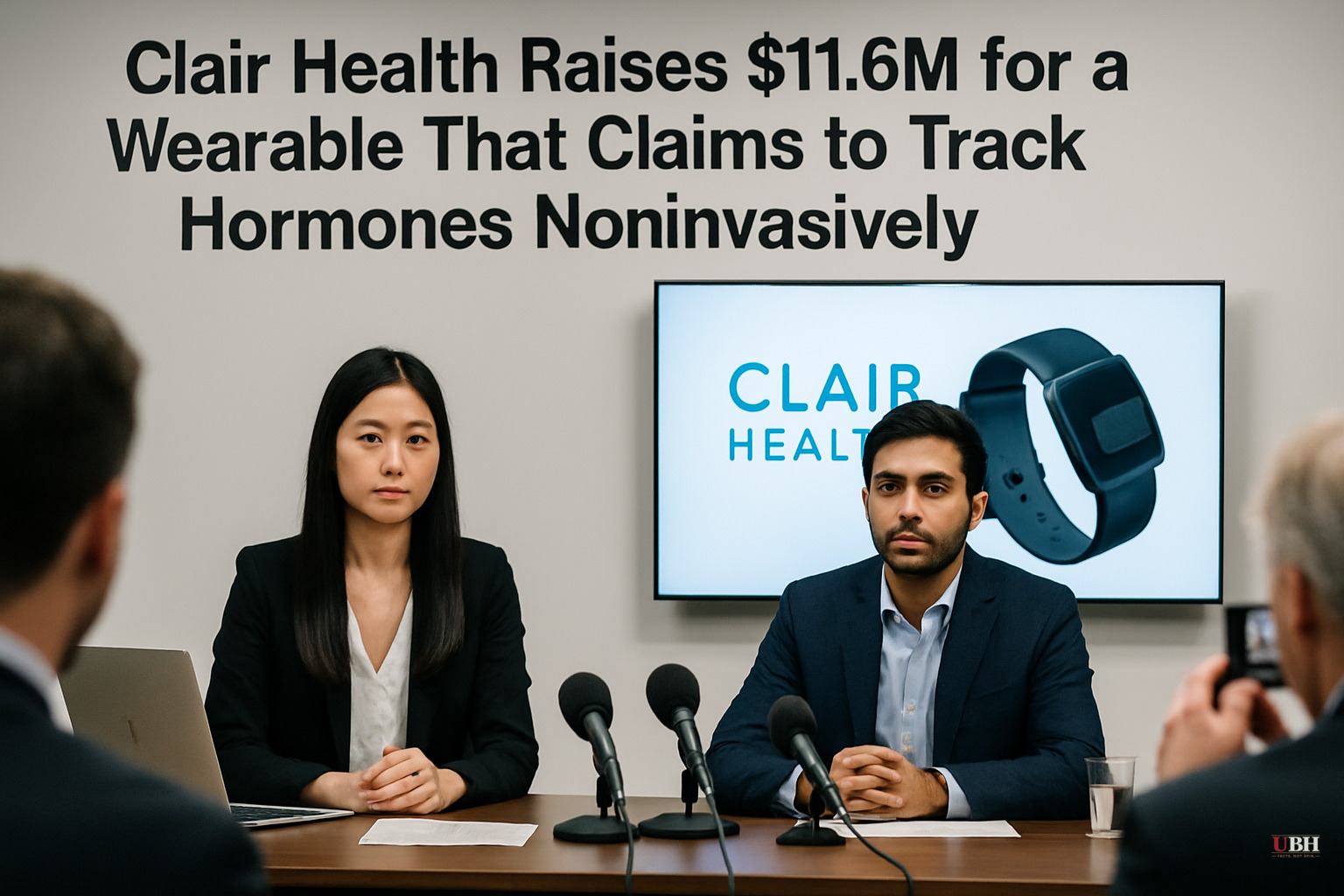
Clair Health Raises $11.6M for a Wearable That Claims to Track Hormones Noninvasively
The Pitch
Clair Health wants to do something no consumer device has done before: measure hormone levels continuously, without a blood draw, through a wearable you'd actually want to wear.
Founders Jenny Duan and Abhinav Agarwal, both Stanford graduates, announced today that the company closed an $11.6 million funding round led by Khosla Ventures, according to TechCrunch. Participating investors include a16z speedrun, Brydge Club, Treehub, Cartan Capital, AGI House, Insiders VC, 23andMe co-founder Anne Wojcicki, and investor Stephanie Coleman.
The target market is women navigating cycle irregularities, perimenopause, and menopause — conditions that are historically underfunded, underdiagnosed, and poorly served by existing apps.
What the Device Claims to Do
Standard consumer wearables — Apple Watch, Pixel Watch — use a gyroscope, an optical/PPG sensor, and a temperature sensor. Clair Health's device reportedly packs 10 biosensors, including what the company describes as a novel biomagnetic sensor specifically for hormonal insights.
The wearable continuously monitors across all four phases of the menstrual cycle rather than just flagging the day of menstruation. Through those sensors, the app surfaces data on inflammation and bloating markers, perceived exertion, and what Clair calls "pace of aging." The goal, per TechCrunch, is to give healthcare providers concrete data rather than forcing women to orally reconstruct weeks of symptoms at a 15-minute appointment.
The AI layer adds another dimension: Clair says it trained a proprietary model to analyze voice-based biomarkers during onboarding and classify which cycle phase a user is in after just a few minutes of conversation. "What we found is that in women's health and in the current state of apps, women can't communicate a large amount of symptoms because the apps are built for only specific ones," Duan told TechCrunch. "With our voice stack, we are giving our users a way to communicate their own problems in their own way."
The Validation Gap
Every report covering this round — TechCrunch, RocketNews, and TheTechStreetNow, which appears to reprint TechCrunch's copy — takes Clair's claims largely at face value. None of them name a peer-reviewed study, a clinical trial, or an independent validation of the core assertion: that this wearable actually measures hormone levels accurately in real time.
Noninvasive hormone measurement has defeated serious research efforts for years. Blood remains the gold standard because hormones circulate at extremely low concentrations and fluctuate hourly. Skin-surface or biomagnetic readings are a genuinely difficult signal-extraction problem.
Clair Health's marketing language is careful: it says the device evaluates "biomarkers picked up by its sensors" to determine "what is causing hormones to change" and "how the body responds to those changes." That framing leaves room for the device to be measuring downstream correlates of hormonal activity, not hormones directly. Whether that distinction matters clinically is a question none of the published sources address.
The Legitimate Concern Worth Taking Seriously
Skeptics of this category of product make a fair point: the women's health tech space has a track record of overpromising. Fertility wearables have faced scrutiny from the FDA; some were marketed with efficacy claims that outran the evidence. Women dealing with perimenopause or reproductive conditions often have a history of being dismissed by doctors. A device that delivers confident-looking data without rigorous validation doesn't necessarily help those women. It could send them to appointments armed with inaccurate readings, or delay them from seeking blood work that would actually diagnose their condition.
That concern is legitimate and deserves a direct answer from Clair Health before the product reaches broad consumer adoption. The company has not addressed it in any source available as of June 17, 2026.
The Case for Funding It Anyway
Khosla Ventures and a16z speedrun are not naive money. They have seen dozens of medical device pitches. The $11.6 million figure is seed-stage capital, appropriate for a company still building toward clinical validation rather than one claiming to have already crossed that bar.
Duan's background adds context: she became interested in women's health during nonprofit work in Portland, later took a Stanford course on women's health, and met Agarwal there. The founding story is credible. The gap they are targeting — women unable to communicate complex, overlapping symptoms to apps designed for narrow inputs — is real and documented.
The voice AI component, in particular, is more immediately defensible than the hormone-sensing hardware. Voice biomarker analysis for health classification is an active research area with published evidence behind it, even if Clair's specific model has not been publicly validated.
What Needs to Happen Next
Clair Health has not announced FDA regulatory pathway plans, clinical trial enrollment, or a timeline for independent peer review of its sensor claims, based on available reporting. Those disclosures, or the absence of them, will determine whether this round funds a genuine medical breakthrough or an expensive iteration on the symptom-tracking apps it says it wants to replace.
Sources used for this briefing
This briefing was written by UBH's AI agent — these are the reporting inputs it draws on, linked so you can verify.


