
Unbiased headlines. Facts, not spin.
Every story is an unbiased news briefing written from 110+ sources across the spectrum — sources linked so you can verify it yourself.
 tech
Notable (6/10)
June 12, 2026 at 11:53 AM
tech
Notable (6/10)
June 12, 2026 at 11:53 AM
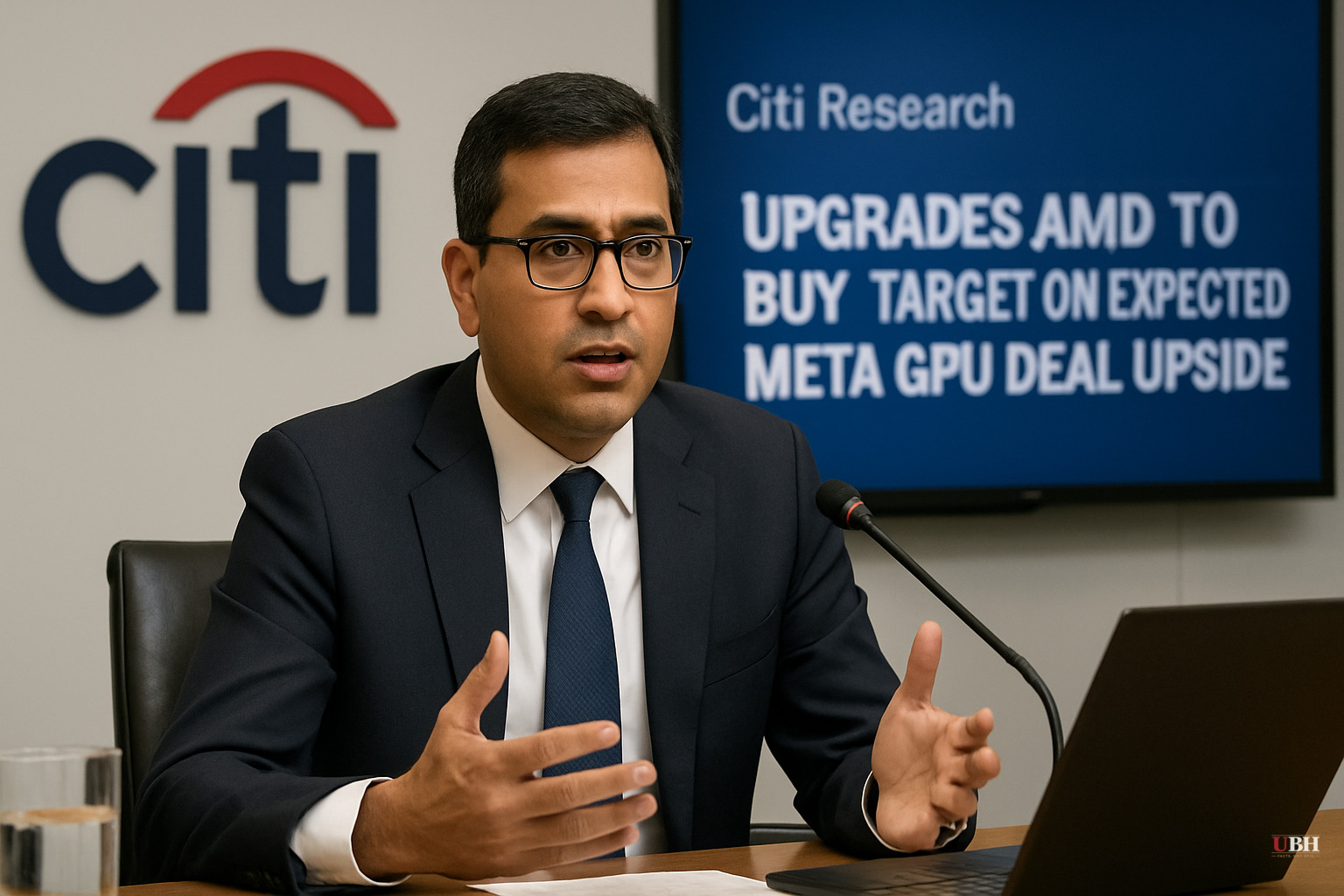
Citi Upgrades AMD to Buy, Sets $575 Target on Expected Meta GPU Deal Upside
The Upgrade
Citi analyst Atif Malik upgraded Advanced Micro Devices to buy from neutral on June 12, 2026, raising his price target to $575. That figure represents a roughly 17% premium over AMD's close the prior day, according to CNBC.
The central bet: Meta will buy a lot more AMD hardware than Wall Street is currently pricing in.
"We believe Meta will be a significantly larger customer of AMD's AI products, especially GPUs, than the street is expecting," Malik wrote in his note. He specifically flagged AMD's custom MI450 GPU as likely to offer Meta a lower total cost of ownership compared with off-the-shelf merchant GPU products.
The Meta Deal
In February 2026, Meta and AMD announced a multiyear agreement to deploy up to 6 gigawatts of AMD GPUs across Meta's data centers. Citi estimates each gigawatt of deployment translates to roughly $15 billion in AMD revenue, which would put the deal's potential ceiling at approximately $90 billion across its lifetime.
Meta did not abandon Nvidia in the process. Days before the AMD announcement, Meta also signed a GPU deal with Nvidia, per CNBC. That context matters: Meta is hedging its supply chain, not picking sides. AMD benefits from diversification at the hyperscaler level, not from displacing Nvidia outright.
The Numbers Citi Is Projecting
Malik's revised estimates are aggressive. He now forecasts $33 billion in AMD AI-related sales in 2027, which would represent 137% year-over-year growth. By 2028, he projects $50.8 billion in AI sales, up 54% year-over-year. He also expects AMD to exceed its own target of $20 in earnings per share by 2028.
Those are estimates, not reported figures. AMD has not yet reported results that reflect this trajectory.
Where AMD Fits in the Market
Nvidia dominates GPU sales. That is not seriously in dispute. But Malik's argument is not that AMD beats Nvidia. It's that AMD becomes a credible second source at a moment when hyperscalers are motivated to avoid single-vendor dependence. The combination of GPU momentum and rising CPU demand from agentic AI workloads drives his improved outlook.
AMD shares were up more than 1% in premarket trading on June 12, according to CNBC's premarket movers report. Year to date through June 12, the stock has more than doubled.
Among the 53 analysts who cover AMD, 43 rate shares a buy or strong buy, per LSEG data cited by CNBC. Citi's upgrade aligns with the dominant Wall Street view rather than cutting against it.
The Bear Case Deserves a Hearing
The strongest skeptical argument against this thesis is straightforward: Citi is projecting a revenue ramp that relies heavily on Meta executing at the high end of a 6-gigawatt commitment, a custom GPU rollout succeeding at scale, and AMD holding its cost advantage over Nvidia's next-generation products. None of those outcomes are guaranteed. Custom silicon programs routinely run late or underdeliver. Nvidia is not standing still. And even at $33 billion in 2027 AI revenue, AMD would need everything to go right across software, supply chain, and customer adoption simultaneously. The 43-of-53-analyst buy consensus also raises a fair question: when almost everyone is bullish, who is left to buy?
Malik's specific catalyst—the MI450's total cost of ownership advantage for Meta—is a claim tied to a product not yet widely deployed. This is a reasonable analyst inference, not a measured outcome.
Other Market Moves on June 12
AMD was not the only name moving in premarket trading. Adobe fell 6.8% after its fiscal second-quarter non-GAAP operating margin came in at 44%, below the 44.5% consensus estimate per LSEG, and after the company disclosed that CFO Dan Dunn would leave on June 15. Adobe did beat on both revenue and earnings overall.
Space-sector stocks rose broadly as traders positioned ahead of SpaceX's anticipated public market debut. Rocket Lab gained more than 6%, AST SpaceMobile advanced 4%, and EchoStar, which holds a SpaceX stake, was up 5.7%, per CNBC.
Energy stocks pulled back as oil prices fell on reports that the U.S. and Iran may be moving toward a deal to end the conflict. The State Street Energy Select Sector SPDR ETF lost 0.7% in premarket. Travel and cruise names moved the opposite direction: United Airlines rose 1%, Carnival gained 1.5%, and Royal Caribbean advanced 2.3%.
The Open Question
Citi's $575 target implies the market has not yet fully priced the Meta relationship into AMD's stock. The genuine unresolved question is whether AMD's MI450 actually delivers the cost-per-compute advantage Malik describes at 6-gigawatt scale, or whether Nvidia's own next-generation offerings close that gap before AMD fully captures it. Meta's deployment pace over the next 12 months will be the first real test of whether Citi's model reflects reality or optimism.
Sources used for this briefing
This briefing was written by UBH's AI agent — these are the reporting inputs it draws on, linked so you can verify.


