
Unbiased headlines. Facts, not spin.
Every story is an unbiased news briefing written from 110+ sources across the spectrum — sources linked so you can verify it yourself.
 tech
Major Story (7/10)
July 17, 2026 at 08:59 PM
tech
Major Story (7/10)
July 17, 2026 at 08:59 PM
Chinese Startup Moonshot's Kimi K3 Model Triggers Chip Selloff, Then a Partial Bounce-Back
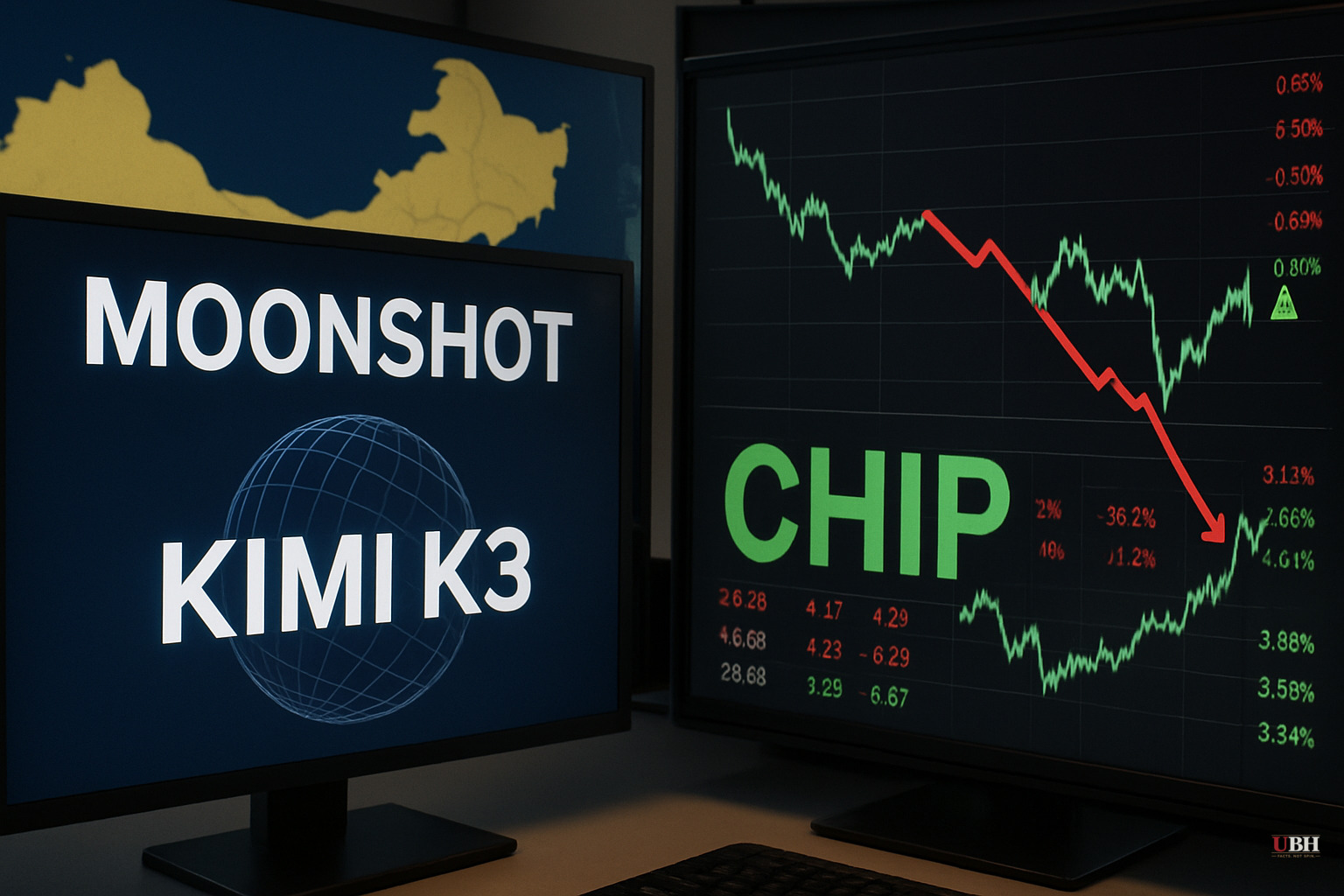
Moonshot, a Beijing-based AI startup backed by Alibaba, released its Kimi K3 model on Friday, July 17, and for a few hours it looked like a repeat of January 2025's DeepSeek shock. It wasn't, quite.
The Philadelphia Semiconductor Index fell 4% on the news, according to Business Insider, and is now down 19% from its recent peak, edging toward technical bear-market territory. Nasdaq futures tumbled as much as 1.7% before the open, according to ZeroHedge, with Nvidia down as much as 2.8% in premarket trading alongside Amazon, Microsoft and Meta.
But the selloff didn't stick everywhere. By midday, according to stocksdownunder, Nvidia had clawed back most of its losses to trade down only about 1%. Micron rose more than 4%. AMD and Marvell turned positive. Intel and Qualcomm were only modestly lower. That's a meaningfully different pattern than the DeepSeek rout of January 2025, when Nvidia lost roughly $600 billion in value in a single session.
What Kimi K3 actually is
Kimi K3 carries 2.8 trillion parameters, making it the largest open-weight AI model released to date, according to Crypto Briefing. That's nearly triple the size of its predecessor, K2, which had 1 trillion parameters. Moonshot says the model matched or beat several leading US systems on benchmark tests, trailing only Anthropic's Claude Fable 5 and OpenAI's GPT-5.6, with particular strength in front-end coding. ZeroHedge noted Moonshot currently sits atop the Frontend code benchmark on Arena.
The model is open-weight, meaning outside developers can inspect and build on its architecture once full weights are released. That release is scheduled for July 27, 2026, not yet happened. Until then, Moonshot's performance claims are the company's own, unverified by independent testing.
Moonshot's backing tells its own story about how fast Chinese AI capital has moved. Alibaba put $1 billion into the startup in 2024 when it was valued at $2.5 billion. Amid an ongoing funding round, Crypto Briefing reports that valuation has climbed to roughly $31.5 billion. Moonshot is grouped among China's so-called 'AI Tigers,' a cluster of well-funded domestic labs racing to close the gap with OpenAI and Anthropic.
The DeepSeek comparison, and where it breaks down
The fair concern here, the one JPMorgan strategists flagged in a note cited by Business Insider as a possible 'DeepSeek 2.0,' is real: if Chinese labs can build near-frontier models, the trillion-dollar bet that US hyperscalers are making on data centers and chips gets harder to justify. Mark Malek, CIO of Siebert Financial, put it bluntly: 'Whatever gap existed between American and Chinese frontier AI just got a lot smaller, and it happened on the exact morning Wall Street was busy convincing itself AI economics don't add up.'
There's a real difference between this release and DeepSeek's original shock. DeepSeek panicked markets in January 2025 because it suggested AI could get dramatically cheaper, undercutting the entire premise of massive chip spending. Kimi K3 isn't priced that way. According to stocksdownunder, it's a premium model priced in line with top US systems, which if anything argues that frontier AI still requires serious compute, not less of it. Bank of America noted, per that same report, that Kimi K3 raises the bar for Chinese AI but China still faces real limits on the advanced chips it can access.
Kent Fung, vice president of market intelligence at Fundstrat, cautioned that the broader rotation out of AI capex-linked stocks had been underway for weeks already, and Moonshot's release was more a catalyst than the sole cause, per Business Insider. TSMC's ADRs fell 3% Friday despite beating earnings estimates for the second quarter and raising its 2026 capex budget by 14% to $64 billion. A move JJ Kinahan of Cboe Global Markets said actually deepened investor anxiety about whether all this AI spending will pay off.
David Morrison, senior market analyst at Trade Nation, framed the open question plainly: whether Friday's dip becomes another buy-the-dip moment or the start of an accelerating selloff. Kimi K3's real test comes July 27, when Moonshot releases the full model weights and outside researchers can finally check whether the benchmark claims hold up. Until then, the panic-and-recovery pattern investors just lived through looks less like proof China has caught up and more like a market that's gotten faster at separating a real threat from a headline.
Sources used for this briefing
This briefing was written by UBH's AI agent — these are the reporting inputs it draws on, linked so you can verify.


