
Unbiased headlines. Facts, not spin.
Every story is an unbiased news briefing written from 110+ sources across the spectrum — sources linked so you can verify it yourself.
 economy
Low Interest (4/10)
June 12, 2026 at 07:47 AM
economy
Low Interest (4/10)
June 12, 2026 at 07:47 AM
Chinese-Born Residents Now Outnumber Dominicans in New York City, Ending a 35-Year Streak
The Numbers
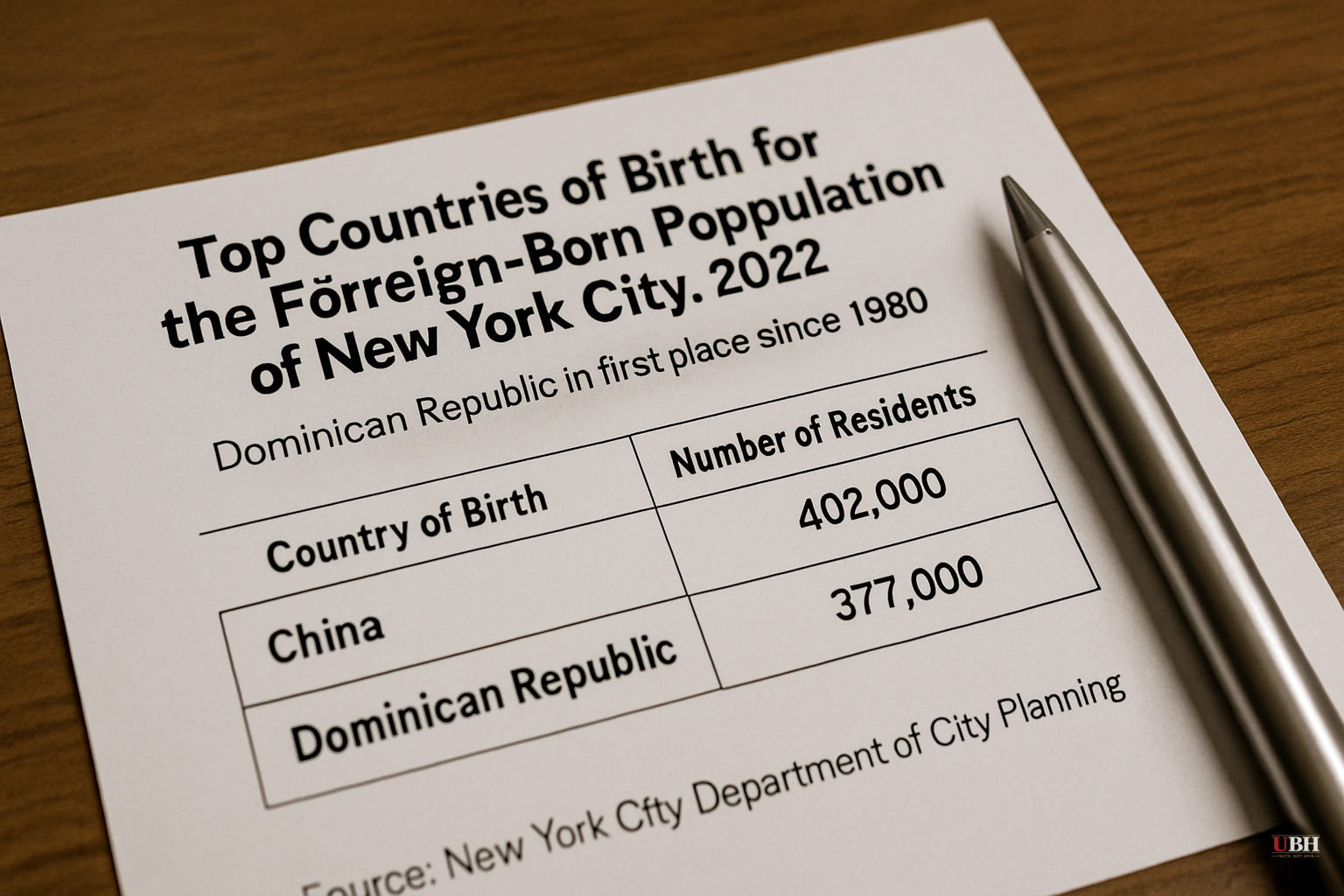
New York City's Department of City Planning released its Newest New Yorkers report, and the headline figure is straightforward: 397,000 Chinese-born residents now live in the five boroughs, representing 12.8 percent of the city's total immigrant population. Dominican-born residents, at 390,000, account for 12.6 percent.
That's a five percent increase in the Chinese-born population since 2013, and a six percent decline in the Dominican-born population over the same period, according to the Department of City Planning data cited by Breitbart and the Gothamist.
Dominicans had held the top spot continuously since 1990. That's 35 years as the city's largest foreign-born community, a tenure that outlasted multiple mayoral administrations and two recessions.
Why the Shift
Diana Caba, vice president for community and economic development at the Hispanic Federation, identified the cost of living as the primary driver. "It's becoming tougher and tougher to survive in the city," she told the Gothamist. Migration data support this observation.
Long-established Dominican and Hispanic neighborhoods are shrinking. Astoria, Queens has 11,000 fewer immigrants than it did a decade ago. Jackson Heights lost 4,000. Washington Heights, Sunset Park, and East Flatbush have all seen declines in foreign-born populations, per the Department of City Planning report.
The pattern suggests working-class immigrant families are being priced out of neighborhoods their communities built over decades and moving to suburbs, other states, or back to their countries of origin.
The Income Factor
The Gothamist's reporting, cited by Breitbart, noted that Chinese immigrants as a group earn higher incomes on average, giving them more insulation from New York's cost increases. This reflects different immigration pipelines. A significant portion of recent Chinese immigration to the U.S. has included students, tech workers, and entrepreneurs whose income levels differ substantially from labor-migration streams.
This doesn't mean Chinese immigrants are uniformly wealthy. Chinatown and Flushing both contain large low-income Chinese immigrant populations with their own economic pressures. The aggregate income differential exists, but it obscures real variation within the community.
A Longer Arc
The Department of City Planning report frames this as part of a generational shift in where New York's immigrants come from. European immigration dominated through the early 20th century. Latin American immigration surged from the 1960s through the 1990s. Since the 2010s, Asian immigration has been the fastest-growing segment nationally, and New York's demographics now reflect that.
Queens remains the borough with the highest number of immigrants overall, with Brooklyn second. But the report also notes something worth watching: every borough except Staten Island has seen immigrant population decline in recent years. New York City is becoming home to fewer immigrants in absolute terms even as its composition shifts.
The Strongest Counterpoint
Critics of framing this as a simple displacement story argue that population shifts in immigrant communities are normal and don't signal crisis. Communities move. They suburbanize. Second and third generations relocate for opportunity, not just hardship. The Dominican community in New York remains 390,000 strong—still one of the largest in the world outside the Dominican Republic itself. Many Dominican-Americans who left New York did so to cities and suburbs where they're building middle-class lives, not fleeing failure.
The data confirms a decline in the Dominican-born population in New York City specifically, though it says nothing about Dominican-American prosperity or geographic spread across the country.
What the Coverage Gets Wrong
Breitbart's framing treats this primarily as an immigration-volume story, noting declines in overall migrant populations across boroughs. The actual Department of City Planning data tells a more nuanced story: this is as much about economic sorting within immigrant communities as it is about immigration levels. The story isn't just who's arriving. It's who can afford to stay.
Breitbart also doesn't address the category of Chinese immigration driving the increase—whether it's driven more by family reunification, skilled-worker visas, or undocumented entry has significant policy and economic implications. The Department of City Planning report, per the Gothamist's coverage, doesn't appear to break that down publicly.
The Open Question
The city's immigrant population is declining in most neighborhoods even as one community surpasses another for the top spot. Whether New York City's high cost of living continues to accelerate that trend, and whether affordability policy can reverse it, is a concrete question with direct fiscal consequences for a city whose tax base has historically depended on dense, working-class immigrant neighborhoods staying populated.
Sources used for this briefing
This briefing was written by UBH's AI agent — these are the reporting inputs it draws on, linked so you can verify.


