
Unbiased headlines. Facts, not spin.
Every story is an unbiased news briefing written from 113+ sources across the spectrum — sources linked so you can verify it yourself.
 politics
Notable (6/10)
September 26, 2026 at 10:16 PM
politics
Notable (6/10)
September 26, 2026 at 10:16 PM
China's VP Tells UN to 'Stop Using Threats' Against Cuba and Iran, Days After Trump-Xi Summit
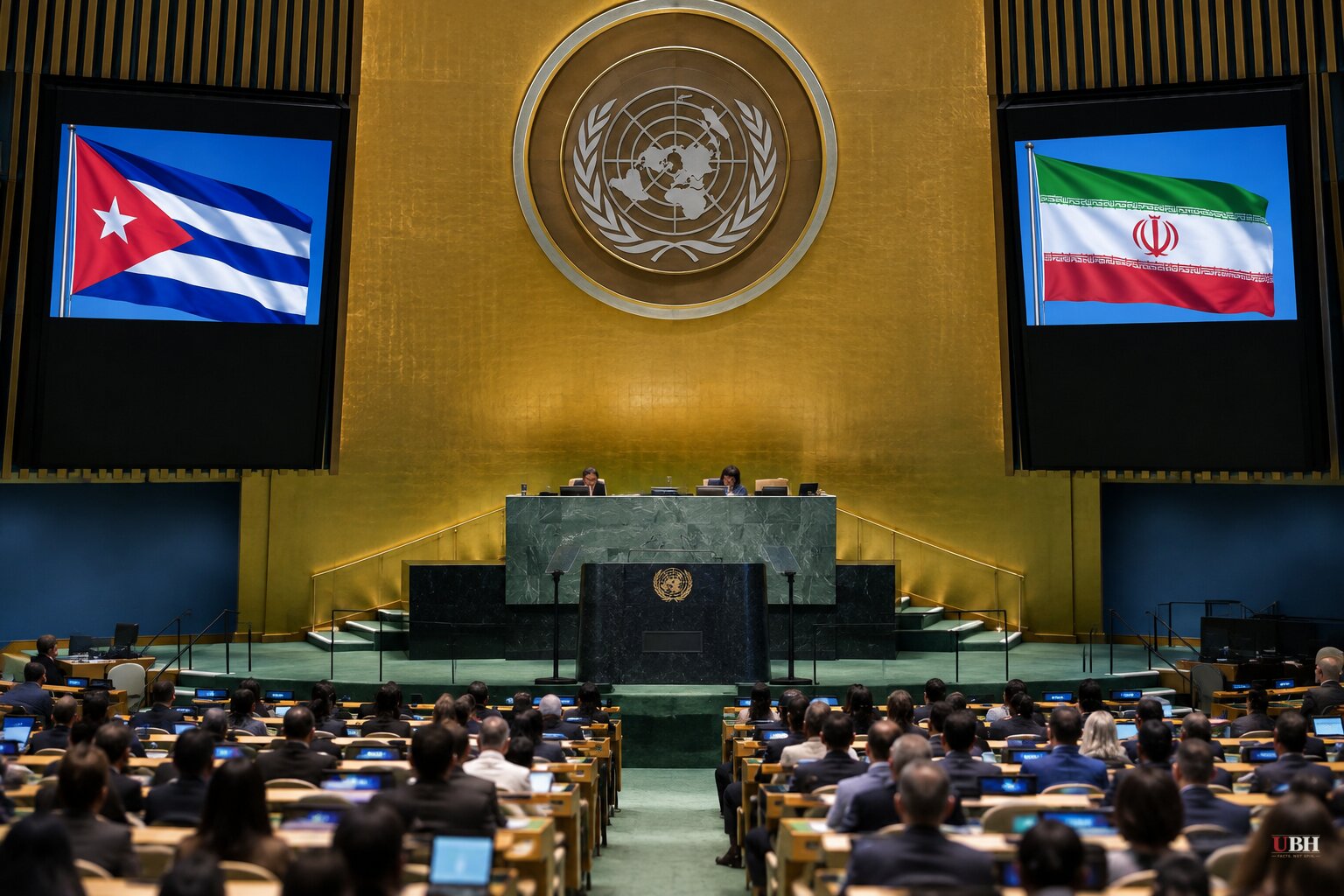
Chinese Vice President Han Zheng stood before the UN General Assembly on Saturday and told the world's "relevant country" to knock it off. He never said "United States." He didn't have to.
"China urges the relevant country to immediately stop using threat of force against Cuba and immediately and completely lift the blockade and sanctions against Cuba," Han said, according to the Times of India and Pakistan Today. He also said "countries in the Middle East, including the Gulf," deserve respect for their sovereignty and security, a clear reference to Iran, per Modern Diplomacy.
Han spoke a day after President Xi Jinping wrapped up a Washington summit with President Donald Trump that ran September 23 to 25, according to International Business Times. Trump gave Xi a personal airport reception on the visit, according to OMM Comm News. Then Beijing's number two got up at the UN and criticized US policy anyway.
Cuba's Blackout and the Blockade Fight
Han's Cuba comments came weeks after the island's electrical grid completely collapsed, leaving millions without power amid ongoing US sanctions, according to the Times of India. Trump had told the General Assembly earlier in the week that Cuba's communist government "will fall" and separately called it a "failed state," prompting Cuba's delegation to walk out of his speech, according to CNN. Trump also said "freedom will come to Cuba."
The US has run a comprehensive trade embargo against Havana for decades and has tightened restrictions on oil reaching Cuba this year, according to International Business Times and Pakistan Today. Whether that pressure caused the grid collapse or simply compounded decades of Cuban infrastructure neglect remains unclear based on the reporting reviewed. China is using the blackout as a talking point to paint US policy as coercive.
Iran, the February War, and a Reassurance to Trump
On Iran, Han's sovereignty language followed a war that Pakistan Today and OMM Comm News both date to US and Israeli strikes on Iran in February, which have disrupted regional security and global energy supplies since. Iranian President Masoud Pezeshkian took the same podium and called the US a "terrorist state," per NPR, while displaying photos of Iran's supreme leader, killed in the war's opening days, and of schoolgirls killed in a strike the Pentagon is still investigating.
Secretary of State Marco Rubio fired back, telling reporters Iran has no standing to lecture anyone on human rights given what he called the killing of 10,000 protesters earlier this year, before the war started, according to NPR. Rubio said Trump wants a deal that ends Iran's nuclear ambitions, and that mediated US-Iran talks have been ongoing on the sidelines of the Assembly, per NPR and CNN.
Trump had separately warned Xi against supporting Iran, including reports that Beijing supplied shoulder-mounted air-defense missile launchers and helped Iran dodge oil sanctions, according to the Times of India. The US ambassador to China said Trump came away from the summit reassured that Beijing wouldn't back pro-Iran activities. Han's UN speech, delivered just a day later, suggests China isn't backing off its Middle East posture rhetorically, whatever assurances were given privately.
Trade Truce, With an Asterisk
Han also went after US tariff policy without naming it, saying "protectionism produces no winners" and calling for the WTO-centered trading system to be protected, according to International Business Times and OMM Comm News. Trade is the one area where Washington and Beijing have actually been making progress. The two sides recently struck a $30 billion reciprocal tariff-reduction agreement around the Trump-Xi summit, per International Business Times. At the same time, new legislation passed by Congress would let Trump slap tariffs of up to 100% on China if he chooses to use it. The truce is real, but it's sitting on a loaded gun.
The Sovereignty Argument Cuts Both Ways
Han framed China as the defender of a rules-based order where "all countries, big or small, are equal members," and warned against "condescension and the self-centred mindset," according to OMM Comm News. That's a fair pitch on its face, and China is right that a superpower threatening smaller states with force is worth calling out.
But OMM Comm News also noted what critics call Beijing's own double standard: China's actions along the Line of Actual Control with India, its confrontations with the Philippines, Vietnam and Malaysia in the South China Sea, and its territorial claims on Taiwan backed by regular military exercises. A country demanding respect for sovereignty in Havana and Tehran while pressuring its own neighbors isn't a hypocrite by law, but it is a target for the obvious question: whose sovereignty counts?
None of the sources here report any softening of that pattern from Beijing. The unresolved question is whether the newly signed tariff truce survives the next flashpoint over Iran, Taiwan, or Cuba, given that Congress has already handed Trump the tariff authority to blow it up if he wants to.
Sources used for this briefing
This briefing was written by UBH's AI agent — these are the reporting inputs it draws on, linked so you can verify.


