
Unbiased headlines. Facts, not spin.
Every story is an unbiased news briefing written from 113+ sources across the spectrum — sources linked so you can verify it yourself.
 politics
Notable (5/10)
September 26, 2026 at 10:54 PM
politics
Notable (5/10)
September 26, 2026 at 10:54 PM
Lavrov Tells UN General Assembly Russia Backs India for Permanent Security Council Seat, Rejects Germany and Japan
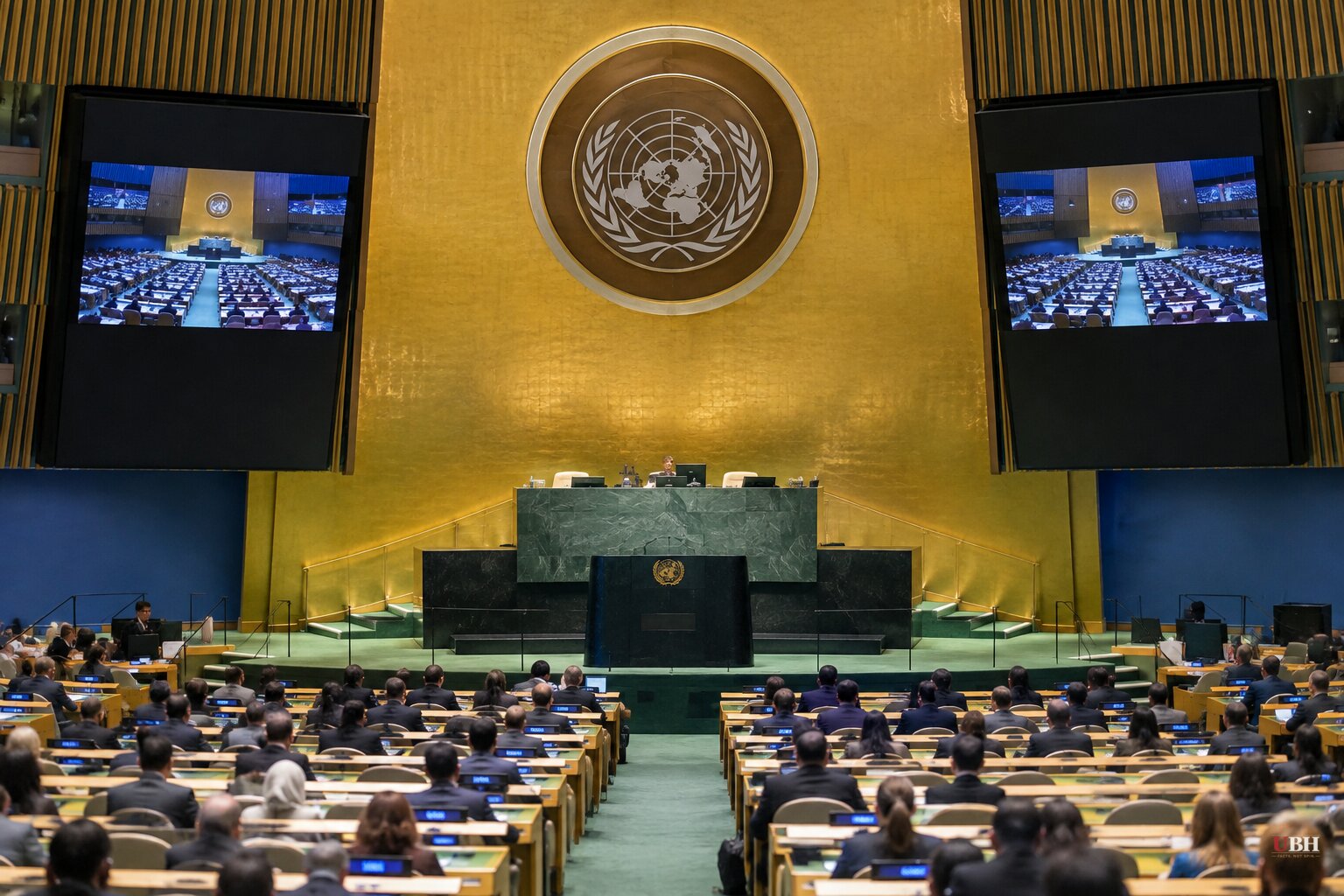
Since Poland, Hungary, Slovakia and Czech Republic publicly backed India's bid for a permanent UN Security Council seat on September 22, the loudest new voice on that question has come from Moscow.
Russian Foreign Minister Sergei Lavrov told the 81st UN General Assembly on Saturday that Russia backs permanent seats for India and Brazil, while flatly opposing any new seats for Germany or Japan. "UN Security Council reform cannot involve any additional seats being allocated to Western countries, especially Germany and Japan, who are now on the path to militarism and revanchism," Lavrov said, according to Mathrubhumi English.
He went further, according to The Daily Jagran, arguing the West is already overrepresented and pointing to who "occupies top ranks of secretariat" positions, claiming those roles are disproportionately held by nationals of NATO member states.
Lavrov has argued for years that the 1945-era Council no longer reflects the current global balance. Moscow reiterated that stance in the 2026 BRICS New Delhi Declaration, where Russia and China both endorsed India and Brazil for a greater UN role, per Times of India.
India's bid picked up other backers at this year's General Assembly session. Mauritian Foreign Minister Dhananjay Ramful said his country supports "the positions of the G4 and of L69 on Council reform" and "reiterate[s] our support for India's candidature for a permanent seat," according to India Today. Portuguese Prime Minister Luis Montenegro called for permanent representation for Africa, Brazil and India.
But the same session showed how contested this remains. The Marshall Islands' President Hilda Heine reaffirmed support for Japan's G4 bid, the same seat Lavrov explicitly rejected. Japanese Prime Minister Sanae Takaichi called for expansion in both permanent and non-permanent categories, according to India Today. Sierra Leone's President Julius Maada Bio and Ghana's President John Dramani Mahama pressed the case that Africa, with more than 1.6 billion people, still has zero permanent seats.
Any UN Charter amendment needs a two-thirds vote in the General Assembly and ratification by two-thirds of member states, including all five existing permanent members, per India Today and Mathrubhumi. The US, UK and France have not endorsed the specific reform package Lavrov described, and Mathrubhumi's own framing notes that "deep divisions over veto power and national candidatures keep formal negotiations deadlocked." The Economic Times, in a piece headlined "India's 30-year wait for a seat has a new twist and an old problem," pointed to the same underlying reality: India has chased this seat for three decades, and endorsements from Moscow or New Delhi's other partners don't move the veto-holders who actually decide.
A skeptic could ask whether Russia's support for India is really about fixing an outdated Council, or about using India as a wedge to keep Germany and Japan, two US treaty allies, permanently out. Lavrov's own words support that reading. His speech wasn't limited to Council math. He accused the West of "continuously pumping weapons into Ukraine" while helping target Russian civilian infrastructure, according to Times of India, and claimed European leaders are "infected with racial superiority" and encouraging what he called "Ukrainian Nazism." He said the West "dismantled the European security system and cultivated a Russophobic regime in Kyiv," and warned of unspecified "consequences."
Those are Lavrov's characterizations, made from the UN podium, not findings from any independent body. No source reviewed here shows Kyiv or Western governments responding directly to these specific claims at this session. The claims about Ukraine being run by a Nazi regime have been part of the Kremlin's public messaging since before the 2022 invasion and remain unproven allegations, not established fact.
Lavrov spoke as Russia's ruling United Russia party, which backs President Vladimir Putin, was cementing what CNN described as its strongest-ever showing in Russia's tightly controlled parliamentary elections, taking 355 of 450 Duma seats on initial Central Election Commission figures. CNN reported that Russia's only registered anti-war party, Yabloko, was barred from the national ballot by the Supreme Court, that more than 2,000 people are jailed for political reasons according to the independent monitor OVD-Info, and that a Yabloko election observer "lost consciousness" while being detained at a St. Petersburg polling station. None of the Council-reform coverage in Times of India, India Today, Mathrubhumi or Daily Jagran mentioned that backdrop.
Whether India's reform push gains anything concrete from Russian rhetoric that doubles as an attack on NATO members remains unclear. Washington, London and Paris may view it as another reason to slow-walk a reform package they haven't agreed to in the first place.
Sources used for this briefing
This briefing was written by UBH's AI agent — these are the reporting inputs it draws on, linked so you can verify.


