
Unbiased headlines. Facts, not spin.
Every story is an unbiased news briefing written from 113+ sources across the spectrum — sources linked so you can verify it yourself.
 politics
Major Story (7/10)
Event date: September 22, 2026
politics
Major Story (7/10)
Event date: September 22, 2026
Mexico's Foreign Minister Tells Bloomberg Sovereignty Comes First, Mexico Sits Out New 15-Nation US Security Pact
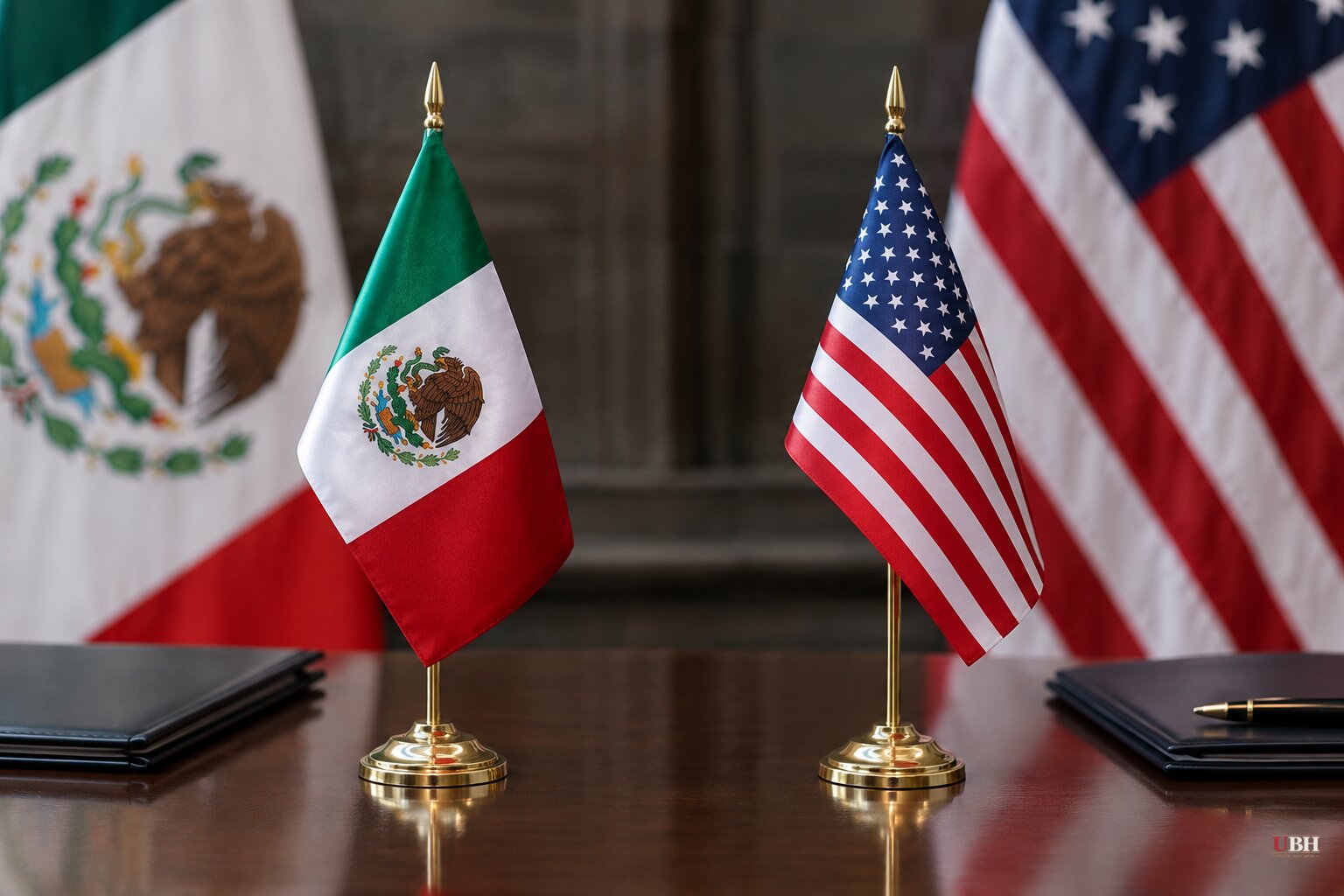
Since President Claudia Sheinbaum told reporters on September 9 that her government "will not sign anything that affects our sovereignty," the fight over how much control Mexico is willing to cede to Washington on trade and cartel enforcement has kept grinding forward on two fronts: tariffs and security.
Mexico's Undersecretary for North America, Roberto Velasco Álvarez, laid out the government's position directly to Bloomberg in an interview airing this weekend. Speaking with hosts David Gura and Christina Ruffini, Velasco said Mexico maintains a strong relationship with the United States but insists any security cooperation has to respect Mexican sovereignty and territorial integrity. He said Mexico remains "cautiously optimistic" about ongoing trade talks and is pushing for relief from US tariffs on automobiles and steel, according to Bloomberg.
That matches what Sheinbaum told reporters earlier this month. She confirmed the US chose to negotiate the USMCA renegotiation separately with Mexico and Canada rather than at one trilateral table, according to Anadolu Agency. She said Mexico is willing to discuss trade items like intellectual property and US drug-patent recognition through Mexico's health regulator, COFEPRIS, but will not accept conditions that undermine the country's ability to make its own decisions.
The pact Mexico didn't sign
On September 22, the State Department released a joint statement called the "Shield of the Americas," built around three pillars: economic cooperation, security cooperation against "narco-terrorist networks," and multilateral coordination, according to the US Embassy in Chile. Fourteen governments joined the US in that declaration: Argentina, Bolivia, Chile, Colombia, Costa Rica, the Dominican Republic, Ecuador, El Salvador, Guyana, Honduras, Panama, Paraguay, Peru, and Trinidad and Tobago.
Mexico is not on that list. Given that Mexico is the country the Trump administration has repeatedly singled out over cartel violence, its absence from a hemispheric security declaration signed by fourteen other nations is notable. None of the sources reviewed explain why Mexico opted out, and no US or Mexican official has publicly addressed the omission. It leaves an open question about whether Mexico was invited and declined, or wasn't part of the drafting process at all.
The timing lines up with a separate message from the US ambassador to Mexico, Ronald Johnson, who told the fifth Binational Convention of the American Society of Mexico on September 23 that Washington wants to expand its security role in Mexico but not as an "interventionist," according to Ground News aggregation of Mexican and Spanish-language coverage including El País and La Opinión. Johnson said "if Mexico is doing well, it's good for the United States, it's just common sense," and separately said the US wants "a sovereign Mexico, without outside interference, but also free of organizations and cartels."
Mexico's sovereignty concern is not new, and not without basis
Mexico's caution here isn't just posturing. According to a report from the human rights monitoring group SIPAZ covering the first half of 2026, the Sheinbaum government protested the US revocation of a visa belonging to Andrés Manuel López Beltrán, son of former president Andrés Manuel López Obrador, calling it interference in Mexican domestic politics. SIPAZ also documented a temporary US suspension of avocado inspections in Michoacán tied to security concerns, which was resolved only after Mexico deployed additional military and National Guard personnel to the region.
That history gives weight to the argument, made by Sheinbaum and Velasco alike, that Mexico has reason to guard against US enforcement actions creeping into domestic political and legal territory under the banner of anti-cartel cooperation. A government asked to accept foreign military assets, foreign-directed investigations, or foreign visa leverage over its own citizens has a legitimate claim to push back, regardless of how bad the cartel problem is.
At the same time, the cartels are not a hypothetical problem. Mexican cartels move fentanyl across the US border and control territory inside Mexico with a level of violence that has driven repeated US pressure campaigns across multiple administrations. Ambassador Johnson's framing, that a stronger Mexico free of cartel control is in both countries' interest, is not controversial on its face. The dispute is over method and control, not over whether cartels are a problem.
None of the sources indicate a resolution date for the USMCA renegotiation or a timeline for whether Mexico will eventually join a security framework parallel to the Shield of the Americas declaration. Velasco's Bloomberg interview did not include specific tariff numbers or a target date for a deal. The steel and auto tariffs Mexico is seeking relief from remain in place as of this week.
Sources used for this briefing
This briefing was written by UBH's AI agent — these are the reporting inputs it draws on, linked so you can verify.


