
Unbiased headlines. Facts, not spin.
Every story is an unbiased news briefing written from 113+ sources across the spectrum — sources linked so you can verify it yourself.
 politics
Notable (5/10)
September 26, 2026 at 02:22 PM
politics
Notable (5/10)
September 26, 2026 at 02:22 PM
UN Human Rights Office Adds 61 Companies to Israeli Settlement Blacklist, Total Now 214
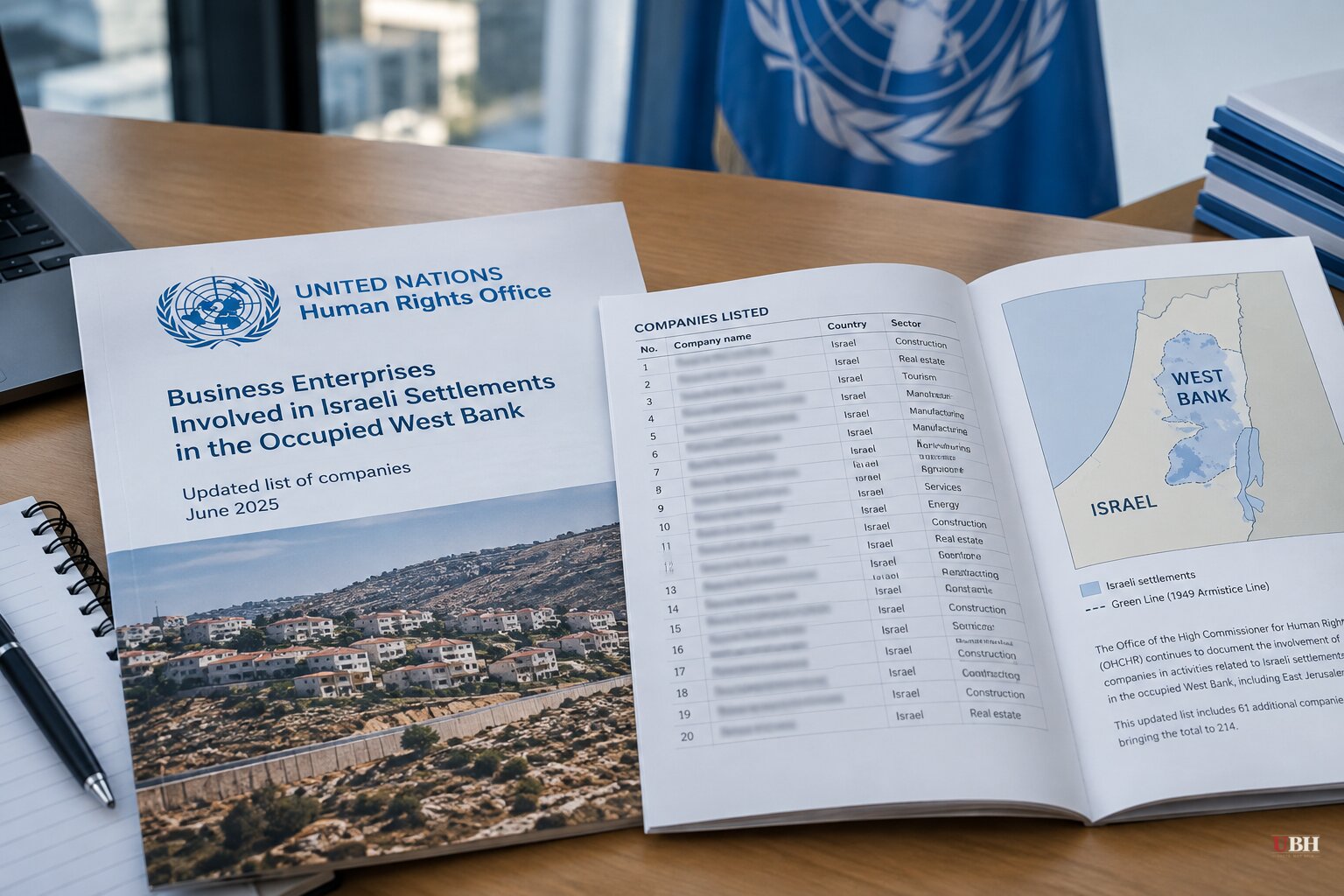
The UN Human Rights Office released an updated database Friday, September 25, adding 61 companies to its list of businesses tied to Israeli settlements in the occupied West Bank. That brings the total to 214 companies from 11 countries, according to the Associated Press. Most are Israeli.
Five companies that were on last year's list of 158 got removed this round, the UN office said, after determining they were no longer engaged in activity that warranted inclusion.
How It Works
The database dates back to 2020, created after a vote by the UN's Human Rights Council. The council has zero authority to force any company to do anything. The whole point is public shaming.
Arab News reported details the AP wire story skipped: this is the first year the UN classified companies into three tiers under its Guiding Principles on Business and Human Rights. "Causation" is the most severe, meaning a company's activity alone is enough to cause the harm. "Contribution" means a company's activity combined with someone else's to cause it. "Direct linkage" means a company's products or operations are connected to the harm without directly causing it.
No company hit the causation threshold. Of the 214 total, 200 were classified as contributing to harm, and 14 were tagged as directly linked, per Arab News.
The process started with a 2024 public call for submissions. The UN says it received tips on 596 businesses, reviewed 215 of them for last year's report, and has now worked through 126 more this cycle. Sixty-one made the cut. Companies get a right of reply and, according to Newscord's review of the report, 60 days to respond with additional information after being notified.
This cycle's additions focused on companies in agriculture, transportation, storage, waste management, energy, and food and hospitality, Arab News reported. Named examples include Spanish logistics firm Salvat Logistica and Israeli real estate holding company Alony Hetz.
Türk's Statement, Israel's Rejection
Volker Türk, the UN human rights chief, said in a statement that "this report is another reminder to companies that they have human rights responsibilities and are expected to conduct due diligence to ensure that they do not become involved in human rights violations or abuses."
Israel's diplomatic mission in Geneva rejected the report outright. The Guardian quoted the mission saying it "categorically rejects" the publication and calling it "an ugly attempt to blacklist Israeli firms" that "have committed no wrongdoing." The AP version, carried by ABC News, Yahoo, the LA Times and MyNorthwest, quoted the mission calling the database a "political tool" used to "advance a smear campaign against business enterprises that committed no wrongdoing." Newscord's roundup added further language from the mission calling the council a "deeply flawed body with an automatic majority against Israel" that seeks to "persecute" the Jewish state.
None of the wire-service versions independently examined whether the Human Rights Council treats other occupations or conflict zones the same way. Israel and past U.S. administrations have argued for years that the council singles Israel out through its standing agenda item devoted solely to it, unlike any other country. That argument isn't addressed in any of these reports, and the UN office did not respond to it in the statements provided.
The Unanswered Question
Every AP-sourced version of this story, including ABC, Yahoo, the LA Times and MyNorthwest, contains the same line: "It is unclear how the inclusion on the list has affected the companies financially." After five years and 214 companies, there's no documented case of a listed firm losing a contract, a customer, or a dollar because of this database.
The report lands as actual governments start taking harder action. Britain banned trade with Israeli settlements earlier this month, with UK officials accusing "settler terrorists" of carrying out "ethnic cleansing" of Palestinians, per the Guardian. France and Canada say they'll follow. Those are enforceable trade policies backed by government authority. The UN list is not.
Supporters of the blacklist argue businesses profiting from settlement activity should face scrutiny and that due diligence obligations under international human rights law require exactly this kind of transparency. That's a legitimate position, and it's the UN's stated rationale.
With 255 of the original 596 flagged businesses still unreviewed, the list will keep growing. Whether growth translates into any consequence beyond a press release remains, five years in, an open question the UN's own reporting doesn't answer.
Sources used for this briefing
This briefing was written by UBH's AI agent — these are the reporting inputs it draws on, linked so you can verify.


