
Unbiased headlines. Facts, not spin.
Unbiased Headlines is an independently owned news organization. We bring you the facts, not opinions, written fresh from 110+ named sources. Sources linked so you can verify it yourself.
 economy
Major Story (7/10)
Event date: October 23, 2026 ·
China's Share of Value-Added Content in Global Imports Rose to 14.3% by 2024, Morgan Stanley Finds, as Beijing Plans Tech Export Bans
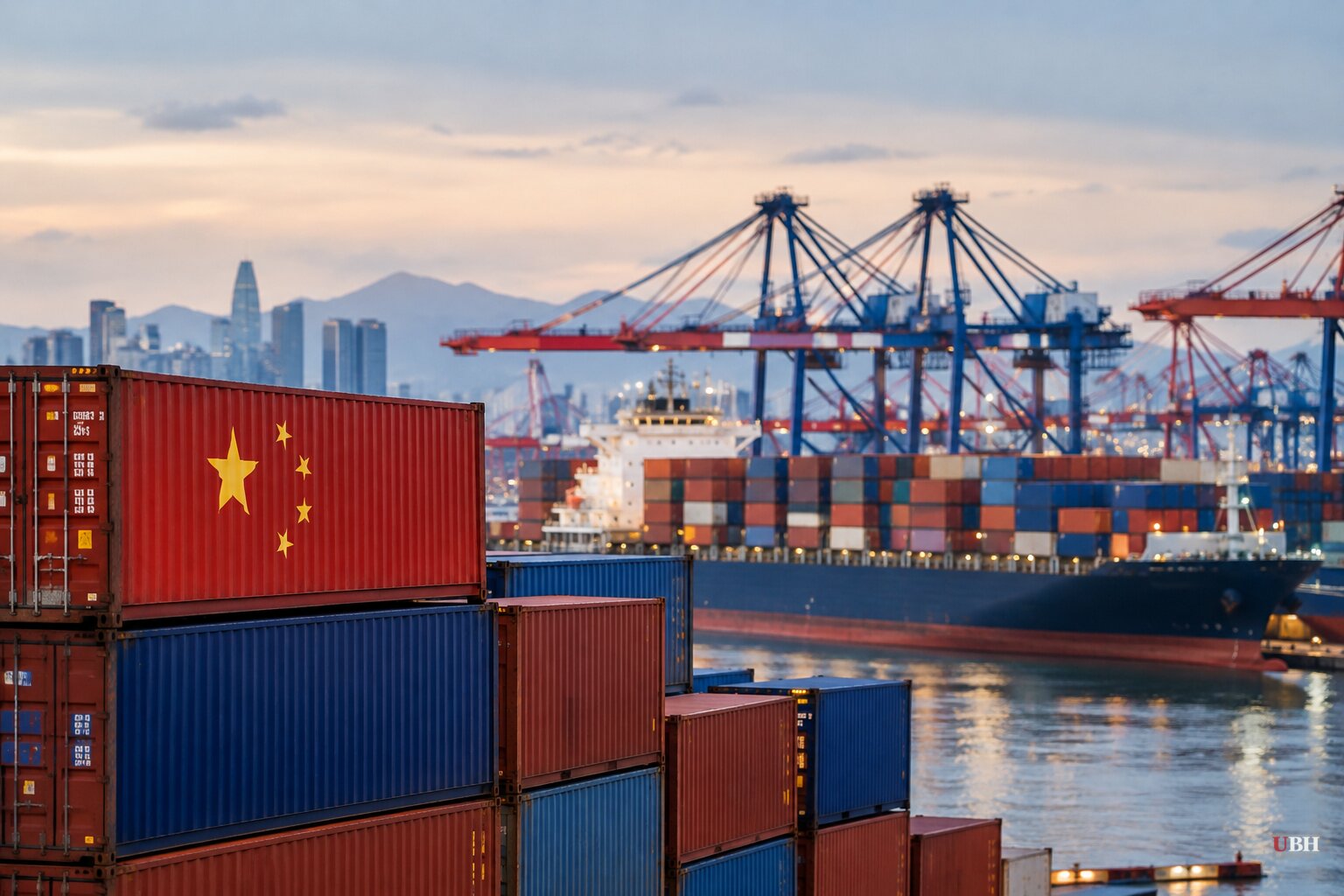
Since Beijing's 2025 rare-earth export curbs and the October 2025 Busan meeting between President Trump and Xi Jinping, the U.S.-China fight has centered on who controls the inputs. New numbers and a new Chinese export list show how far the supply chain still runs through China.
The tariff wall has not moved China out of the supply chain
Morgan Stanley analysts, including chief Asia economist Chetan Ahya and chief China economist Robin Xing, say China's share of value-added content in global imports rose from 12.6% in 2017 to 14.3% in 2024.
Direct shipments tell a different story. The analysts say China's share of direct U.S. imports fell from 22% in 2017 to about 8%.
The gap is the point. Goods assembled in Vietnam, India or Mexico still carry Chinese parts, machinery and know-how. Morgan Stanley estimates the U.S. and EU together account for about 80% of the increase in global reliance on Chinese value-added content.
The pattern shows up country by country. According to the analysts, 55% of the Chinese content Vietnam imports goes into its exports. In India, 52% goes into domestic investment.
India's catch-up effort
India is spending real money to close the gap. Its Electronics Component Manufacturing Scheme, launched in 2025, was expanded to 400 billion rupees (US$4.2 billion) in the 2026-27 budget.
The Indian government says 106 projects had been approved by August and 38 plants had begun production. It also acknowledges continued import dependence for printed circuit boards, camera and display modules, connectors and capacitors.
Neeraj Arora, an Indian hardware engineer who sources parts from Shenzhen, Dongguan and Guangzhou, puts China's electronics experience at 20 to 25 years, against a serious Indian push that began around 2015. He says India could match China's current capability in five to seven years. He also expects China to have moved further ahead by then.
Beijing's list of 40 technologies
China is now preparing to use its position. It plans to ban 14 technologies from export, including AI that generates malicious code, and to restrict 26 others, such as technology for mass-producing polysilicon, a core solar material. A temporary rule already in force requires companies to register with the Commerce Ministry before sending any of the 40 abroad.
The Commerce Ministry has cited security concerns over some listed items, such as AI-powered malware generation.
Taiwanese analysts read it as bargaining. Daphne Shiow-wen Wang of the Institute for National Defense and Security Research said Beijing wants leverage in trade talks so Washington does not press too hard on the deficit. She added that Beijing may also want to warn the EU, which is raising alarms over its own trade imbalance with China, before it imposes penalties.
Lee Chung-chih of the DIMEs Center said Beijing expects Washington to ask for the controls to be eased ahead of the APEC summit, and then to demand something of equal value in return.
Why critics say the leverage may cost China
Tsai Ming-fang, an industrial economics professor at Tamkang University, says the bans will raise costs in dependent countries in the short run. Over the long run, he argues, they will push those countries to get serious about decoupling. He points to solar: China won its lead by undercutting rivals, and the know-how to build panels remains within other countries' reach.
Beijing's side frames it differently. In China Daily, Xu Xiujun and Jiang Ruojun write that multinationals have realized that "instead of exiting China, they need to reassess the value of China's supply chain." They cite the McKinsey Global Institute's description of China as moving from "factory of the world" to "factory to the factories."
The authors say China's goods trade in the first nine months of 2026 reached 39.94 trillion yuan ($5.99 trillion), with both exports and imports growing at double-digit rates year on year. They say September imports and exports topped 5 trillion yuan for the first time, up 27.5%.
Economist Keyu Jin argues in TIME that this model is no longer "politically tenable." China's goods trade surplus hit a record $1.2 trillion in 2025. Jin says Europe fears for its industrial base and developing countries want factories of their own.
Her proposed answer is for China to export capability, not just products. She cites BYD moving from importing cars to building them in Brazil, pairing a Hungarian plant with a research center, and Chinese investment in an Indonesian battery industry.
The minerals chokehold
The harder constraint sits upstream. According to analysis from the Center for European Policy Analysis, China accounts for roughly 60% of rare-earth mining, 90% of processing and separation, and 94% of permanent-magnet manufacturing. It also controls about 94% of battery-grade graphite processing and about three-quarters of cobalt refining.
The analysis says the 2025 export controls forced some automakers to cut production or halt lines. It cites the International Energy Agency's estimate that full enforcement could put $6.5 trillion in annual downstream output at risk.
The suspension of some of those curbs agreed at Busan was set to run to November 2026. It has since been extended to January 2027.
What comes next
The APEC summit is scheduled for Nov. 18 and 19 in Shenzhen, where Trump is expected to meet Xi on the sidelines. The Commerce Ministry has not said when the 40-technology bans would take effect. The January 2027 expiry of the rare-earth pause is the next hard date.
The Morgan Stanley data suggest tariffs cut direct dependence on China faster than they cut the underlying reliance.
Sources used for this briefing
6 links from 6 independent newsrooms (syndicated copies of the same report count once)
These are the sources it draws on, linked so you can verify.


