
Unbiased headlines. Facts, not spin.
Unbiased Headlines is an independently owned news organization. We bring you the facts, not opinions, written fresh from 110+ named sources. Sources linked so you can verify it yourself.
 economy
Major Story (7/10)
Event date: October 17, 2026 ·
Asia Factory Growth Cools in South Korea, Japan and Taiwan as IMF Flags Risk of AI Investment Pullback
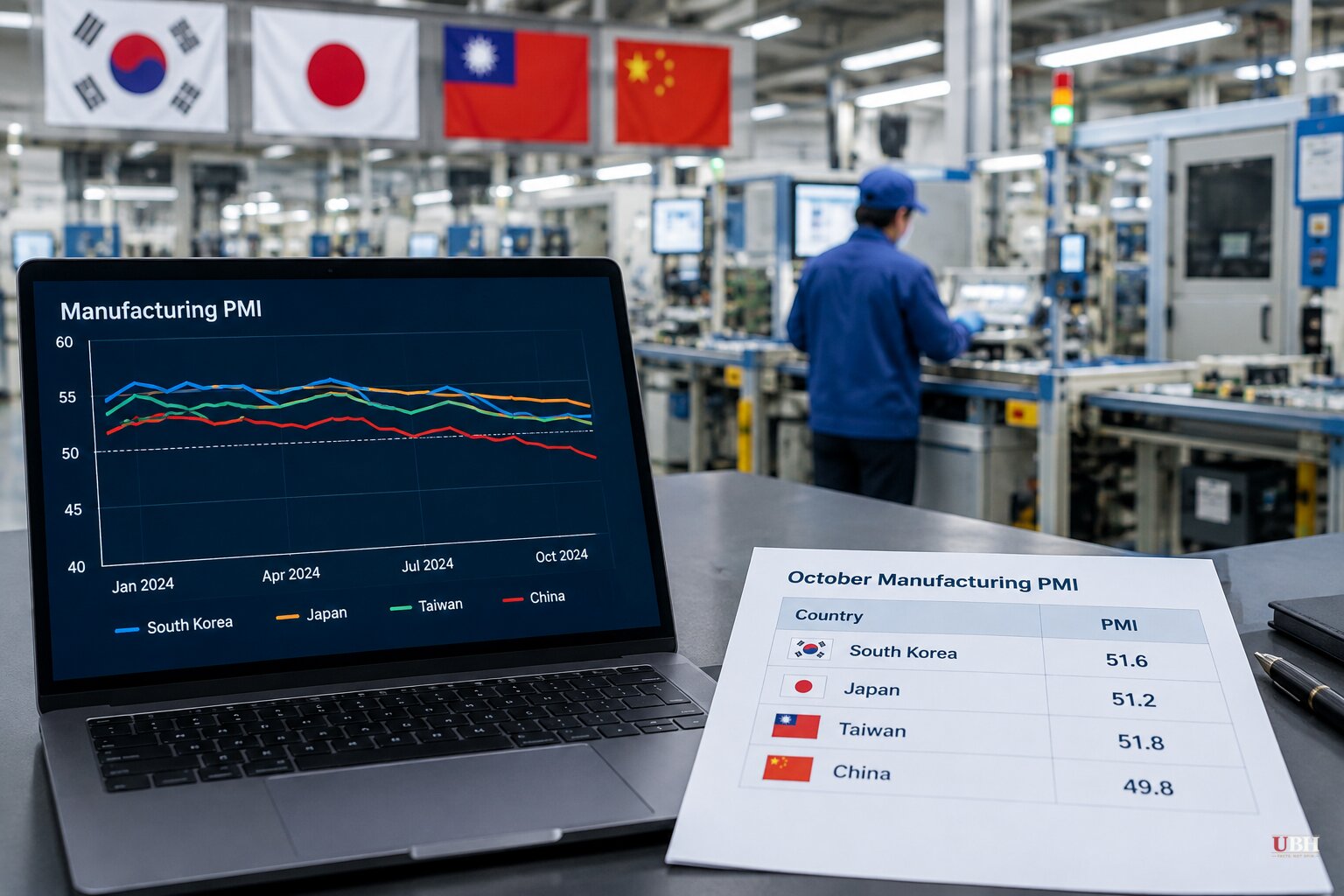
Asia's factories are still growing. They are growing more slowly in the places most tied to the AI chip trade.
S&P Global's October manufacturing surveys, released today, Nov. 2, put South Korea's PMI at 51.3, its lowest in eight months. Japan came in at 53.3, a seven-month low. Taiwan, home to much of the world's advanced chipmaking, posted 54.9, down from 56.7 in September.
Anything above 50 is expansion. None of the three has stopped growing.
China is the exception. Its official manufacturing PMI slipped to 49.3, which means contraction.
The IMF's warning
The surveys land three weeks after the International Monetary Fund used its annual meetings in Bangkok to flag AI as the biggest swing factor in the global outlook. The IMF's October World Economic Outlook, released Oct. 13, forecasts global growth of 3.1% in 2026, down from 3.5% in 2025, and 3.4% in 2027.
In its downside scenario, a steep fall in AI investment triggers a sharp drop in asset prices. Global GDP ends up 1.1% below baseline by 2028, with U.S. output down 1.8%. The IMF's modeling also assumes U.S. stocks fall about 20% in that scenario.
Managing director Kristalina Georgieva put it bluntly at a Bretton Woods Committee event: "We now have an economy that is standing on one leg, the AI leg. What if it wobbles?"
The fund's concern is not only about chips. In a separate Oct. 12 analysis, the IMF said hyperscalers, the largest data-center operators, are "borrowing more and more, while investors have been leveraging to invest in AI stocks."
Its review of 14 circular financing deals among AI firms found roughly $300 billion in equity investment and $650 billion in debt since 2023. In exchange, those deals carry $1.4 trillion in future revenue commitments.
Jason Wu, an assistant director in the IMF's Global Markets Analysis Division, said that if there are doubts about AI monetization, "the equity investments will deplete in value, the debt may be difficult to service, and the revenue commitments in the future may not materialize."
How much of the trade is AI
IMF chief economist Silvana Tenreyro said trade in AI goods grew 29% between 2023 and 2025, more than triple the 8.3% growth in global trade. Strip out AI goods and overall trade growth would have been 4.6%.
The ASEAN+3 Macroeconomic Research Office (AMRO) sees the same dependence in Asia. It says the region accounts for 50% of global sales of AI-enabled and AI-branded goods, and AI-related exports made up two-thirds of its export growth in the first half of 2026.
AMRO chief economist He Dong said the main uncertainty is no longer tariffs or oil prices but whether AI growth momentum holds. AMRO's modeling shows that even a mere slowdown in global AI investment growth in 2027, short of an outright contraction, would cut regional growth by 1.5 percentage points.
The Bank of Korea has run its own numbers. A slowdown in AI-related capital spending could cut South Korea's semiconductor exports by $50 billion to $100 billion, which the central bank says could shave 0.4 percentage points off 2027 GDP growth.
The other side of the ledger
Not everyone treats this as a looming problem. Federal Reserve Chairman Kevin Warsh, speaking with Georgieva at the Bangkok meetings, called AI "probably the most consequential change to the U.S. and the global economy in my lifetime."
Warsh said it hits demand before supply, which central bankers have to treat as a shock. But he called it "a positive supply shock in the medium term" and said economies that put it to good use will be more productive and wealthier. He also warned that the path there is "likely to be a very bumpy one."
The IMF itself modeled an upside. In its optimistic scenario, global total factor productivity rises 0.8% within a decade.
The IMF has also said AI-driven investment is an important offset to energy costs pushed up by the U.S.-Iran war. Its Asia forecast improved modestly from July, with emerging and developing Asia expected to grow 5.1% in 2026 and 4.9% in 2027.
The October PMIs show a cooling in the AI-exposed economies, not a collapse. The surveys do not say what drove the slowdown, and no source ties it to a pullback in AI spending.
China leans on the same engine
China's National Bureau of Statistics reported today that third-quarter GDP grew 4.5% from a year earlier, up from 4.3% in the second quarter and at the low end of Beijing's 4.5% to 5% target. Exports of chips and electronics components helped carry that result.
Domestic demand is still weak. Fixed-asset investment fell 7.2% in the first nine months, and property investment dropped 20.2%. Retail sales rose 1.1% in September, the fastest pace since March.
National Bureau of Statistics vice-minister Mao Shengyong acknowledged that "the problem of insufficient domestic demand remains relatively prominent." The IMF forecasts China at 4.5% growth in 2026 and 4.0% in 2027.
Chipmakers keep investing
The companies closest to the AI trade are still spending. Four people familiar with the plans told Reuters that Samsung Electronics and SK Hynix are upgrading their Chinese memory plants to make more advanced NAND chips.
Both companies confirmed the upgrades to Reuters and said they are being done in close consultation with Washington. Samsung said it is "not expanding production capacity or constructing new manufacturing facilities."
One person said Samsung's Xian plant is being converted to 286-layer chips, with a target of 5,000 wafers a month in December and 40,000 by December 2027. Reuters could not determine how many U.S. export licenses have been granted for the equipment.
Whether AI spending keeps climbing at that pace is the open question for 2027. Samsung's December wafer target, if met, would show at least one major producer still betting on demand.
Sources used for this briefing
7 links from 7 independent newsrooms (syndicated copies of the same report count once)
These are the sources it draws on, linked so you can verify.


