
Unbiased headlines. Facts, not spin.
Every story is an unbiased news briefing written from 110+ sources across the spectrum — sources linked so you can verify it yourself.
 economy
Notable (6/10)
June 16, 2026 at 02:50 AM
economy
Notable (6/10)
June 16, 2026 at 02:50 AM
China's Retail Sales Drop for First Time Since 2022 as Domestic Demand Cracks Under Export Boom
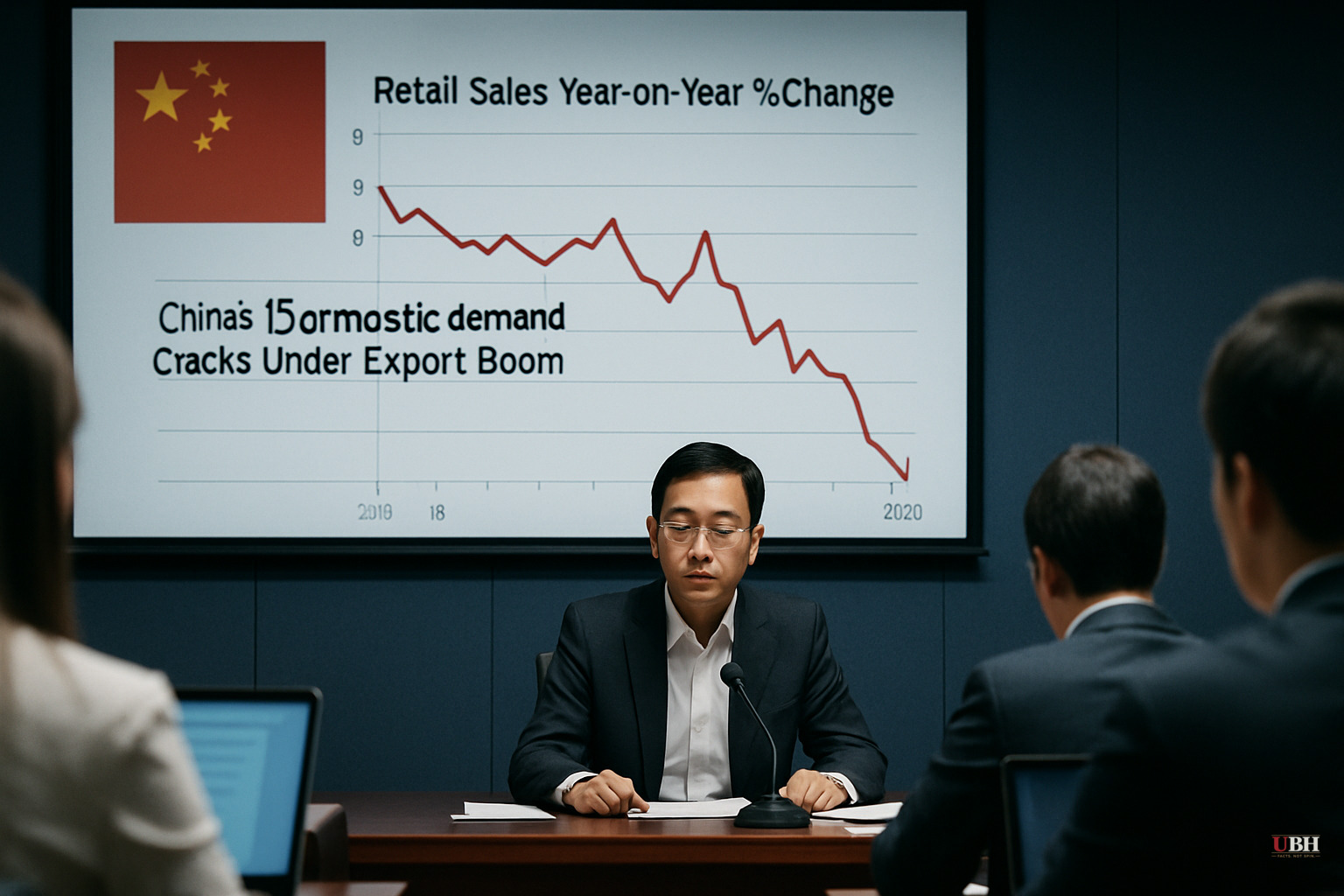
China's Retail Sales Expected to Post First Drop Since 2022 as Domestic Demand Cracks Under Export Boom
What to Watch
China's National Bureau of Statistics is set to release May economic data on Tuesday, June 16, and the headline figure is expected to be a 0.6% year-on-year decline in retail sales. That would reverse April's 0.2% gain and come in below the consensus forecast of flat growth, according to a Reuters economist poll cited by both CNBC and Business Times Singapore.
If confirmed, it would be the worst retail reading since the tail end of China's COVID lockdowns in late 2022.
Industrial output may offer a lone counterweight. Factory production is forecast to have risen 4.5% year-on-year in May, which would beat the Reuters consensus estimate of 4.3% and improve on April's near three-year low of 4.1%.
Two Economies, One Country
The divergence is stark. China posted a 19.4% export gain in May, driven in part by a surge in AI-related manufacturing demand and, according to Business Times Singapore, Gulf-war stockpiling tied to the U.S.-Israel conflict with Iran. Factory-gate inflation rose to its highest level since July 2022.
None of that export revenue appears to be reaching consumers. Consumer inflation remains stagnant, and the gap between what factories are charging and what households are spending is widening. Business Times Singapore has called it plainly: a "two-speed" economy.
Auto sales declined for an eighth consecutive month in May, according to Business Times Singapore, in the world's largest car market. The government's consumer-goods trade-in scheme, meant to juice purchases, is losing steam.
Even the five-day Labour Day holiday at the start of May failed to move the needle. Per-capita holiday spending lagged behind the same period in 2025, CNBC reported.
Investment Is Falling Off a Cliff
Fixed-asset investment, covering infrastructure, manufacturing, and real estate, is expected to have contracted 4.1% in the January-through-May period compared with a year earlier. Economists had forecast a 2% decline. If confirmed, that would be more than twice the miss, steepening sharply from the 1.6% drop recorded through April.
Real estate is the structural anchor dragging everything down. Property investment fell 16.2% in the first five months of the year, according to pre-release data cited by InvestingLive via Reuters, deepening from a 13.7% decline in January-April. New home prices are expected to have continued falling at a slightly faster monthly pace in May.
Manufacturing fixed-asset investment is expected to have contracted for the first time since December 2020, according to Wind data cited by CNBC. Infrastructure investment is forecast to have eked out 0.6% growth.
What Beijing Is Expected to Say
Fu Linghui, spokesman for the NBS, is scheduled to speak at a Tuesday press briefing. Based on prior briefings and the anticipated data, analysts expect the bureau to maintain that the economy "remained broadly stable" while acknowledging what it has previously described as an acute "domestic imbalance between strong supply and weak demand."
The statistics bureau has previously called for investment in new technology and greater employment support to achieve "an appropriate increase in economic output."
The unemployment rate is expected to have ticked down to 5.1% in May from 5.2% in April, technically a positive. But InvestingLive flags an important caveat: rising anxiety over AI-driven job displacement may itself be suppressing household confidence and borrowing appetite, making any headline unemployment improvement less reassuring than it looks.
The Strongest Counter-Argument
Defenders of China's economic position have a real point worth stating clearly. Industrial output accelerating past forecasts, a near-20% export surge, and falling unemployment are not the profile of an economy in free fall. The argument from Beijing-aligned analysts is that the current imbalance is a transitional phase: China is successfully pivoting toward high-value manufacturing and AI-driven exports, and domestic consumption will follow once household balance sheets stabilize and the property correction bottoms out. A retail sales dip, on this view, would be a demand-timing problem, not a structural collapse.
China's AI manufacturing boom is generating real output and real export revenue.
The problem is the demand side has been hearing "it will turn around" for three years. The property sector is still falling — a 16.2% investment decline through May is anticipated — consumer confidence has not recovered, and government stimulus programs are visibly losing potency. A transitional phase that keeps extending stops being transitional.
What's Unresolved
Beijing has signaled plans for a two-trillion-yuan AI infrastructure investment program, according to Business Times Singapore. Whether that spending can generate domestic consumption multiplier effects or simply adds to the supply-side overcapacity problem is the central economic question China faces heading into the second half of 2026. Tuesday's data release will not answer it, but it will sharpen the terms of the debate.
Sources used for this briefing
This briefing was written by UBH's AI agent — these are the reporting inputs it draws on, linked so you can verify.


