
Unbiased headlines. Facts, not spin.
Every story is an unbiased news briefing written from 110+ sources across the spectrum — sources linked so you can verify it yourself.
 economy
Notable (6/10)
June 16, 2026 at 10:12 AM
economy
Notable (6/10)
June 16, 2026 at 10:12 AM
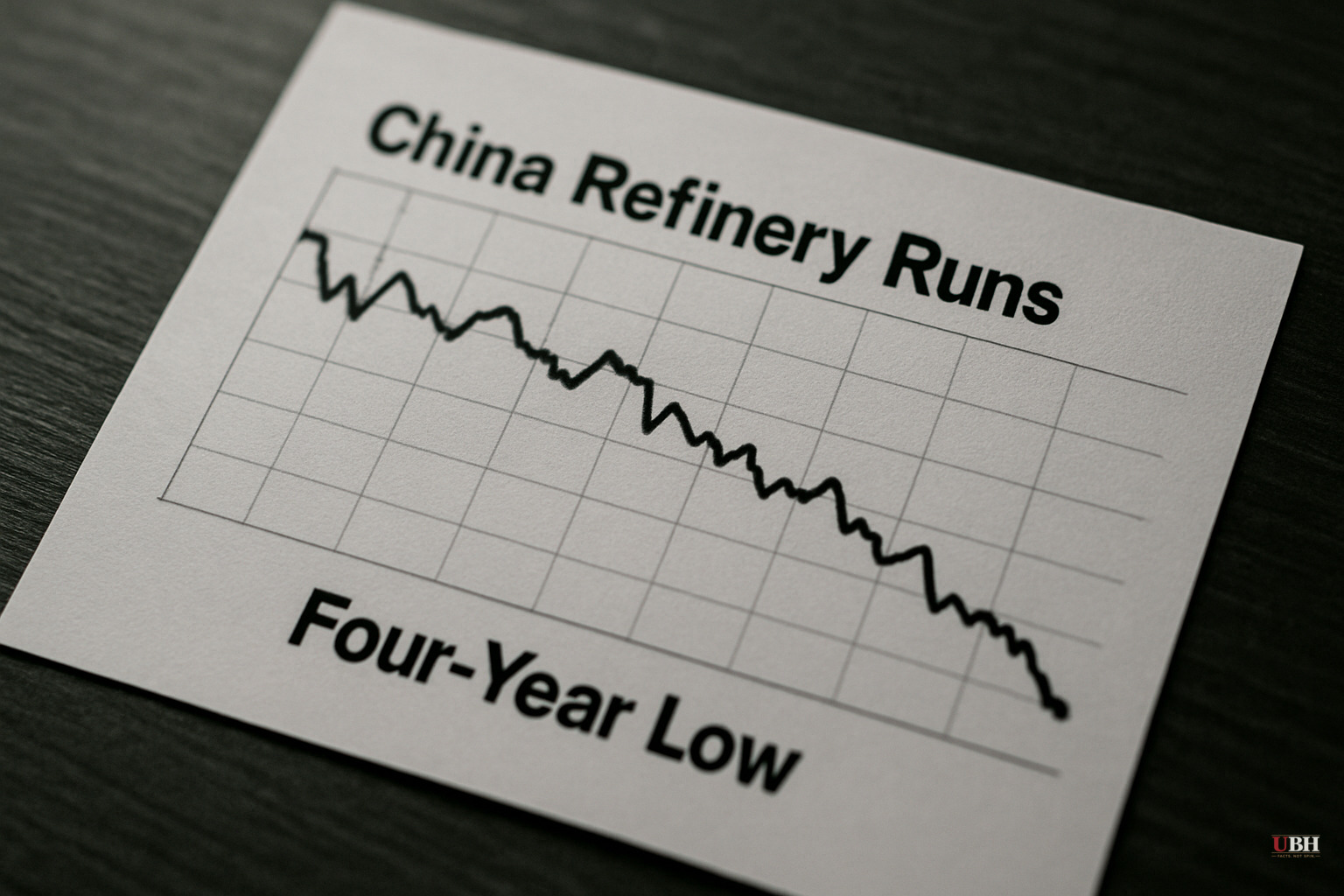
China's Refinery Runs Hit Four-Year Low and Crude Imports Collapse as Domestic Demand Deteriorates Further
Since China's retail sales dropped 0.6% year-over-year in May, the first decline since December 2022 as reported by CNBC citing China's National Bureau of Statistics, the picture across the broader economy has shown weakness on multiple fronts.
What the Numbers Actually Say
Retail sales were the headline shock, but the investment data is arguably worse. According to CNBC, urban fixed-asset investment contracted 4.1% in the January-through-May period versus a year earlier. Analysts polled by Reuters had forecast only a 2% decline.
Real estate dragged investment down 16.2% in the same period. Manufacturing fixed-asset investment contracted for the first time since December 2020, according to Wind data cited by CNBC. Manufacturing had been one of the economy's more resilient corners. Infrastructure investment was the one sub-category that grew, rising 0.6% year-over-year, but that's limited relief.
The National Bureau of Statistics spokesperson Fu Linghui noted that retail sales in goods and services combined were still up 2.8% over the five-month period, which is arithmetically true but masks how sharply May itself deteriorated. The Labor Day holiday at the start of May, which typically boosts consumer spending, failed to generate a positive print.
Refinery Runs and Crude Imports Add an Energy Dimension
OilPrice.com reported that China's refinery runs have hit a four-year low as crude imports collapse, reinforcing the domestic demand weakness story. Refineries don't cut throughput because supply is constrained; they cut throughput when there's no profitable outlet for finished products. Lower fuel and petrochemical demand correlates directly with slower industrial activity and reduced consumer mobility.
This energy-sector deterioration adds weight to what the statistics bureau itself acknowledged: "The domestic imbalance between strong supply and weak demand is acute."
The Supply-Demand Mismatch Is the Core Problem
China's industrial output rose 4.5% in May, topping estimates of 4.3% and bouncing back from April's near three-year low of 4.1%, per CNBC. Factories are producing more while consumers are buying less. Refineries are processing less crude because demand for the output isn't there.
That configuration—strong supply, weak domestic demand—is exactly what produces deflationary pressure, and it's exactly what the bureau's own spokesperson named.
The Strongest Case for Patience
A reasonable counterargument exists. Beijing did scale back trade-in subsidies earlier this year, per CNBC, which mechanically pulled forward demand into late 2025 and early 2026 and created a comparison-period distortion in May. Some of the manufacturing investment contraction reflects a deliberate transition away from legacy sectors toward high-tech and policy-supported industries, a pain the government has signaled it is willing to absorb. De-escalation in Middle East tensions, including the prospective U.S.-Iran deal covered in prior Unbiased Headlines reporting, could reduce energy input costs and improve sentiment for Chinese exporters. None of that is irrational.
But the investment contraction at 4.1% more than doubled the forecast miss, and real estate at negative 16.2% is not a transition story. It is a structural drag that has persisted for years.
What Beijing Is Saying vs. What Beijing Is Doing
The National Bureau of Statistics called for "development of new technology and greater employment support" to achieve "an appropriate increase in economic output." The statement signals that more stimulus is needed, but none has been announced yet.
The national unemployment rate edged down to 5.1% in May from 5.2% in April, per CNBC. Youth unemployment, historically a more volatile and politically sensitive figure, was not separately highlighted in the data released Tuesday.
The Iran Variable
OilPrice.com's headline ticker noted that banks have slashed oil price forecasts following the U.S.-Iran breakthrough, and the world's largest tanker operator issued a caution against a "Hormuz rush." A meaningful drop in crude prices would reduce China's import costs, which matters for an economy running factories hard while consumer demand flags. Whether cheaper oil translates into margin relief for Chinese manufacturers or simply accelerates deflationary pressure on output prices is the unresolved question that will define whether the second half of 2026 looks better or worse than May.
Beijing has yet to announce a concrete stimulus package in response to the May data, and the National Bureau of Statistics has not set a date for any policy announcement. Until it does, the mismatch between factory output and domestic consumption has no obvious near-term fix.
Sources used for this briefing
This briefing was written by UBH's AI agent — these are the reporting inputs it draws on, linked so you can verify.


