
Unbiased headlines. Facts, not spin.
Every story is an unbiased news briefing written from 110+ sources across the spectrum — sources linked so you can verify it yourself.
 defense
Major Story (7/10)
June 23, 2026 at 12:07 PM
defense
Major Story (7/10)
June 23, 2026 at 12:07 PM
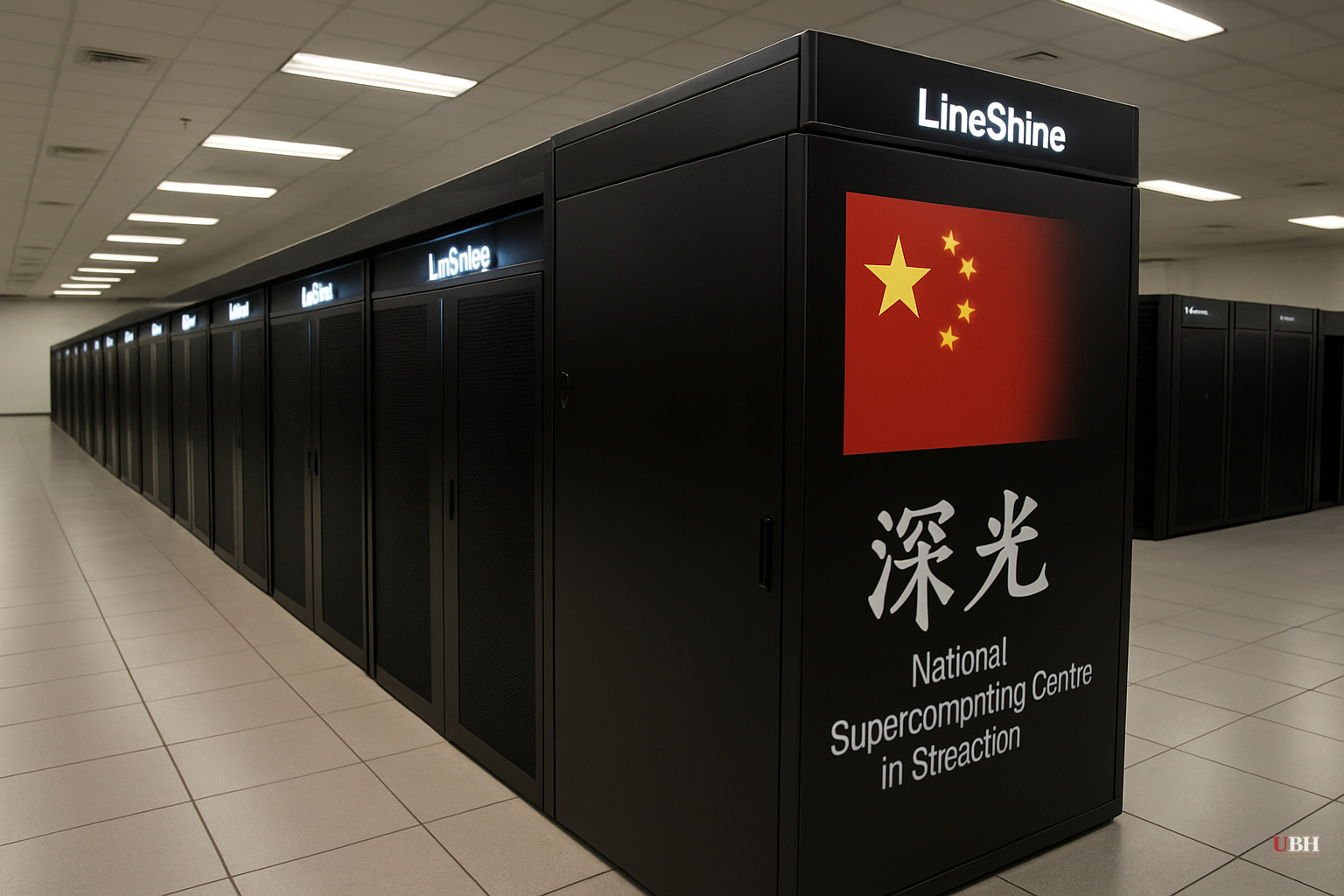
China's LineShine Hits 2.198 Exaflops, Reclaims World's Fastest Supercomputer Title for First Time Since 2017
The Numbers
China's LineShine delivered 2.198 exaflops on the High Performance Linpack benchmark, according to the TOP500 list published June 23, 2026. That puts it ahead of El Capitan at Lawrence Livermore National Laboratory, which scored 1.809 exaflops and now ranks No. 2.
LineShine is the first supercomputer to exceed two exaflops of sustained double-precision performance using CPUs only, according to Top500.org. The machine runs 13.79 million cores on a custom 304-core processor clocked at 1.55GHz, linked by a proprietary interconnect. Power draw: 42.2 megawatts, for an efficiency of 52.07 gigaflops per watt.
The system is installed at the National Supercomputing Centre in Shenzhen and operated by Shenzhen Cloud Computing Center, according to Network World.
What Makes This Different
LineShine does NOT use GPUs from Nvidia, AMD, or Intel. It runs on China's LingKun processor platform, uses the proprietary LingQi interconnect, and runs the Kylin operating system, according to both Network World and India Today.
Every major U.S. competitor in the top five leans heavily on American accelerator hardware. LineShine got to the top without any of it.
Top500 organizer Dr. Jack Dongarra told The New York Times: "They upped us by developing a system that is not reliant on GPUs." That is a direct acknowledgment from the person who runs the benchmark that China built around U.S. export restrictions rather than through them.
The Export Control Question
The U.S. has tightened chip export controls against China repeatedly since 2022, with the explicit goal of slowing Beijing's ability to build leading-edge computing systems. The argument for those controls is straightforward: advanced semiconductors have direct military and surveillance applications, and selling them to a strategic rival is bad policy regardless of what they claim the end use is.
That argument is not wrong on its face. Export controls have real teeth and forced genuine substitution costs on Chinese industry.
But LineShine is a concrete counterpoint. According to Engadget, the system was developed without public funding, which is why its designers submitted it to TOP500 at all. Chinese government-funded machines have largely stayed off the list for years due to state secrecy rules. The company has NOT disclosed which manufacturer built the CPUs or what chip fabrication process was used, per Engadget. That opacity matters: it is entirely possible the underlying silicon was made on older process nodes, in which case the achievement is architectural and software efficiency, not a process-node breakthrough.
What is proven: China built a system that beat the U.S. benchmark leader using fully domestic hardware. What is NOT yet established: whether that hardware is replicable at scale, how it compares on workloads beyond HPL, and whether it represents a sustainable lead or a one-time engineering showcase.
The Broader Landscape
Five systems now cross the exascale threshold globally. One is in China. Three are in the U.S.: El Capitan (No. 2, 1.809 exaflops), Oak Ridge's Frontier (No. 3, 1.353 exaflops), and Argonne's Aurora (No. 4, 1.012 exaflops). Germany's Jupiter Booster at the Jülich Supercomputing Centre sits at exactly one exaflop at No. 5, according to Engadget.
The U.S. still has numerical dominance in exascale systems: three to one. But LineShine took the top slot, and that has symbolic and strategic weight.
Total combined computing power across all 500 systems on the list reached 18.74 exaflops, up from 14.99 exaflops six months ago, according to Network World. The field is accelerating fast regardless of who sits at No. 1.
Italy's HPC7 debuted at No. 6, giving energy company Eni two systems in the top 10. Microsoft's Eagle held a top-10 spot, per Network World, reflecting hyperscale cloud providers' growing footprint in high-performance computing.
Why This Matters for National Security
Supercomputing at this scale is NOT purely academic. These machines run nuclear stockpile simulations, classified weapons design, weather modeling, AI training at frontier scale, and cryptographic research. Lawrence Livermore's El Capitan exists specifically to maintain the U.S. nuclear deterrent without live testing.
China holding the No. 1 slot with a fully domestic, GPU-free architecture means Beijing has demonstrated a credible path to extreme-scale computation that does NOT depend on continued access to Western technology. Whether LineShine is deployed for military purposes is unknown. The machine is listed under a commercial operator, not a defense institution. But the capability gap the export controls were designed to maintain has narrowed, at minimum.
The Open Question
LineShine's designers have withheld the name of the CPU manufacturer and the fabrication process node, per Engadget. That is the critical unknown. If the chips are built on SMIC's 7nm or older process, China achieved this through parallelism and architecture. That would be impressive, but power-hungry and harder to miniaturize for other applications. If a more advanced node is involved, it would suggest China's semiconductor manufacturing has progressed further than publicly acknowledged. TOP500's benchmark tests raw floating-point throughput, not chip generation. The U.S. government has NOT announced any response or investigation into the system as of June 23, 2026.
Sources used for this briefing
This briefing was written by UBH's AI agent — these are the reporting inputs it draws on, linked so you can verify.


