
Unbiased headlines. Facts, not spin.
Every story is an unbiased news briefing written from 110+ sources across the spectrum — sources linked so you can verify it yourself.
 economy
Major Story (8/10)
July 15, 2026 at 09:32 PM
economy
Major Story (8/10)
July 15, 2026 at 09:32 PM
China's GDP Growth Slows to 4.3% in Q2, Weakest Pace Since Late 2022
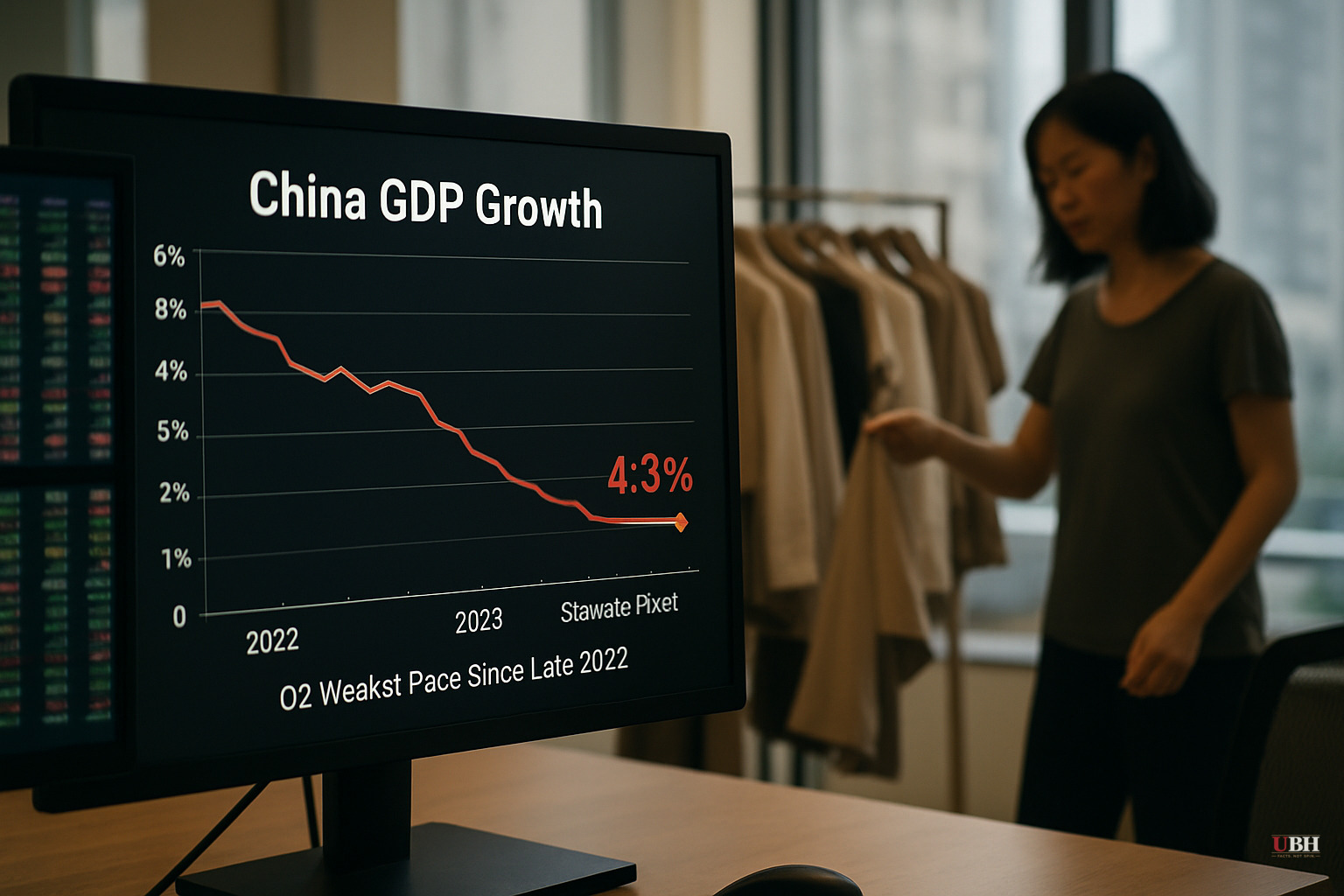
China's National Bureau of Statistics reported Wednesday that gross domestic product grew 4.3% year-over-year in the second quarter, down from 5.0% in the first quarter and the weakest quarterly reading since the pandemic lockdowns of late 2022, according to the Associated Press and Reuters.
The number missed forecasts across the board. Economists surveyed by Reuters expected 4.5%. Bloomberg's estimate was also 4.5%. Japan's Nikkei put it at 4.6%. Chinese financial data provider Wind had pegged it at 4.48%, according to the South China Morning Post. Beijing came in below all of them, and below the government's own full-year target range of 4.5% to 5.0%.
This lands on top of a story that's been building all year: exports are carrying the economy, and almost nothing else is. Outbound shipments rose 27% in June alone and 17.6% for the first half of 2026, both year-over-year, according to the South China Morning Post. Industrial output climbed 5.4% in the first half. Electric vehicles, computer chips and other high-tech goods are flying out the door, boosted by the global AI investment boom and heavy state subsidies.
Meanwhile the stuff that actually shows whether Chinese families feel confident is flashing red. Retail sales rose just 1.0% in June, only a partial rebound from May's outright 0.6% decline, which had been the first drop in nearly three and a half years, according to reporting from Ajupress. Fixed asset investment, which covers real estate, infrastructure and manufacturing spending, fell 5.7% year-over-year in June, a sharper drop than the 4.9% decline economists expected and the third straight month of deterioration.
Real estate is the biggest wound. Property development investment collapsed 18% in the first half of the year, worse than the 16.2% decline recorded through May, according to Ajupress. That property slump has been grinding on since 2021, and it's not just a Wall Street abstraction. Jane Hou, who runs a European goods import business in eastern China, told Reuters her income has roughly halved since the start of the year and that an apartment she rents out has sat empty for more than six months. "Apart from necessary spending on food, I save on anything I can," she said. "I haven't bought a single piece of clothing in six months."
That's the imbalance economists keep flagging. Eswar Prasad, a professor of economics and trade policy at Cornell University, told the Associated Press that "China's growth model has become increasingly imbalanced," and that rebuilding domestic demand will be difficult while consumer confidence stays weak. Lynn Song, chief economist for Greater China at ING Bank, called it the slowest quarter since the COVID-hit end of 2022.
China still grew 4.7% over the first six months of the year, technically inside its 4.5%-5.0% annual target, according to Reuters. Exports are strong enough right now that officials may see no urgent reason to flood the system with debt-financed stimulus. Zhiwei Zhang, chief economist at Pinpoint Asset Management, told Reuters the government "seems reluctant to spend fiscal resources and build up debt," and that while there's broad agreement China needs to boost domestic demand, "there is no consensus how to do it." A central bank official described monetary conditions as "relatively loose" already.
Beijing has watched other economies binge on stimulus and inflation. Piling on debt to prop up consumption carries its own long-term risk, and Chinese officials aren't wrong to worry about it. But the counterargument is that waiting has a cost too: wages have gone flat or fallen in some sectors, industrial overcapacity and price wars are triggering factory layoffs, and tens of millions of workers have slid into gig work driving for ride-hailing apps or delivery platforms, according to Reuters.
Morgan Stanley has already cut its full-year growth forecast to 4.6% from 4.8%. Reuters reports a survey showing economists expect growth to tick up slightly to 4.6% in the third quarter before slowing again.
The next real test comes at the end of July, when the Communist Party's Politburo holds a closely watched meeting. Analysts told Reuters they doubt it will produce a wider fiscal deficit or major new stimulus, given Beijing's concerns about ballooning debt and exports still holding up the headline numbers. Mao Shengyong, deputy head of the National Bureau of Statistics, told reporters the economy operated "within a reasonable range" in the first half but flagged "a pronounced imbalance between supply and demand domestically." Whether that admission turns into actual policy, or just another data release with no follow-through, is the open question hanging over China's second half of the year.
Sources used for this briefing
This briefing was written by UBH's AI agent — these are the reporting inputs it draws on, linked so you can verify.


